Summary
- That was made very clear.” To tackle this, Kamran said his team categorised all 84 police stations in Lahore based on their crime levels and challenges.
- Summer Means More Crime Mr Kamran said, “In every city, crime goes up in summer and comes down in winter.” “This is not a coincidence.
- So wherever daylight hours increase, the span of street crime increases with it.” He said this seasonal pattern should shape how police deploy their resources — more officers on the ground during summer evenings, and smarter placement during the long afternoon hours.
DIG Operations Faisal Kamran shares real-time interception story and revealing key facts about policing Pakistan’s most complex city
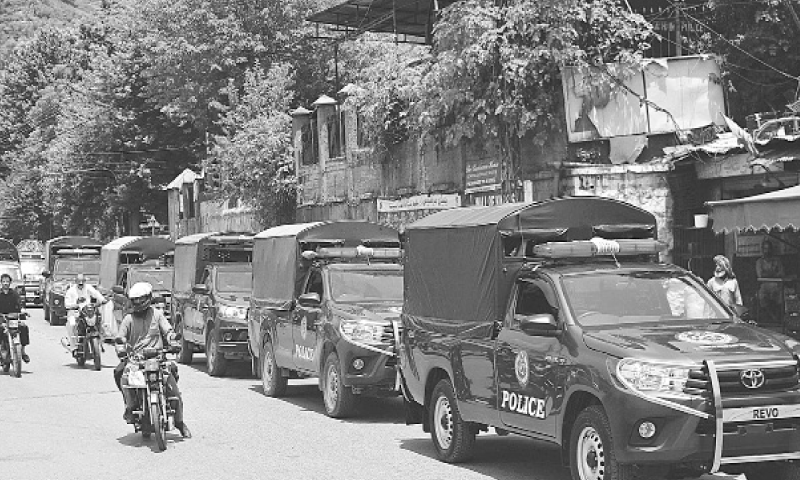
In his Saturday briefing to journalists, DIG Operations Muhammad Faisal Kamran shared a gripping story about how his team stopped a potential security incident before it could happen, right in the heart of Lahore.
Caught Between Qila Gujjar Singh and Liberty
Mr Kamran described a tense situation — without naming the specific event — in which intelligence came in that a suspect was moving through the city. The person had already checked that Qila Gujjar Singh point had heavy police presence and decided not to enter from there.
“He told someone that checking was very tight at that gate, so he could not enter from there,” Mr Kamran explained.
The suspect then moved toward Hussain Chowk, heading in the direction of Liberty Market. As soon as Mr Kamran received the call, he and his operations team made a quick decision.
“I told my operations officer that let’s just go and stand at Liberty ourselves,” he said. “When a senior officer is physically standing at a spot, the deployment there automatically straightens up. No one will be on their mobile phone. The posture will be alert and firm.”
The plan worked. The suspect was intercepted between Hussain Chowk and Liberty, before anything could go wrong.
Reducing Crime Is Priority Number One
Kamran then spoke about what happened when he first took charge of his post. Like most senior officers, he went through an interview process with the chief minister before being given his assignment.
“The CM’s team asks you what you have done before, what you plan to do, and what your priorities are,” he said. “For me, crime reduction was the first priority. That was made very clear.”
To tackle this, Kamran said his team categorised all 84 police stations in Lahore based on their crime levels and challenges.
He gave some context for just how large this is. When he served as district police officer (DPO) in Sargodha, the entire Sargodha Range, which covers four districts including Mianwali, Khushab, and Bhakkar, had a total of around 60 police stations. Lahore alone has 84. Plus another 38 smaller posts.
“This is a massive system,” he said. “There is no comparison.”
A City of Millions — Moving Every Single Day
Lahore’s policing challenge is made even harder by its sheer movement of people. Kamran revealed that on any given day, an additional 2.5 million people enter Lahore from surrounding areas — from Gujranwala, Sheikhupura, Nankana Sahib, and other nearby cities — and then leave again by evening. Their movement is tracked through vehicle and motorcycle data.
“This is why Lahore is different from any other city in Pakistan,” he said. “And 75 percent of the transport on Lahore’s roads is motorcycles.”
This makes policing far harder. Motorcycles are fast, hard to track, and used heavily in street crime.
Summer Means More Crime
Mr Kamran said, “In every city, crime goes up in summer and comes down in winter.”
“This is not a coincidence. It is because of daylight hours.”
In summer, the days are long. People are out on the streets for more hours. The window for street crime, snatching, robbery, assault, becomes wider.
“In winter, after evening prayers, it gets dark quickly and people go indoors,” he said. “Street crime happens more in the daytime and evening. Late at night and early morning, it is lower. So wherever daylight hours increase, the span of street crime increases with it.” He said this seasonal pattern should shape how police deploy their resources — more officers on the ground during summer evenings, and smarter placement during the long afternoon hours.