Summary
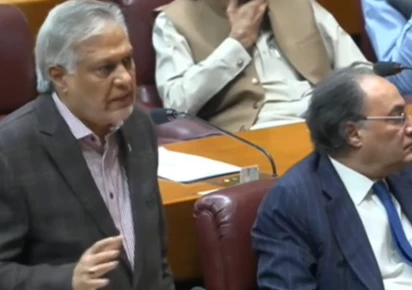
- Deputy Prime Minister and Foreign Minister Ishaq Dar presented the three-page US-Iran agreement in the National Assembly on Wednesday, saying the next stage of negotiations would focus on nuclear issues, sanctions and frozen assets, and the Lebanon conflict.
- Addressing lawmakers, Dar said the agreement and the June 22 joint communiqué issued by the United States, Iran, Qatar and Pakistan had been widely misunderstood and misquoted.
- Dar said a formal ceremony was later held in Switzerland, where discussions among the four participating countries produced the June 22 joint communiqué.
Deputy Prime Minister and Foreign Minister Ishaq Dar presented the three-page US-Iran agreement in the National Assembly on Wednesday, saying the next stage of negotiations would focus on nuclear issues, sanctions and frozen assets, and the Lebanon conflict.
Addressing lawmakers, Dar said the agreement and the June 22 joint communiqué issued by the United States, Iran, Qatar and Pakistan had been widely misunderstood and misquoted. He told the House that the documents were being officially placed on record so parliamentarians could review and reference them directly.
The foreign minister said every page of the agreement carried the initials of the participating sides, while the final page contained complete signatures. He added that Pakistan’s Foreign Office had already uploaded the joint communiqué to its official website to ensure transparency regarding the roadmap agreed upon by all parties.
Dar revealed that the diplomatic breakthrough came after an intensive 21-hour negotiation session held on April 10 and 11, during which six rounds of talks continued through the night until dawn. He praised both Washington and Tehran for agreeing to sit at the same table under Pakistan’s mediation.
According to Dar, the American delegation included JD Vance, Steve Witkoff and Jared Kushner, while Iran was represented by senior officials led by Bagher Ghalibaf and members of Iran’s National Security Council.
Pakistan’s delegation, he said, was led by himself alongside Asim Munir and senior intelligence officials.
Dar acknowledged that negotiations faced serious obstacles after the initial discussions, as both sides needed approval from their leaderships. However, he credited Prime Minister Shehbaz Sharif, Field Marshal Asim Munir and Pakistan’s diplomatic team for keeping the process alive despite fears that the talks could collapse.
He also disclosed that a regional contact group comprising Saudi Arabia, Pakistan, Egypt and Türkiye actively supported the peace efforts through meetings held in Riyadh, Antalya, Islamabad and Cairo.
The agreement was initially scheduled to be signed physically in Geneva on June 19, but plans changed after former US President Donald Trump opted to sign the document electronically during the G7 summit in France. Iranian President Masoud Pezeshkian later signed the accord, followed by Prime Minister Shehbaz Sharif on behalf of Pakistan as mediator.
Dar said a formal ceremony was later held in Switzerland, where discussions among the four participating countries produced the June 22 joint communiqué.
Highlighting Pakistan’s role, the foreign minister said Islamabad maintained complete neutrality throughout the process and refused to share draft documents even with close allies in order to preserve trust between the negotiating parties.
He explained that the agreement had been divided into two phases. The first phase focused on de-escalation and immediate stability measures, while the second phase would involve technical negotiations over Iran’s nuclear programme, sanctions and frozen assets, and the situation in Lebanon.
Dar noted that progress on Lebanon had been particularly difficult, with renewed Israeli military action delaying negotiations before a ceasefire allowed talks to resume.
He also claimed that the agreement had already delivered economic benefits, including lower prices, the end of maritime restrictions and the removal of additional fees and permits imposed by Iran.
Speaking about Pakistan’s diplomatic standing, Dar said international partners had recognised Islamabad’s role in easing tensions between Washington and Tehran, describing Pakistan as an emerging “net security provider” for the region.
The foreign minister further acknowledged the contribution of China, saying Beijing supported regional peace efforts and backed initiatives aimed at keeping the Strait of Hormuz open and free from restrictions.
We welcome your contributions! Submit your blogs, opinion pieces, press releases, news story pitches, and news features to opinion@minutemirror.com.pk and minutemirrormail@gmail.com