Summary
- The midnight price hike dealt an immediate blow to the party’s optic strategy, unleashing a wave of social media ridicule and revitalizing arguments from critics who view JI not as a threat to the status quo, but as a controlled pressure valve designed to absorb public anger and deflect attention from larger democratic crises.
- In that episode, the party faced similar embarrassment when the government slapped a fresh hike on electricity tariffs the very day it signed a formal pact with JI to end the protest.
- Speaking at a press conference on the third day of the ongoing demonstrations, party Emir Hafiz Naeem ur Rehman reframed the narrative, asserting that it was JI’s relentless street pressure that ultimately forced the government to review predatory power deals, shutter five costly IPPs, and save the national treasury an estimated Rs3.36 trillion.
Lahore: In Pakistan’s turbulent political theater, timing is everything and for Jamaat-e-Islami, it continues to be painfully cruel.
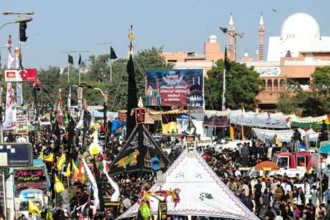
As the religio-political party mobilized over 10,000 protesters on Lahore’s Mall Road and outside the Governor Houses in Karachi and Peshawar, the government responded late Monday night with a quiet, defiance-laden move: it raised petroleum prices yet again. The midnight price hike dealt an immediate blow to the party’s optic strategy, unleashing a wave of social media ridicule and revitalizing arguments from critics who view JI not as a threat to the status quo, but as a controlled pressure valve designed to absorb public anger and deflect attention from larger democratic crises.
This public relations setback carries a strong sense of political deja vu. Observers quickly pointed to JI’s high-profile sit-in in Rawalpindi over capacity payments to Independent Power Producers (IPPs). In that episode, the party faced similar embarrassment when the government slapped a fresh hike on electricity tariffs the very day it signed a formal pact with JI to end the protest. While critics seized on the pattern as evidence of strategic naivety, JI leadership insists these optics mask genuine structural victories. Speaking at a press conference on the third day of the ongoing demonstrations, party Emir Hafiz Naeem ur Rehman reframed the narrative, asserting that it was JI’s relentless street pressure that ultimately forced the government to review predatory power deals, shutter five costly IPPs, and save the national treasury an estimated Rs3.36 trillion.
So far, the government has shown little inclination to make major concessions, extending only a lukewarm offer for negotiations. Instead of engaging directly on the ground, federal authorities extended a light invitation for JI delegates to travel to Islamabad and attend a ministerial committee meeting on the petroleum levy. Rehman promptly rejected the offer, refusing to travel to the capital and instead turning the tables by inviting government representatives to come directly to the sit-in sites if they were serious about dialogue. The standoff highlights a crucial economic dilemma: the petroleum development levy has become the virtual backbone of state budget revenues under strict fiscal targets, generating hundreds of billions of rupees annually. Completely abolishing or drastically slashing it remains an near-impossible proposition for a cash-strapped administration fighting to maintain its sovereign balance sheet.
Determined to leverage the street despite the government’s calculated posture, Rehman warned of a full-scale countrywide strike if the latest fuel price hike is not immediately reversed.
Framing the petroleum levy as outright extraction rather than fair taxation, he demanded the surcharge be scrapped to bring petrol down to Rs225 per litre. He also announced that lawyers and women’s organizations would join the sit-ins, broadening the protest from a partisan rally into a wider civic movement against skyrocketing utility bills and fuel surcharges. Turning his attention to institutional failures, the JI chief leveled severe allegations of corruption against the Federal Board of Revenue, accusing the tax-collecting body of protecting elite interests while squeezing working-class families.
Rehman then expanded his critique into a broad-spectrum attack on the ruling coalition, claiming the PML-N, PPP, and MQM-P remain locked in a mutually beneficial political arrangement that starves the public. He pointed to deep economic distress across urban and rural belts, citing flour prices reaching Rs160 per kilogram, bread at Rs25, and basic farming inputs like DAP and urea fertilizers becoming completely unaffordable for smallholders.
Denouncing Punjab’s policy of outsourcing thousands of public schools and the decaying healthcare system in Sindh, the JI chief charged both provincial governments with systemic neglect. He rounded off his barrage by pointing to the indefinite delays in holding local government elections in Punjab and Balochistan, contrasting the erosion of grassroots democracy with the lavish official protocols enjoyed by top political figures, singling out Prime Minister Shehbaz Sharif’s “67-vehicle convoy” in Karachi alongside President Asif Ali Zardari’s security details.
Whether JI can channel this multi-front critique into an effective nationwide strike remains uncertain, but the party is betting heavily on the street to prove its independence.
We welcome your contributions! Submit your blogs, opinion pieces, press releases, news story pitches, and news features to opinion@minutemirror.com.pk and minutemirrormail@gmail.com