Summary
- LAHORE: Provincial Minister for Health Khawaja Salman Rafique has said that the reign of the Righteous Caliph, Amir al-Mu’minin Hazrat Umar Farooq (RA), is a glorious chapter of justice, exemplary leadership, and a welfare state that will continue to guide humanity until the end of time, and only by following the principles established by him can we lay the foundation of a true Islamic and welfare society.
- Ehsaan Bhutta thanked the honorable guests for their arrival and clarified in the light of historical facts that the life of Hazrat Umar Farooq (RA) was a beautiful blend of justice, bravery, honesty, public service, and fear of Allah because he was the “Great Architect” of the Islamic state who took several revolutionary steps including the Hijri calendar, the permanent system of Bait-ul-Mal, establishment of the judiciary, appointment of Qazis, formation of provincial and district administration, and police and jails, the effects of which are still visible in the administrative systems of the world today.
- Ehsaan Bhutta further stated that Hazrat Umar (RA) separated the judiciary from the executive for the first time in Islamic history and made it independent, which established the immortal system of “Adl-e-Faroqi” (Farooqian Justice), while by fixing regular stipends for orphans, widows, disabled persons, senior citizens, and the poor, he laid the foundation of the world’s first practical welfare state, and the level of strict accountability was such that no governor was above the law; he also possessed immense love for the Ahl-e-Bait-e-Athar and despite being the Caliph of the time, he used to patrol at night to know the public conditions and would personally carry relief goods from Bait-ul-Mal on his own shoulders for the needy, which is the true character of a sincere servant of the public, and he reiterated the commitment that the process of spreading the teachings of ancestors from the platform of Auqaf will continue.
LAHORE: Provincial Minister for Health Khawaja Salman Rafique has said that the reign of the Righteous Caliph, Amir al-Mu’minin Hazrat Umar Farooq (RA), is a glorious chapter of justice, exemplary leadership, and a welfare state that will continue to guide humanity until the end of time, and only by following the principles established by him can we lay the foundation of a true Islamic and welfare society. He further said that the Messenger of Allah (PBUH) bestowed upon him the title of “Farooq” because he clearly distinguished between truth and falsehood, and his entire life bears witness that he always stood by the truth and stood firm against falsehood, meaning every aspect of Farooq-e-Azam’s (RA) life is a beacon of light for the Muslim Ummah by following which contemporary administrative and social challenges can be tackled.
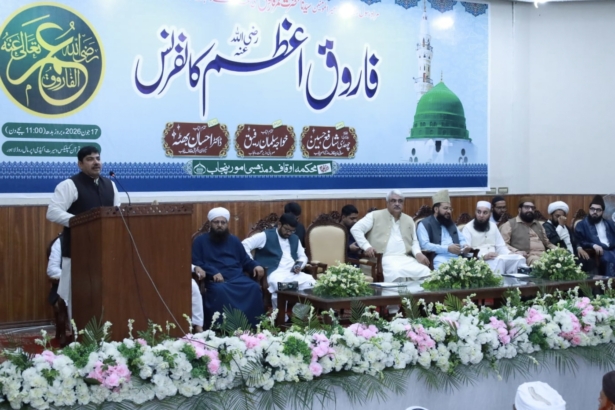
He expressed these views while addressing as the chief guest at a special conference titled “Martyrdom of Farooq-e-Azam: Golden Principles of Justice, Leadership, and the Islamic State,” organized by the Department of Auqaf and Religious Affairs Punjab at Khatam-un-Nabiyyin University (Quran Board Building), Upper Mall, on the occasion of 1st Muharram-ul-Haram, the Day of Martyrdom of Farooq-e-Azam (RA). He further said that today we are mentioning a great personality whose life is a beautiful blend of justice, honesty, bravery, public service, governance, and fear of Allah, the example of which is rarely found in world history, as he is that great personality whose acceptance of Islam brought honor, strength, and stability to Muslims, and this is why Hazrat Abdullah bin Masood (RA) used to say that “Umar’s Islam was an honor, his migration was help, and his caliphate was a mercy.”
Addressing the conference, Secretary and Chief Administrator Auqaf Punjab Dr. Ehsaan Bhutta thanked the honorable guests for their arrival and clarified in the light of historical facts that the life of Hazrat Umar Farooq (RA) was a beautiful blend of justice, bravery, honesty, public service, and fear of Allah because he was the “Great Architect” of the Islamic state who took several revolutionary steps including the Hijri calendar, the permanent system of Bait-ul-Mal, establishment of the judiciary, appointment of Qazis, formation of provincial and district administration, and police and jails, the effects of which are still visible in the administrative systems of the world today. Dr. Ehsaan Bhutta further stated that Hazrat Umar (RA) separated the judiciary from the executive for the first time in Islamic history and made it independent, which established the immortal system of “Adl-e-Faroqi” (Farooqian Justice), while by fixing regular stipends for orphans, widows, disabled persons, senior citizens, and the poor, he laid the foundation of the world’s first practical welfare state, and the level of strict accountability was such that no governor was above the law; he also possessed immense love for the Ahl-e-Bait-e-Athar and despite being the Caliph of the time, he used to patrol at night to know the public conditions and would personally carry relief goods from Bait-ul-Mal on his own shoulders for the needy, which is the true character of a sincere servant of the public, and he reiterated the commitment that the process of spreading the teachings of ancestors from the platform of Auqaf will continue.
At the end of the ceremony, Director General of Religious Affairs Hafiz Anees-ur-Rehman specifically mentioned Hazrat Umar Farooq’s (RA) administrative measures, the establishment of Bait-ul-Mal, and public relief measures during the days of famine, urging the religious scholars and intellectuals to introduce the new generation to the golden principles of Farooq-e-Azam (RA) so that extremism can be eliminated from society.
Eminent religious scholars, including Maulana Intikhab Nuri, Maulana Zubair Hasan, Maulana Allama Zubair Ahmed Zaheer, Maulana Qazi Abdul Ghaffar Qadri, Maulana Allama Shafiq Pasruri, Allama Sajid Hussain Jawadi, Mufti Imran Hanfi, Mufti Ahmed, Allama Mukhtar Ahmed Nadeem, and Maulana Abdul Razzaq Azad paid rich tribute to the system of government of Syedna Farooq-e-Azam (RA) in their respective speeches during the conference, and while highlighting the philosophy of “Adl-e-Faroqi,” they emphasized that the concept of the welfare state established by him is not just a part of history but the only solution to the economic and social crises of every era. The scholars further said that in the contemporary era, the retrieval of Farooqian principles has become inevitable to deal with the internal and external challenges, economic inequality, and administrative weaknesses faced by the Muslim Ummah, and they urged the government and powerful circles to practically adopt “Adl-e-Faroqi” as a guiding light for transparency, strict accountability, rule of law, and protection of the rights of the common man in the national system, while reserving the resolve that the intellectual training of the new generation will be carried out through the pulpit and niche (Mihrab-o-Minbar) so that extremism can be eradicated from society and the dream of a true Islamic society based on unity of the Ummah, tolerance, and exemplary peace and order can be realized.
The ceremony concluded with a special collective prayer for the safety of the country and nation, the establishment of peace, and the unity of the Muslim Ummah, which was offered by Khateeb Data Darbar Mosque, Allama Muhammad Nadeem Mukhtar.
We welcome your contributions! Submit your blogs, opinion pieces, press releases, news story pitches, and news features to [email protected] and [email protected]