Summary
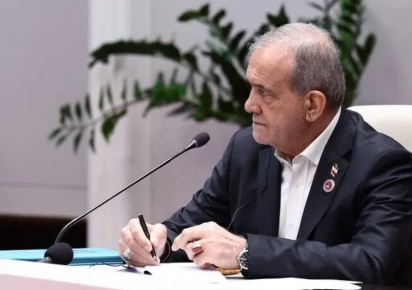
- NEW DELHI: Iranian President Masoud Pezeshkian has called on members of the BRICS group to strengthen cooperation against unilateral sanctions and establish a permanent secretariat to improve the bloc’s ability to implement decisions.
- Speaking at the BRICS summit in New Delhi on Saturday, Pezeshkian said the organisation needed stronger mechanisms to increase efficiency and ensure that decisions taken by its members were effectively implemented.
- The second area is economic and financial cooperation that is less dependent on what he described as “monopolistic instruments.” The Iranian president said BRICS members should work toward developing stronger economic relationships that can operate independently of restrictive financial mechanisms.
NEW DELHI: Iranian President Masoud Pezeshkian has called on members of the BRICS group to strengthen cooperation against unilateral sanctions and establish a permanent secretariat to improve the bloc’s ability to implement decisions.
Speaking at the BRICS summit in New Delhi on Saturday, Pezeshkian said the organisation needed stronger mechanisms to increase efficiency and ensure that decisions taken by its members were effectively implemented.
He identified several measures that he said could strengthen the group, including resistance to unilateral sanctions, turning competition into cooperation and creating a permanent secretariat.
Pezeshkian outlined three key areas where Iran wants to see greater cooperation within BRICS. The first is stronger political coordination based on the principles of the United Nations Charter and respect for national sovereignty.
The second area is economic and financial cooperation that is less dependent on what he described as “monopolistic instruments.” The Iranian president said BRICS members should work toward developing stronger economic relationships that can operate independently of restrictive financial mechanisms.
The third area involves cooperation in science and technology, energy and food security. According to Pezeshkian, stronger collaboration in these fields could help address challenges faced by countries across the Global South.
The Iranian president also used his speech to address the Palestinian issue, describing the right of Palestinians to determine their own future as a major test of the credibility and legitimacy of the international system.
He said any fair and lasting solution to the Palestinian issue must respect the wishes of the Palestinian people. Pezeshkian also called on BRICS to take a more active role in opposing occupation and supporting what he described as the legitimate rights of Palestinians.
Separately, Pezeshkian said foreign ministers from Arab countries would meet in Muscat, Oman on Monday to sign an agreement concerning the establishment of a joint Iran-Oman shipping route through the Strait of Hormuz.
In an interview with Indian broadcaster , published on Saturday, Pezeshkian said the participating countries would notify the International Maritime Organisation about the agreement. He added that countries whose territories had allegedly been used to launch attacks against Iran by the United States would also participate in the meeting.
Pezeshkian also discussed the ongoing confrontation with Washington and the economic pressure facing Iran. He argued that the United States had failed to achieve its objectives through military means and had consequently turned toward economic pressure.
Despite those measures, he said Iran would continue resisting US pressure.
Addressing the reported US naval blockade of Iran, Pezeshkian said Iran was not completely dependent on maritime routes for its survival. He argued that restricting access to sea routes would therefore not necessarily allow Washington to achieve its objectives.
The Iranian president further said Tehran would reopen the Strait of Hormuz once the United States ended its blockade and military attacks against Iran.
His remarks come as tensions surrounding Iran, the United States and regional shipping routes remain high. The Strait of Hormuz is a critical international maritime passage, making developments involving the waterway a major concern for regional and global trade.
We welcome your contributions! Submit your blogs, opinion pieces, press releases, news story pitches, and news features to opinion@minutemirror.com.pk and minutemirrormail@gmail.com