Summary
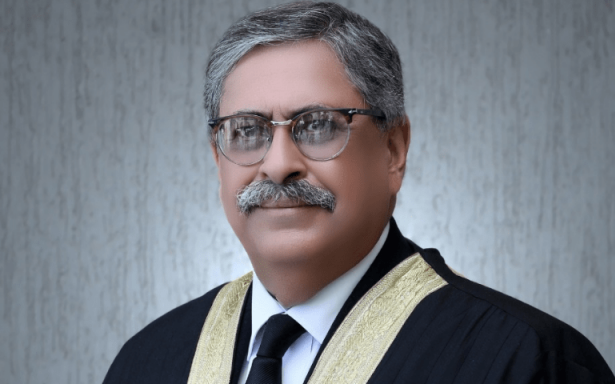
- ISLAMABAD: Former Supreme Court judge and former Islamabad High Court chief justice Athar Minallah has raised serious concerns about the direction of Pakistan’s judicial system arguing that courts can only regain public confidence by standing up for vulnerable citizens and resisting pressure from powerful quarters.
- Recalling his tenure at the Islamabad High Court Minallah said the court had earned credibility because people from different parts of Pakistan approached it when they believed their rights had been violated.
- Discussing the concerns raised by six Islamabad High Court judges, Minallah criticised the manner in which the controversy was handled.
ISLAMABAD: Former Supreme Court judge and former Islamabad High Court chief justice Athar Minallah has raised serious concerns about the direction of Pakistan’s judicial system arguing that courts can only regain public confidence by standing up for vulnerable citizens and resisting pressure from powerful quarters.
Speaking during a discussion with former federal minister Shireen Mazari and former senator Farhatullah Babar, Minallah reflected on the lawyers’ movement and the expectations it generated among ordinary Pakistanis.
He said the movement had created a rare environment in which citizens were able to openly follow political developments and hear different viewpoints. Extensive television coverage he noted helped people understand events that were previously difficult to access.
However, Minallah said the expectations created by the movement were not fully realized after the restoration of the judiciary. He described what followed as a serious disappointment for the people who had supported the struggle for judicial independence.
The former judge also discussed the importance of the 18th Amendment saying the constitutional reform had strengthened the role of the provinces. He maintained that political tensions that emerged afterward had remained a major feature of the country’s political landscape.
Recalling his tenure at the Islamabad High Court Minallah said the court had earned credibility because people from different parts of Pakistan approached it when they believed their rights had been violated.
He recalled receiving handwritten applications from prisoners at Adiala Jail. These complaints were converted into formal petitions while judges also visited the prison to hear inmates directly.
According to Minallah enforced disappearances were among the most difficult matters dealt with by the court. He said families seeking information about missing relatives often struggled to obtain justice, while lawyers could face pressure when taking up such cases.
He also recalled efforts to address problems in Balochistan through a commission comprising political figures academics and other prominent voices. Minallah said the commission prepared a report but it had never been made public.
Another issue highlighted by the former judge was the large number of death-penalty cases awaiting decisions. He said a three-member bench examined hundreds of such matters many involving prisoners who had spent years behind bars.
Minallah claimed that the majority of death-row prisoners came from poor backgrounds and could not afford competent legal representation. In some cases he said individuals were eventually acquitted after spending decades in prison because the evidence against them was insufficient.
He argued that cases involving poor and socially vulnerable people rarely receive the same public attention as high-profile legal disputes.
Discussing the concerns raised by six Islamabad High Court judges, Minallah criticised the manner in which the controversy was handled. He said the judges had been appointed because of their professional integrity and independence and suggested that their willingness to resist outside influence had made them uncomfortable for some quarters.
Minallah also emphasised the importance of freedom of expression. He argued that without an independent media and the ability of citizens to speak openly accountability becomes extremely difficult.
He said public confidence in the judiciary cannot be created through official statements or speeches. Instead trust develops when people approach courts with genuine grievances and believe that judges will hear them fairly.
Former senator Farhatullah Babar separately discussed the legal proceedings involving Imaan Mazari and Hadi Chattha. He expressed concern over the length of the proceedings and urged civil society members to attend the upcoming Supreme Court hearing.
Babar said people could demonstrate support simply by appearing peacefully at the court rather than resorting to slogans or disorder.
Shireen Mazari also spoke about her experiences with the Islamabad High Court during Minallah’s tenure. She recalled instances in which the court provided relief in sensitive cases and contrasted that period with the present judicial environment.
She also discussed efforts concerning missing persons journalists’ rights and legislation aimed at protecting vulnerable groups.
The speakers collectively stressed the importance of an independent judiciary, freedom of expression and an active civil society. Minallah concluded that meaningful change would require citizens to remain willing to speak honestly particularly when institutions or powerful individuals come under scrutiny.
We welcome your contributions! Submit your blogs, opinion pieces, press releases, news story pitches, and news features to opinion@minutemirror.com.pk and minutemirrormail@gmail.com