Summary
- The Khyber-Pakhtunkhwa government has renewed efforts to bring millions of out-of-school children into the formal education system, with new classrooms, accelerated learning centres and incentives for girls planned as part of its education strategy for the 2026-27 financial year.
- Education Department Procurement Specialist Muhammad Ijaz Khalil said the provincial government was expanding existing schools while also promoting alternative forms of education, including distance learning and non-formal education, to reach children who remain outside the mainstream system.
- Naseem said bringing all out-of-school children into the education system would require an estimated 15,000 additional schools, making infrastructure expansion a long-term challenge.
The Khyber-Pakhtunkhwa government has renewed efforts to bring millions of out-of-school children into the formal education system, with new classrooms, accelerated learning centres and incentives for girls planned as part of its education strategy for the 2026-27 financial year.
Education Department Procurement Specialist Muhammad Ijaz Khalil said the provincial government was expanding existing schools while also promoting alternative forms of education, including distance learning and non-formal education, to reach children who remain outside the mainstream system.
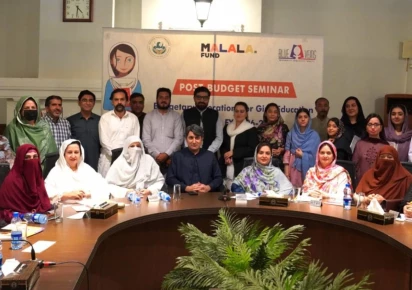
He was speaking at a post-budget seminar on girls’ education organised by the Khyber-Pakhtunkhwa Commission on the Status of Women in collaboration with Blue Veins.
Khalil said 73 education projects had been included in the provincial development programme for 2026-27, with a combined cost of Rs125.14 billion. An amount of Rs3.89 billion had been earmarked for the first quarter.
According to him, the government is also working on the construction of nearly 10,000 additional classrooms to increase the capacity of existing schools and accommodate more students.
Another initiative involves converting 50 mosques into government primary schools. The move is aimed at providing children in underserved areas with access to formal education by utilising existing infrastructure.
The Elementary and Secondary Education Foundation (ESEF), along with partner organisations, has established around 300 Accelerated Learning Programme centres across the province. These centres are intended to provide educational opportunities to out-of-school and over-age children and help them enter or re-enter the education system.
The government is also offering financial incentives to encourage girls to remain in school. Khalil said female students in the merged districts were currently receiving a monthly stipend of Rs500 with support from the World Food Programme. Efforts were underway to raise the amount to Rs1,000 per month.
K-P Commission on the Status of Women Chairperson Dr Sumera Shams said the seminar was aimed at reviewing education allocations, development projects and measures intended to improve girls’ access to education.
She noted that the provincial education budget had increased by around 11% during the current financial year. However, she stressed that effective monitoring of spending was essential to ensure that allocated funds translated into tangible improvements for students, particularly girls.
Blue Veins Programme Manager Qamar Naseem highlighted the scale of the province’s education challenge, citing the 2023 census estimate that around 4.9 million children in K-P were out of school. Of these, approximately 2.9 million were girls.
He said about 52% of girls between the ages of five and 16 were not attending school, while a significant proportion of enrolled girls failed to continue their education up to secondary level.
Naseem said bringing all out-of-school children into the education system would require an estimated 15,000 additional schools, making infrastructure expansion a long-term challenge. He pointed out that even with sufficient resources, the provincial government could build only around 300 schools a year.
He therefore welcomed the proposed Multi-Sectoral Response policy and suggested exploring public-private partnerships to expand school capacity. He referred to a model adopted in Sindh in which private schools provide additional space for students and suggested that K-P consider a similar approach.
K-P Assembly Secretary Syed Wiqar Shah also called for stronger enforcement of minimum-wage regulations in private schools, particularly to improve the salaries of female teachers. He said inadequate pay could adversely affect teachers’ performance.
We welcome your contributions! Submit your blogs, opinion pieces, press releases, news story pitches, and news features to opinion@minutemirror.com.pk and minutemirrormail@gmail.com