Summary
- Lebanese and Israeli delegations gathered in Rome on Tuesday for a fresh round of talks aimed at implementing a US-brokered framework that Beirut hopes will eventually lead to a full Israeli military withdrawal from southern Lebanon, though officials cautioned that a breakthrough was unlikely to come quickly.
- Pilot zones under discussion Lebanese President Joseph Aoun said in comments released by his office on Monday that he hoped the Rome talks would produce concrete, practical steps toward implementing the agreement, including the start of an Israeli troop withdrawal that would allow the Lebanese army to deploy across the south.
- A Lebanese official said the country’s negotiating team would push for a gradual, sequential Israeli withdrawal, moving from one zone to the next under a pilot zone arrangement in which Hezbollah disarms, Israeli troops pull back and Lebanese forces move in region by region.
Lebanese and Israeli delegations gathered in Rome on Tuesday for a fresh round of talks aimed at implementing a US-brokered framework that Beirut hopes will eventually lead to a full Israeli military withdrawal from southern Lebanon, though officials cautioned that a breakthrough was unlikely to come quickly.
American-led diplomacy on the Lebanon front intensified after Hezbollah and Israel resumed open conflict on March 2, part of a broader regional confrontation. The effort has continued despite firm opposition from Hezbollah, which argues that only direct pressure from Iran on Washington can bring the fighting to a close and force an Israeli pullout.
Iran had pushed for an end to the Lebanon war as a condition of its own interim arrangement with the United States, reached last month, but that understanding has come under strain over the past week following a fresh spike in tension between Washington and Tehran in the Gulf.
Israeli forces currently hold what the military calls a buffer zone stretching roughly ten kilometers into Lebanese territory along the length of the border. Israeli officials describe the zone as essential for shielding communities in northern Israel from Hezbollah attacks.
A meeting held in Washington on June 26 produced a framework calling for a formal end to the conflict, the disarmament of armed groups operating in the south, an apparent reference to Hezbollah, the deployment of Lebanese army units to the region and a phased withdrawal of Israeli troops. Israeli strikes have nonetheless continued since that meeting, and Hezbollah has publicly rejected both the agreement itself and any attempt to strip it of its weapons. Israel has said its forces will remain in southern Lebanon for as long as Hezbollah stays armed.
Lebanese officials said their delegation would meet Israeli counterparts at the American embassy in Rome on Tuesday and Wednesday to map out how the framework agreement might actually be carried out. One official said shifting the venue to Rome gave both delegations easier access to their respective governments during the negotiations.
Italian Foreign Minister Antonio Tajani confirmed on Monday that Italy had volunteered to host the discussions in support of reaching a genuine ceasefire in Lebanon. Speaking ahead of a European Union gathering in Brussels, Tajani said Rome was proud to serve as the site of the talks and called the Italian capital a capital of peace in this context.
Pilot zones under discussion
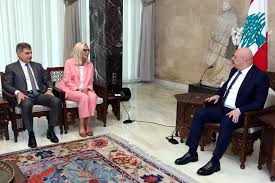
Lebanese President Joseph Aoun said in comments released by his office on Monday that he hoped the Rome talks would produce concrete, practical steps toward implementing the agreement, including the start of an Israeli troop withdrawal that would allow the Lebanese army to deploy across the south.
A Lebanese official said the country’s negotiating team would push for a gradual, sequential Israeli withdrawal, moving from one zone to the next under a pilot zone arrangement in which Hezbollah disarms, Israeli troops pull back and Lebanese forces move in region by region. The June 26 framework identified two areas as an initial starting point for this approach.
A US official said last week that the American military’s Central Command was working with both Lebanon and Israel to get the pilot zones running, and a US military delegation traveled to Lebanon over the weekend to discuss details of the plan with the Lebanese army.
Israeli forces have displaced local residents from their homes in parts of southern Lebanon and carried out controlled demolitions of entire villages, actions the military says are meant to destroy Hezbollah infrastructure, including underground tunnel networks.
Lebanon’s health ministry says more than 4,000 people in the country have died and over a million have been displaced since the Israeli campaign resumed in March, though the ministry has not specified how many of the dead were combatants. Hezbollah has not released its own casualty figures from the war. At least 32 Israeli soldiers and four Israeli civilians have died in Hezbollah attacks, the majority of them in southern Israel since fighting resumed.
The Rome talks mark the latest attempt by Washington to translate a fragile framework into measurable action on the ground, a process complicated by continued strikes, mutual distrust and the broader instability now affecting US relations with Iran. Diplomats involved in the process have signaled that progress is likely to be incremental, with the fate of the pilot zones seen as an early test of whether the wider framework can hold.
We welcome your contributions! Submit your blogs, opinion pieces, press releases, news story pitches, and news features to opinion@minutemirror.com.pk and minutemirrormail@gmail.com