Summary
- Its relationships with Saudi Arabia, Türkiye, Iran, China, and other regional actors provide Pakistan with diplomatic space that could potentially be used to promote communication and confidence-building among states whose strategic interests do not always converge.
- Rather than allowing the Agreement to become another instrument of regional polarization, its participating states could use it as a foundation for a broader conversation on collective security, strategic stability, confidence-building, and the gradual development of a more autonomous regional security architecture.
- If diplomacy can accompany deterrence, and strategic autonomy can coexist with mutual reassurance, the Makkah Agreement could evolve beyond a conventional defence arrangement into an important component of a new regional order—one in which security is increasingly defined and safeguarded by the states of the region themselves rather than determined predominantly by external powers.
By Muhammad Imran, Staff Member, SAHSOL-LUMS and Asma Rahmat, Final Year Law Student, SLC, Superior University
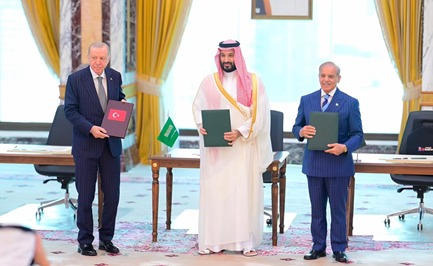
Introduction: The Makkah Joint Defence Agreement was always likely to generate a degree of unease in Tehran – actually, this is not the case. Any emerging collective-security arrangement involving Pakistan, Saudi Arabia, and Türkiye was bound to attract scrutiny in Iran, particularly against the backdrop of longstanding strategic rivalries in the Persian Gulf, shifting regional alignments, and uncertainty regarding the eventual scope, institutional structure, and strategic trajectory of the agreement. Nevertheless, Iran’s official response has so far been notably measured, restrained, and constructive. This approach deserves particular recognition at a time when the Middle East is already experiencing profound geopolitical uncertainty and strategic volatility.
Iran’s Measured Diplomatic Response: Some degree of skepticism among Iranian politicians, commentators, and strategic analysts is neither surprising nor inherently problematic. What is considerably more significant, however, is the position adopted by the Iranian government itself. Rather than immediately portraying the agreement as an emerging threat or an instrument of strategic encirclement, Tehran has adopted a comparatively cautious and pragmatic interpretation.
Iranian Foreign Ministry spokesperson Esmaeil Baqaei has characterized recent regional developments as indicative of a broader transformation in the way Middle Eastern states perceive and pursue their security interests. In particular, he has suggested that regional countries are increasingly recognizing that their long-term security cannot remain excessively dependent upon external powers, particularly the United States. This interpretation is strategically significant. It enables Tehran to acknowledge the emergence of new regional security arrangements without necessarily interpreting them through an exclusively confrontational lens. More importantly, it creates diplomatic space for Iran to engage with the evolving regional security architecture without prematurely positioning itself in opposition to the emerging arrangement.
Not an Anti-Iran Arrangement: Perhaps even more consequential is Tehran’s indication that it sees no compelling reason, at least at this stage, to regard the Makkah Agreement as being directed against Iran. By emphasizing the deep historical, cultural, civilizational, economic, and diplomatic ties connecting Iran with Pakistan, Türkiye, and Saudi Arabia, the Iranian Foreign Ministry has sought to place the agreement within the broader context of regional developments rather than reducing it to a zero-sum strategic competition.
This diplomatic framing is important. At a particularly sensitive juncture in Middle Eastern politics, the manner in which states interpret one another’s strategic initiatives can be almost as consequential as the initiatives themselves. Pakistan, Saudi Arabia, and Türkiye have emphasized the defensive character of the agreement and have maintained that it is not directed against any particular state. Tehran’s apparent willingness to acknowledge that position reduces the possibility that the agreement will become the subject of an unnecessary cycle of suspicion, countermeasures, and strategic miscalculation.
This, however, does not mean that Iran will disregard the agreement or refrain from carefully assessing its potential implications. Tehran will undoubtedly examine its institutional structure, military dimensions, strategic objectives, operational capabilities, and possible future trajectory. Every major regional actor is likely to do the same. Diplomatic reassurance and strategic calculation are not mutually exclusive: states can remain vigilant regarding developments affecting their national security while simultaneously choosing diplomacy over confrontation.
A Critical Formative Stage: The Makkah Agreement remains at a relatively early stage of development. Its eventual character, institutional capacity, strategic purpose, and regional consequences will depend substantially upon how its participating states define, institutionalize, and implement it over time. At this formative stage, responsible rhetoric and prudent diplomacy are therefore particularly important.
Prematurely treating the agreement as an instrument of confrontation could create precisely the tensions that its participating states claim they seek to avoid. Conversely, maintaining strategic ambiguity alongside diplomatic reassurance may provide sufficient space for the arrangement to evolve without immediately becoming embedded within the region’s existing patterns of rivalry.
Iran could have responded with immediate hostility, framing the agreement as a direct threat to its national security and thereby contributing to another cycle of regional polarization. Instead, at least for the present, Tehran has chosen a different course. By maintaining a measured tone, recognizing the possibility of legitimate regional security concerns, and leaving open the possibility of dialogue, Iran has preserved diplomatic space for engagement rather than confrontation. This approach should be welcomed by all concerned.
Towards a Regionally Owned Security Architecture: The emergence of new regional security arrangements does not necessarily have to produce new geopolitical divisions. If Pakistan, Saudi Arabia, Türkiye, and Iran can resist the temptation to interpret every strategic development exclusively through the lens of rivalry, the present moment could provide an opportunity to develop a more genuinely regionally owned security architecture.
Such an architecture should not rest exclusively upon military deterrence. It should also incorporate dialogue, confidence-building measures, mutual reassurance, economic interdependence, diplomatic engagement, and respect for the legitimate security concerns of neighboring states. The long-term objective should be to reduce, rather than institutionalize, the structural mistrust that has historically characterized relations among major regional actors.
Pakistan’s Emerging Strategic Role: The broader geopolitical context is equally significant. Pakistan appears to be assuming a more consequential role in regional affairs, supported by what its proponents regard as the dynamic and assertive leadership of Field Marshal Syed Asim Munir. At the same time, India is confronting significant diplomatic challenges in its regional and international engagement.
This changing strategic environment provides Pakistan with an opportunity to pursue a more confident, balanced, and strategically autonomous foreign policy. Pakistan’s greatest diplomatic advantage may lie not in becoming another participant in a rigid bloc system, but in positioning itself as a bridge between competing regional interests.
Its relationships with Saudi Arabia, Türkiye, Iran, China, and other regional actors provide Pakistan with diplomatic space that could potentially be used to promote communication and confidence-building among states whose strategic interests do not always converge.
The Changing Role of the United States: Another important dimension of the Makkah Agreement concerns the evolving role of the United States in the Middle East. The agreement may, at least from the perspective of some regional observers, be understood as part of a broader movement towards greater regional strategic autonomy.
The perception that Middle Eastern states can no longer rely exclusively upon the United States as the ultimate guarantor of their security has become increasingly prominent. Repeated regional conflicts, shifting alliances, and changes in the distribution of military and diplomatic influence have encouraged several states to diversify their strategic partnerships and reconsider traditional assumptions regarding external security guarantees.
Iran’s prolonged confrontation with the United States has also contributed to the perception that Washington’s ability to exercise uncontested strategic influence in the Middle East is no longer what it once was. This does not necessarily mean that American influence has disappeared; rather, it suggests that regional actors are increasingly seeking greater autonomy in determining their own strategic and security priorities.
The significance of the Makkah Agreement should therefore also be assessed against this broader transformation in the regional order.
Implications for Israel: The implications for Israel are particularly noteworthy. The Makkah Agreement is not expressly directed against Israel, nor should it automatically be characterized as an anti-Israel alliance. Nevertheless, its emergence must be understood within the wider context of rapidly changing strategic alignments in the Middle East.
Israeli concerns regarding the possible emergence of a broader Sunni strategic bloc, particularly in light of Türkiye’s growing regional influence, illustrate the extent to which traditional assumptions about the regional balance of power are being reconsidered. Whether such concerns are entirely justified is a separate question. What is undeniable, however, is that the emergence of new security partnerships is being interpreted through the prism of an increasingly fluid and competitive regional environment.
The central issue, therefore, is not whether the Makkah Agreement is formally directed against Israel or Iran. Such a characterization would oversimplify its strategic purpose and could undermine its potential diplomatic utility. The more consequential question is whether the Agreement contributes to the emergence of a regional security architecture in which Middle Eastern and neighbouring states possess greater capacity to determine their own security priorities.
If continuing regional conflicts and military interventions generate persistent insecurity among neighbouring states, the likely consequence may be the gradual consolidation of alternative security arrangements. In that sense, the strategic consequences of Israel’s regional policies may ultimately extend beyond its immediate confrontation with Iran and influence the broader architecture of Middle Eastern security.
The Real Test of the Makkah Agreement: The real test of the Makkah Agreement, therefore, will not simply be whom it excludes, but what kind of regional order it ultimately helps to create.
If it develops merely into another military alignment, it risks reinforcing the very cycle of polarization that has contributed to instability in the region for decades. If, however, it evolves into a platform for dialogue, deterrence, confidence-building, strategic coordination, and greater regional autonomy, it could represent an important step towards a more balanced and self-reliant security order.
For Pakistan, this presents both a strategic opportunity and a diplomatic responsibility. Its growing relevance should be employed to promote regional stability rather than to deepen existing geopolitical divisions. Pakistan can potentially play a constructive role by maintaining close strategic relations with Saudi Arabia and Türkiye while preserving meaningful diplomatic engagement with Iran and other regional actors.
Conclusion – From Military Alignment to Regional Stability: Ultimately, the durability, credibility, and strategic value of any regional security arrangement will depend not merely upon the strength of its military commitments, but upon its capacity to coexist constructively with neighbouring states without hardening existing divisions or creating permanent blocs of confrontation.
In this context, Iran’s measured response to the Makkah Agreement presents a modest yet potentially significant diplomatic opening. Rather than allowing the Agreement to become another instrument of regional polarization, its participating states could use it as a foundation for a broader conversation on collective security, strategic stability, confidence-building, and the gradual development of a more autonomous regional security architecture.
The opportunity before Pakistan, Saudi Arabia, Türkiye, and Iran is therefore larger than the Agreement itself. They have the possibility of demonstrating that regional security need not be synonymous with regional confrontation. If diplomacy can accompany deterrence, and strategic autonomy can coexist with mutual reassurance, the Makkah Agreement could evolve beyond a conventional defence arrangement into an important component of a new regional order—one in which security is increasingly defined and safeguarded by the states of the region themselves rather than determined predominantly by external powers.
We welcome your contributions! Submit your blogs, opinion pieces, press releases, news story pitches, and news features to opinion@minutemirror.com.pk and minutemirrormail@gmail.com