Summary
- The floods have also raised questions about disaster information sharing between Nepal and China.
- Foreign Minister Khanal said China had been providing Nepal with information and data since the disaster.
- Khanal suggested that the sudden nature of the disaster meant neither side may have had complete information before the floods struck.
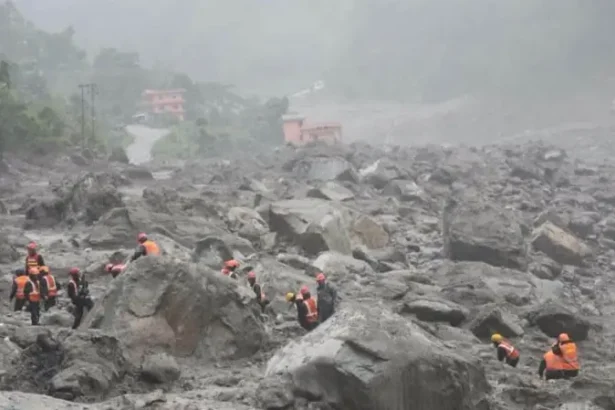
KATHMANDU: The death toll from devastating flash floods along Nepal’s border with Tibet has risen to 675, while thousands of people remain missing as rescue teams continue searching through heavily damaged areas.
Nepal’s National Disaster Risk Reduction and Management Authority said 2,498 people had been rescued so far. At least 219 others were injured, while more than 18,700 rescuers have been deployed for search and rescue operations.
The disaster struck on Wednesday after what officials believe was a glacier collapse triggered a sudden surge of water, mud and debris. Several communities were overwhelmed within minutes, leaving roads, buildings and infrastructure severely damaged.
Nepal’s Foreign Minister Shisir Khanal has called for a stronger global response to climate change, warning that the Himalayan region is increasingly vulnerable to extreme weather events.
Scientists have linked the growing instability of Himalayan glaciers and mountain slopes to rising temperatures. Accelerated melting of glaciers, snow and permafrost can weaken mountain structures and increase the risks of landslides, avalanches and sudden floods.
Rescue teams are also working to locate workers trapped inside a tunnel at the Trishuli-3 ‘A’ hydropower facility.
Energy Minister Biraj Bhakta Shrestha said rescuers had managed to drill a hole into the tunnel. Oxygen will be supplied through the opening while a camera is expected to assist the search for survivors.
Shrestha described the development as a partial success and said even limited progress offered hope to families waiting for news.
He said rescue operations had continued despite difficult weather conditions, with dozens of people working at the site for nearly two days.
Search efforts are also underway at the Trishuli-3 ‘B’ hydropower facility. Nepalese authorities said a specialist Chinese team had arrived to assist with the operation.
The disaster has also affected a large number of foreign nationals who were in the affected areas.
According to the Nepal Tourism Board, 261 foreign nationals have been rescued, while another 320 remain unaccounted for.
Indian nationals make up the largest number of foreigners still being sought, while citizens from China, Ukraine, the United States, Germany and several other countries have also been affected.
Families have gathered at rescue and recovery centres, waiting for information about relatives who remain missing.
The floods have also raised questions about disaster information sharing between Nepal and China.
Foreign Minister Khanal said China had been providing Nepal with information and data since the disaster. He said authorities from both countries were now maintaining close communication.
Khanal suggested that the sudden nature of the disaster meant neither side may have had complete information before the floods struck.
China has rejected accusations that it failed to warn Nepal. Its embassy said the two countries had maintained communication on managing disasters that cross their shared border.
The embassy also pointed to discussions held in May aimed at improving mechanisms for sharing information about disasters.
Nepalese officials have acknowledged that although discussions on cross-border disaster cooperation have taken place, a fully organised system for sharing urgent information has yet to be established.
We welcome your contributions! Submit your blogs, opinion pieces, press releases, news story pitches, and news features to opinion@minutemirror.com.pk and minutemirrormail@gmail.com