Summary
- Pakistan’s military takeover on October 12, 1999, brought an abrupt end to the elected government of then-prime minister Nawaz Sharif and marked another major turning point in the country’s political history.
- How the takeover unfolded On October 12, 1999, tensions between the prime minister and the army chief reached a decisive point when Nawaz Sharif moved to remove Musharraf and appoint then-Inter-Services Intelligence chief General Ziauddin Butt as the new army chief.
- More than two decades after the 1999 takeover, civilian supremacy and military involvement in politics remain central themes in Pakistan’s political debate.
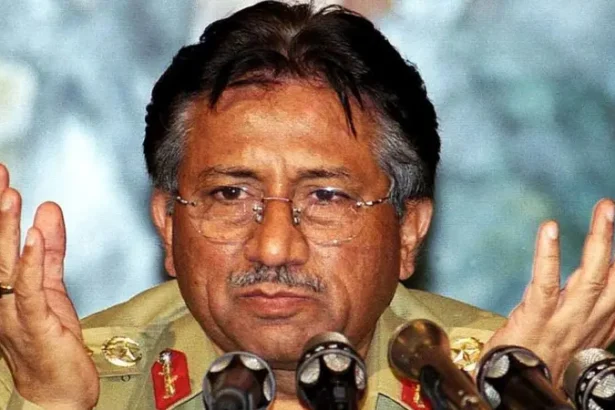
Pakistan’s military takeover on October 12, 1999, brought an abrupt end to the elected government of then-prime minister Nawaz Sharif and marked another major turning point in the country’s political history. However, some senior members of Sharif’s government later claimed that they had received indications weeks earlier that army chief General Pervez Musharraf was preparing to take control.
Former information minister and senior cabinet member Mushahid Hussain Syed recalled an incident from September 14, 1999, when Nawaz Sharif travelled to Skardu with several ministers and government officials. General Musharraf and senior military officers were present to receive the prime minister.
According to Mushahid Hussain, the visit included a gathering in the evening where participants listened to and sang old songs. During the event, Musharraf and other military officers reportedly raised slogans in support of Nawaz Sharif. However, Mushahid noticed that Lieutenant General Mahmood, the Rawalpindi corps commander whose command also covered the Northern Areas, was absent.
When Mushahid asked Musharraf about the corps commander, he was told that Mahmood could not attend because of other commitments in Rawalpindi. Mushahid later interpreted the absence as a possible indication that contingency plans were already in place for a military takeover. He claimed that if events in Skardu had gone against Musharraf, an alternative plan could have involved a rebellion from Rawalpindi.
Mushahid also recalled that changes were made to the guard at the Prime Minister’s House during September. The commander of the army’s 111 Brigade, which has historically played a prominent role in security operations in the capital, was also replaced. He further alleged that military-linked personnel had approached some political and social activists, including lawyers and human rights workers, in late August and early September. According to him, they suggested that the government would soon fall and asked whether the activists would consider serving as ministers in a new administration.
Mushahid maintained that preparations were under way on both sides and that the central question was who would make the first move. Musharraf, however, consistently rejected the claim that he had planned the removal of Nawaz Sharif in advance. He maintained that the army had acted as an institution in response to what it considered an unfair and non-transparent attempt to dismiss its chief.
How the takeover unfolded
On October 12, 1999, tensions between the prime minister and the army chief reached a decisive point when Nawaz Sharif moved to remove Musharraf and appoint then-Inter-Services Intelligence chief General Ziauddin Butt as the new army chief.
Veteran journalist Zafar Abbas, who was in Karachi on leave at the time, recalled hearing the news while following television and radio reports. Soon afterwards, Pakistan Television’s transmission was interrupted, with an announcement saying that services would resume shortly.
Suspecting that a major political crisis was unfolding, Abbas contacted fellow journalist Idrees Bakhtiar. The two decided to gather information in Karachi and went to the airport after learning that Musharraf was returning from Colombo.
At the airport, the situation remained unclear, and journalists struggled to determine whether the prime minister or the military was in control. Rumours circulated as the confrontation between Sharif and Musharraf intensified. Musharraf was also appointed chairman of the Joint Chiefs of Staff Committee during the unfolding crisis, raising hopes among some observers that tensions might ease.
Those hopes proved short-lived. According to Abbas, the events of October 12 made it clear that the army had decided to take control even though Musharraf was outside Pakistan when the prime minister attempted to remove him. The military moved against the government, bringing the confrontation to an end in its favour.
‘Relax, Major, don’t shoot’
Mushahid Hussain recalled that he was having dinner with his wife and children at around 7pm when he received a telephone call informing him that soldiers had arrived. By then, the Prime Minister’s House had reportedly been surrounded.
He said soldiers entered his home after breaking windows and doors. Hearing their footsteps upstairs, he realised that a military takeover was under way.
Mushahid described the opening moments as frightening, with confusion and fear spreading quickly. When an armed army major approached him, he told the officer to remain calm and not to fire, explaining that nobody in the house was armed.
According to Mushahid, the officer replied that the army had taken over and instructed him to sit down. Mushahid then asked the soldiers to wait in the drawing room, explaining that he had been eating with his family. He recalled that his wife even reprimanded some soldiers for smoking inside the house.
Mushahid claimed that other ministers were living in the Ministers’ Enclave, but soldiers did not enter every residence. He later learned that Pakistan Television had also been surrounded.
The takeover caused widespread uncertainty. Reports from the time described people gathering outside government buildings and asking one another what was happening and who was in charge of the country.
Musharraf’s justification for rejecting the Constitution
On October 17, 1999, Musharraf addressed corps commanders at General Headquarters in Rawalpindi. In remarks cited in Shuja Nawaz’s book Crossed Swords, he compared the nation to a body and the Constitution to one of its organs.
Musharraf said he had faced a choice between eliminating the entire body and removing only one organ, explaining that he had chosen to set aside the Constitution. The statement reflected the military leadership’s justification for suspending constitutional rule following the takeover.
The episode became another chapter in Pakistan’s long-running struggle over the balance of power between elected governments and the military establishment.
Nawaz Sharif’s relationship with the military
The political consequences of the 1999 takeover continued to shape debates about civilian supremacy in the years that followed. Nawaz Sharif’s later governments also experienced tensions with the military, particularly during his third term from 2013 to 2017.
Author Shuja Nawaz argued that Sharif continued to rely heavily on a small circle of trusted advisers, drawing parallels between his earlier governing style and his later political leadership. Political analyst Sohail Warraich, however, suggested that Sharif had changed considerably and argued that his demand for an end to military interference in politics was consistent with the Constitution.
During Sharif’s third term, disagreements between the civilian government and the military continued over national security and political decision-making. Tensions also surfaced during the debate over the China-Pakistan Economic Corridor and security operations against armed groups in Balochistan.
The 2016 Dawn Leaks controversy further strained relations. The report concerned a high-level meeting in which the civilian government reportedly warned military officials that Pakistan could face international isolation if action against terrorism was not strengthened. The military leadership treated the leak as a national security matter and called for an investigation.
The controversy reignited questions about the relationship between the government, the military and the media. Critics argued that disagreements over national security information often exposed deeper tensions between civilian authorities and powerful state institutions.
Can civilian supremacy become a reality?
More than two decades after the 1999 takeover, civilian supremacy and military involvement in politics remain central themes in Pakistan’s political debate. Politicians, journalists and analysts continue to disagree over how much influence the military should exercise in political affairs and whether elected governments can establish lasting constitutional authority.
Shuja Nawaz has emphasised the importance of the Charter of Democracy, arguing that political parties should work together to protect democratic institutions. Mushahid Hussain, meanwhile, has stressed that politicians must recognise that the path to power runs through elections rather than military headquarters.
He argued that free and fair elections are essential to strengthening civilian rule and urged politicians not to invite the military to act against their political opponents.
We welcome your contributions! Submit your blogs, opinion pieces, press releases, news story pitches, and news features to opinion@minutemirror.com.pk and minutemirrormail@gmail.com