Summary
- In a diplomatic triumph that underscores Pakistan’s growing influence on the world stage, Azerbaijani Foreign Minister Jeyhun Bayramov has extended his congratulations to Deputy Prime Minister and Foreign Minister Ishaq Dar on the signing of the Islamabad Memorandum of Understanding between the United States and Iran.
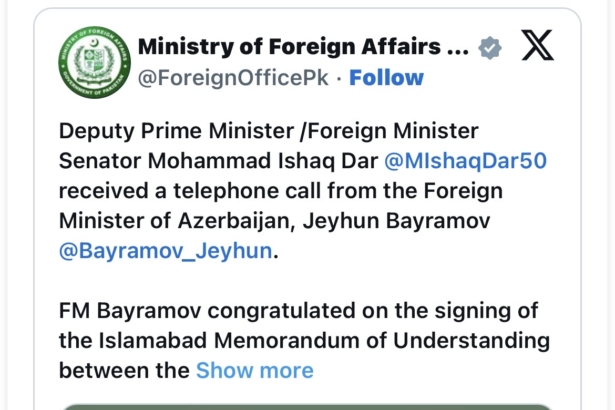
- The phone call, confirmed in a post on X by Pakistan’s Foreign Office, saw Bayramov appreciating Pakistan’s “sincere and sustained diplomatic efforts as a mediator that contributed to this important development.” The acknowledgment from Baku is significant, coming from a nation that shares complex ties with both Tehran and Washington, and whose endorsement carries weight in the broader Caucasus and Central Asian region.
- For Deputy Prime Minister Dar, the recognition from Baku adds to a growing list of diplomatic achievements.
In a diplomatic triumph that underscores Pakistan’s growing influence on the world stage, Azerbaijani Foreign Minister Jeyhun Bayramov has extended his congratulations to Deputy Prime Minister and Foreign Minister Ishaq Dar on the signing of the Islamabad Memorandum of Understanding between the United States and Iran.
The phone call, confirmed in a post on X by Pakistan’s Foreign Office, saw Bayramov appreciating Pakistan’s “sincere and sustained diplomatic efforts as a mediator that contributed to this important development.” The acknowledgment from Baku is significant, coming from a nation that shares complex ties with both Tehran and Washington, and whose endorsement carries weight in the broader Caucasus and Central Asian region.
The term “Islamabad Memorandum” is particularly noteworthy. It suggests that the agreement, while between the U.S. and Iran, has been formally designated after the Pakistani capital a clear signal that Islamabad played a central role in facilitating the breakthrough. While Switzerland had offered to host a signing ceremony, the final agreement appears to have been concluded under Pakistan’s diplomatic umbrella, cementing Islamabad’s status as an essential broker in one of the most consequential geopolitical negotiations of the decade.
According to the Foreign Office readout, both sides noted the development as “an important step towards lasting peace and stability for the region, as well as towards strengthening confidence in the global economic outlook.” The inclusion of global economic confidence reflects the widespread relief that a U.S.-Iran thaw could bring to energy markets, shipping lanes, and international trade routes that have been disrupted by years of sanctions and military posturing.
Pakistan’s role as a mediator is not entirely without precedent. Islamabad has long maintained channels of communication with Tehran, given their shared border and historical ties. Simultaneously, Pakistan has been a key U.S. ally in the fight against terrorism. This unique position allowed Pakistani diplomats to shuttle between the two adversaries, offering proposals and bridging gaps when direct dialogue proved impossible.
The Azerbaijani congratulation also highlights the regional dimensions of the MoU. As a nation bordering Iran and maintaining close ties with Israel and Turkey, Azerbaijan’s endorsement signals that the agreement has broader acceptance across diverse geopolitical camps. Baku’s support may encourage other regional players including Saudi Arabia, the UAE, and Turkey to publicly welcome the deal.
For Deputy Prime Minister Dar, the recognition from Baku adds to a growing list of diplomatic achievements. The Islamabad Memorandum not only de-escalates U.S.-Iran tensions but also elevates Pakistan’s standing as a peacemaker in a volatile region. Whether this momentum translates into lasting regional stability remains to be seen. But for now, Pakistan can rightfully claim its place at the center of a historic diplomatic breakthrough.
We welcome your contributions! Submit your blogs, opinion pieces, press releases, news story pitches, and news features to [email protected] and [email protected]