Summary
- Pakistan has called for an inclusive and responsible approach to digital financial innovation, urging developing countries to play a greater role in shaping global rules for emerging technologies.
- Saqib said digital financial technologies could help lower the cost of cross-border remittances, speed up transactions and expand access to financial services.
- UNDP Chief Digital Officer Robert Opp highlighted efforts to strengthen government capacity and support responsible applications of blockchain, while UNCTAD New York Office Chief Juan José Martinez Badillo discussed the financial and development implications of digital assets.
Pakistan has called for an inclusive and responsible approach to digital financial innovation, urging developing countries to play a greater role in shaping global rules for emerging technologies.
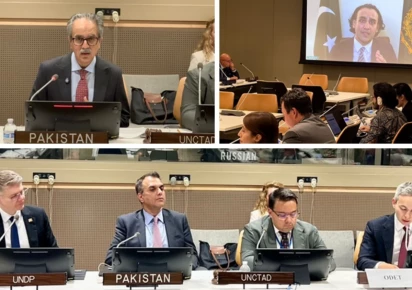
The call was made during a briefing held at the United Nations headquarters in New York, jointly organised by Pakistan’s Permanent Mission to the UN, the United Nations Development Programme (UNDP), UN Trade and Development (UNCTAD) and the Office of the Secretary-General’s Envoy on Technology.
The session focused on the opportunities and policy challenges linked to digital assets, blockchain, tokenisation and distributed ledger technologies (DLT).
Addressing the gathering, Pakistan’s Permanent Representative to the UN, Ambassador Asim Iftikhar Ahmad, said digital technologies were becoming increasingly important in finance, investment, payments and broader digital transformation.
He said developing countries faced challenges including limited digital infrastructure, technical expertise, institutional capacity and access to financing. These countries, he added, should not remain passive users of technologies developed elsewhere but should have the ability to understand, influence and benefit from them.
Ahmad stressed the importance of international cooperation, technical assistance, knowledge-sharing and capacity-building. He said the UN could help countries navigate the rapidly changing digital environment and ensure developing economies were represented in discussions on emerging global standards.
Minister of State and Pakistan Virtual Assets Regulatory Authority (PVARA) Chairman Bilal Bin Saqib delivered the keynote address, outlining Pakistan’s efforts to establish a regulatory framework for virtual assets.
Saqib said digital financial technologies could help lower the cost of cross-border remittances, speed up transactions and expand access to financial services. He noted that remittances remain an important source of income for millions of families in developing countries, while high transfer costs continue to pose a challenge.
He stressed that regulation and innovation should complement rather than compete with each other. According to Saqib, clear rules can strengthen public confidence, protect users and provide businesses with a stable environment to develop digital financial products responsibly.
He highlighted Pakistan’s recent regulatory initiatives, including the creation of PVARA, legislation and licensing measures, as well as plans for a regulatory sandbox aimed at supporting innovation.
Saqib identified affordable remittances, tokenisation-based investment mechanisms and greater transparency in financial flows as key areas where digital infrastructure could contribute to economic development.
He also pointed to possible blockchain applications in development financing, subsidies, aid distribution and climate finance, while emphasising the need to address risks such as illicit financing, cybersecurity threats and financial losses.
The PVARA chairman warned that differences in technological and regulatory capabilities could create a new financial divide between developed and developing economies. He offered to share Pakistan’s experience in legislation, licensing and regulatory sandboxes with other developing countries exploring responsible digital-asset policies.
Senior UN officials also discussed the role of digital technologies in development. UNDP Chief Digital Officer Robert Opp highlighted efforts to strengthen government capacity and support responsible applications of blockchain, while UNCTAD New York Office Chief Juan José Martinez Badillo discussed the financial and development implications of digital assets.
Quintin Chou-Lambert, Deputy to the UN Secretary-General’s Envoy on Technology, spoke about digital cooperation, technology governance and capacity-building.
A panel discussion examined practical uses of blockchain and DLT in areas including digital finance, identity systems, public services and financial traceability. Participants also discussed regulatory gaps, interoperability, cybersecurity, institutional readiness and equal access to technology.
The discussion highlighted UN initiatives such as the UNDP Government Blockchain Academy and the SDG Blockchain Accelerator, which support governments in developing expertise and exploring practical uses of blockchain technology.
In his closing remarks, Ambassador Ahmad said digital assets and blockchain could play an important role in the future of digital finance and public-service delivery. However, he stressed that technology alone could not guarantee development.
He said countries also needed effective policies, strong institutions, secure infrastructure and solutions tailored to their national circumstances.
We welcome your contributions! Submit your blogs, opinion pieces, press releases, news story pitches, and news features to opinion@minutemirror.com.pk and minutemirrormail@gmail.com