Summary
- Pakistan’s political and diplomatic leadership has vowed to protect the country’s water rights under the Indus Waters Treaty through all available legal, diplomatic and international channels.
- The seminar brought together federal ministers, political leaders, legal experts, water specialists and international scholars from several countries to discuss the importance of preserving international water agreements and preventing the use of water as a political weapon.
- He said the matter concerns international law, treaty obligations and the rights of downstream states that depend on shared water resources.
Pakistan’s political and diplomatic leadership has vowed to protect the country’s water rights under the Indus Waters Treaty through all available legal, diplomatic and international channels.
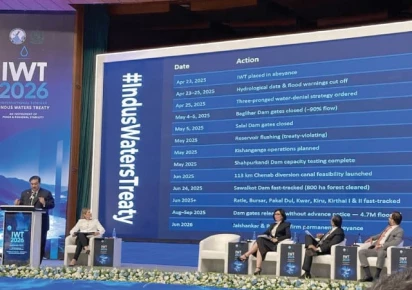
The commitment was expressed during an international seminar held in Islamabad on the future of the treaty and the growing concerns over water security in South Asia.
The seminar brought together federal ministers, political leaders, legal experts, water specialists and international scholars from several countries to discuss the importance of preserving international water agreements and preventing the use of water as a political weapon.
Deputy Prime Minister and Foreign Minister Ishaq Dar said the Indus Waters Treaty cannot be suspended or terminated unilaterally by any country.
He said the agreement has remained in force for more than six decades and contains no provision allowing one party to withdraw from its obligations on its own.
Dar described India’s decision to place the treaty in abeyance as illegal and contrary to international law.
He said uninterrupted water flows from the western rivers are essential for Pakistan’s agriculture, food production, energy generation and economic development.
The foreign minister warned that any attempt to divert, block or reduce Pakistan’s water share would have serious implications for regional peace and security.
He reiterated that Pakistan remains committed to dialogue and peaceful dispute resolution but would firmly defend its national interests and water rights.
Speaking at the seminar, Bilawal Bhutto Zardari said the issue goes beyond a dispute between two neighbouring countries.
He said the matter concerns international law, treaty obligations and the rights of downstream states that depend on shared water resources.
Bilawal called for international efforts to stop the weaponisation of water and proposed stronger global protections for countries relying on transboundary rivers.
He stressed that water should never be used as a tool of pressure or political influence.
The PPP chairman also urged Pakistan to continue improving its domestic water infrastructure by constructing reservoirs, canals, barrages and flood protection systems.
Federal Information Minister Attaullah Tarar described the Indus River system as the lifeline of more than 240 million Pakistanis.
He said millions of people depend on the river system for drinking water, farming, industry and electricity production.
Tarar stated that international agreements cannot be amended, suspended or cancelled unilaterally and must be respected by all parties.
He warned that turning water into a weapon could undermine regional cooperation and create long-term instability.
Climate Change Minister Musadik Malik highlighted the impact of changing river flows on farmers and vulnerable communities.
He said uncertainty in water supplies threatens food security and affects the livelihoods of millions of people living in agricultural areas.
Musadik Malik also called for stronger international laws and agreements governing shared water resources.
Pakistan’s Commissioner for Indus Waters, Mehar Ali Shah, said the treaty was designed to prevent conflicts and ensure cooperation between neighbouring countries.
He noted that recent fluctuations in river flows have complicated irrigation management and flood forecasting efforts in Pakistan.
According to him, predictable water supplies are essential for effective planning and the protection of downstream communities.
Several international experts attending the seminar also expressed concern over attempts to use water resources as a geopolitical tool.
Experts from the United States, China and Russia stressed the need to uphold international agreements and resolve disputes through legal and diplomatic mechanisms.
The participants agreed that the Indus Waters Treaty remains an important pillar of regional peace and stability.
They emphasised that shared rivers should become a source of cooperation and development rather than conflict and confrontation.
The seminar concluded with a renewed call for the international community to support the protection of international water treaties and discourage the use of water as a political weapon.
We welcome your contributions! Submit your blogs, opinion pieces, press releases, news story pitches, and news features to opinion@minutemirror.com.pk and minutemirrormail@gmail.com