Summary
- Pakistan on Wednesday called on all parties involved in the escalating US-Iran conflict to “give diplomacy a little more chance,” warning the United Nations Security Council that continued hostilities risk destabilising the wider Middle East and undermining global security frameworks.
- He warned that a fragile ceasefire environment could collapse at any moment, triggering “unbearable consequences.” According to Pakistan, the intensifying US-Iran confrontation has significantly complicated diplomatic efforts surrounding Iran’s nuclear programme and broader regional negotiations.
- He said these efforts were aimed at “breaking the momentum of hostilities, saving lives and giving diplomacy a chance.” Ambassador Asim Iftikhar Ahmad described Pakistan’s approach as part of a long-standing commitment to regional stability and peaceful conflict resolution, based on dialogue and international cooperation.
Pakistan on Wednesday called on all parties involved in the escalating US-Iran conflict to “give diplomacy a little more chance,” warning the United Nations Security Council that continued hostilities risk destabilising the wider Middle East and undermining global security frameworks.
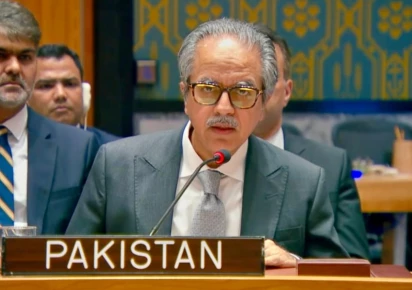
Addressing a high-level UN Security Council briefing on nuclear non-proliferation, Pakistan’s Permanent Representative to the United Nations, Ambassador Asim Iftikhar Ahmad, expressed “deep concern” over the rapidly deteriorating situation in the region.
He said recent developments had exposed the “fragility of the situation” and highlighted the urgent need for diplomatic engagement before tensions spiral further out of control.
“Events of the last few days have amply underscored the risk of escalation and the need for diplomatic efforts to come to fruition sooner than later,” the ambassador told the council.
Warning over regional instability
The envoy stressed that the ongoing cycle of violence in the Middle East posed a serious threat not only to regional stability but also to international peace and economic security. He warned that a fragile ceasefire environment could collapse at any moment, triggering “unbearable consequences.”
According to Pakistan, the intensifying US-Iran confrontation has significantly complicated diplomatic efforts surrounding Iran’s nuclear programme and broader regional negotiations.
Ambassador Asim Iftikhar Ahmad said the conflict had disrupted the work of the International Atomic Energy Agency (IAEA), weakening its ability to carry out essential verification and monitoring responsibilities.
“Regrettably, the breakdown of diplomacy and outbreak of hostilities has also impacted consideration of the Iran nuclear issue, pushing the parties further apart,” he said, adding that the IAEA’s verification mandate had been seriously affected.
Pakistan calls for dialogue and restraint
Reaffirming Islamabad’s position, Pakistan urged all stakeholders to resolve disputes through dialogue rather than military escalation.
“We reaffirm our support for the resolution of all outstanding issues, including the Iran nuclear issue, through peaceful means, diplomatic engagement and sustained dialogue,” the ambassador said.
He emphasised that diplomacy should remain the “guiding principle” in addressing complex geopolitical disputes, particularly those involving nuclear risks.
Pakistan also highlighted its own diplomatic engagement with regional and global actors, stating that it had worked behind the scenes to encourage de-escalation and facilitate communication between conflicting parties.
“We, along with partners, initiated diplomatic efforts to stop the war and bring the parties to the table,” he noted, adding that Islamabad had consistently pushed for ceasefire arrangements and stability measures.
Behind-the-scenes mediation efforts
The envoy further revealed that Pakistan had maintained contact with both Tehran and Washington, as well as other regional stakeholders, in an effort to reduce tensions and encourage negotiations.
He said these efforts were aimed at “breaking the momentum of hostilities, saving lives and giving diplomacy a chance.”
Ambassador Asim Iftikhar Ahmad described Pakistan’s approach as part of a long-standing commitment to regional stability and peaceful conflict resolution, based on dialogue and international cooperation.
He also referenced what he called the “Islamabad Talks,” describing them as a rare high-level engagement between the United States and Iran after decades of strained relations.
According to him, Pakistan appreciated both sides for engaging in dialogue and participating in discussions that could help pave the way for a ceasefire and longer-term settlement.
Concern over nuclear escalation
The UN briefing also came amid renewed international concern over Iran’s nuclear programme. Recent reports by the International Atomic Energy Agency indicate limited progress in clarifying uranium stockpiles and continued uncertainty about access to key nuclear sites damaged in earlier strikes.
The IAEA has repeatedly urged Iran to fully comply with its safeguards obligations under the Nuclear Non-Proliferation Treaty (NPT), warning that suspension of verification activities could raise serious global security risks.
Diplomatic efforts to resolve the nuclear dispute have stalled amid ongoing military tensions, with negotiations reportedly linked to broader ceasefire arrangements in the region.
Pakistan urges global responsibility
Concluding his remarks, the Pakistani envoy called on all sides to avoid actions that could undermine fragile diplomatic efforts already underway.
“As we work earnestly with partners to find a peaceful solution, we urge all sides to exercise restraint and give peace a little more chance,” he said.
He added that the international community continues to hope for a negotiated settlement, stressing that diplomacy remains the only viable path forward in preventing further escalation in an already volatile region.
We welcome your contributions! Submit your blogs, opinion pieces, press releases, news story pitches, and news features to [email protected] and [email protected]