
Summary
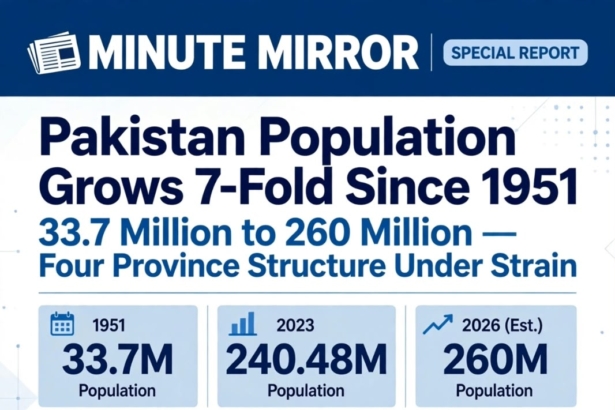
- ISLAMABAD: Pakistan’s population has grown from 33.7 million in 1951 to more than 240 million recorded in the 2023 census, intensifying pressure on the country’s administrative structure, public services and resource distribution.
- Population Growth and Regional Disparities Pakistan’s first census after independence recorded a population of 33.7 million within the geographical boundaries of present-day Pakistan.
- Investment in education, healthcare, vocational training and employment will be essential to translate demographic growth into economic progress Mehboob Questions the Need for New Provinces Speaking to Minute Mirror, Ahmed Bilal Mehboob, founder and president of the Pakistan Institute of Legislative Development and Transparency (PILDAT), argued that population growth alone should not determine whether new provinces are established.
ISLAMABAD: Pakistan’s population has grown from 33.7 million in 1951 to more than 240 million recorded in the 2023 census, intensifying pressure on the country’s administrative structure, public services and resource distribution. The rapid increase has renewed debate over whether the existing four-province system can effectively address the needs of a growing population.
An international discussion on administrative reforms by the World Economic Forum (WEF) highlights the challenges governments face when demographic growth outpaces institutional capacity. In Pakistan, the debate centres on whether creating additional provinces would improve service delivery or whether strengthening local governments and accountability mechanisms should take priority.
Population Growth and Regional Disparities
Pakistan’s first census after independence recorded a population of 33.7 million within the geographical boundaries of present-day Pakistan. The 2023 digital census placed the population at approximately 240.48 million, making the country the world’s fifth most populous nation.
Punjab accounts for more than half of the national population, while Balochistan, despite being the largest province by area, has a comparatively small population. These differences create challenges for infrastructure development, political representation, public spending and access to essential services.
Pakistan’s large youth population also presents both an opportunity and a challenge. Investment in education, healthcare, vocational training and employment will be essential to translate demographic growth into economic progress
Mehboob Questions the Need for New Provinces
Speaking to Minute Mirror, Ahmed Bilal Mehboob, founder and president of the Pakistan Institute of Legislative Development and Transparency (PILDAT), argued that population growth alone should not determine whether new provinces are established.
He pointed to international examples, including the United States and India, to illustrate that administrative boundaries do not necessarily need to change in direct proportion to population growth.
Mehboob emphasised that Pakistan’s fundamental challenges require improvements in governance, transparency, corruption prevention, poverty reduction, employment opportunities and access to justice.
He warned that creating additional provinces without addressing existing institutional weaknesses could increase government expenditure while reducing the resources available for development and public services.
Local Governments as an Alternative
Mehboob has advocated empowering local governments rather than relying exclusively on the creation of new provinces. Article 140-A of the Constitution provides for the devolution of political, administrative and financial responsibility to elected local governments.
Greater authority for municipal, tehsil and village-level institutions could bring decision-making closer to citizens and help address local problems without requiring every matter to pass through provincial capitals.
He also stressed the importance of transparent census procedures. Reliable population data are essential for determining political representation, distributing federal resources through the National Finance Commission framework and planning public services.
Economic and Social Consequences
Rapid population growth has increased demand for schools, hospitals, housing, employment and clean water. Major urban centres, including Karachi, Lahore and Faisalabad, continue to face pressure from urban expansion and infrastructure requirements.
Population figures also influence provincial resource allocation and representation in elected institutions. Disagreements over the appropriate balance between population, geographical area and economic disadvantage remain part of the wider debate.
Water scarcity presents another concern, as growing demand places additional pressure on available resources.
Reforms Beyond Administrative Boundaries
Mehboob’s position underscores the need for accountable institutions, stronger local governments, transparent development spending, effective tax collection and timely access to justice.
Pakistan’s population growth has made administrative reform an increasingly important policy question. Whether the country retains its existing provincial structure or considers new units, improving governance and ensuring that public resources reach citizens will remain central to addressing the challenges ahead.
We welcome your contributions! Submit your blogs, opinion pieces, press releases, news story pitches, and news features to opinion@minutemirror.com.pk and minutemirrormail@gmail.com