
Summary
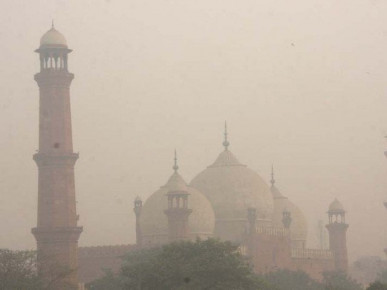
- LAHORE: Forecast rain and thunderstorms across Punjab have raised hopes of temporary relief from worsening air pollution, but uneven air quality readings across Lahore suggest that the seasonal smog threat remains a concern.
- Lahore air quality shows mixed picture According to the Punjab Environmental Protection Agency’s real-time monitoring dashboard, Lahore recorded an overall Air Quality Index (AQI) of 131 at 10am on Saturday, placing the city in the moderate category.
- Rain may bring temporary relief Environmental expert Dr Munawar Sabir said rainfall could help reduce airborne pollution by bringing suspended particles to the ground.
LAHORE: Forecast rain and thunderstorms across Punjab have raised hopes of temporary relief from worsening air pollution, but uneven air quality readings across Lahore suggest that the seasonal smog threat remains a concern.
The Pakistan Meteorological Department (PMD) has forecast rain, strong winds and thunderstorms, with isolated hailstorms, in upper and central parts of Punjab until October 15, with intermittent breaks. Lahore and surrounding areas are expected to experience changing weather conditions on Sunday and again on October 13 and 14.
The expected rainfall could wash some suspended pollutants out of the atmosphere, while winds may help disperse accumulated pollution. However, experts caution that the improvement could be short-lived if emissions from traffic, industries and other sources continue unchecked.
Lahore air quality shows mixed picture
According to the Punjab Environmental Protection Agency’s real-time monitoring dashboard, Lahore recorded an overall Air Quality Index (AQI) of 131 at 10am on Saturday, placing the city in the moderate category.
The reading was lower than the 163 recorded at the same time a day earlier, indicating an improvement in overall air quality. However, pollution levels varied considerably between neighbourhoods.
Safari Park recorded an AQI of 157, while Shahdara and DHA Phase 6 registered 155 each. Multan Road recorded 154, with all four locations classified as unhealthy for sensitive groups.
In contrast, the Wagah Border area recorded an AQI of 93, while Egerton Road registered 87, placing both locations in the satisfactory category under the dashboard’s classification.
The difference between monitoring stations highlights how residents in heavily polluted neighbourhoods may face greater exposure than citywide averages suggest.
The dashboard also recorded a weekly AQI peak of 246 at midnight on October 4, while the minimum reading during the reported period was 112 on Saturday.
An Environmental Protection Department official said the latest figures showed that the improvement had not been uniform across Lahore. The official stressed the importance of reliable monitoring, timely public advisories and targeted enforcement to address localised pollution hotspots.
Rain may bring temporary relief
Environmental expert Dr Munawar Sabir said rainfall could help reduce airborne pollution by bringing suspended particles to the ground. Wind could also disperse accumulated pollutants, improving conditions in affected areas.
However, he cautioned that these benefits might not last if emissions continued and weather conditions subsequently became unfavourable.
The PMD attributed the expected weather change to a westerly wave affecting upper and central parts of the country.
Why smog remains a challenge
Rain alone cannot resolve Punjab’s recurring smog problem, which results from several sources of pollution, including vehicle exhaust, industrial emissions, brick kilns, construction dust and smoke from agricultural residue burning.
As autumn advances towards winter, weaker atmospheric mixing and temperature inversions can trap pollutants closer to the ground, allowing pollution levels to rise even after temporary improvements.
The coming days could therefore bring some relief to Lahore and other parts of Punjab, depending on the intensity and distribution of rainfall.
But without sustained action to control emissions, cleaner air from the expected showers may prove temporary, leaving residents vulnerable as the winter smog season approaches.
We welcome your contributions! Submit your blogs, opinion pieces, press releases, news story pitches, and news features to opinion@minutemirror.com.pk and minutemirrormail@gmail.com