Summary
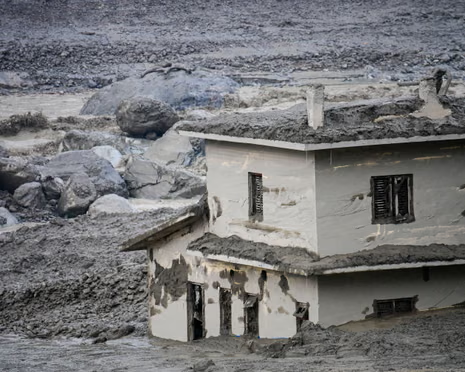
- Rescue workers pulled two men alive from a tunnel connected to a hydropower station on Nepal’s Trishuli River on Friday, nine days after a massive wall of ice, rock and mud swept through the valley, killing more than 1,300 people and leaving thousands more unaccounted for.
- Nepal’s army said separately that it had recovered two bodies from a tunnel at the Langtang Hydropower Station and that search operations there were continuing.
- Nepal’s disaster management authority said Friday that at least 1,287 people have been confirmed dead nationwide after the floods tore through towns and villages near the border with China’s Tibet region, destroying homes, roads and schools.
Rescue workers pulled two men alive from a tunnel connected to a hydropower station on Nepal’s Trishuli River on Friday, nine days after a massive wall of ice, rock and mud swept through the valley, killing more than 1,300 people and leaving thousands more unaccounted for.
Officials and rescue teams believe the disaster began on August 26, when a glacier collapsed along the upper stretches of the river, sending debris crashing downstream and trapping at least 900 people inside tunnels linked to six hydropower projects along the waterway.
The two workers pulled from the tunnel at the Upper Trishuli 3A Hydropower Station became the first survivors recovered from any of the affected hydropower sites, offering rescue teams a rare moment of hope even as the chances of finding additional survivors continue to fade. Both men were transported to an army hospital in the capital, Kathmandu. The army separately confirmed that a body had also been recovered from the same site.
Footage released by Nepali authorities showed one of the survivors, Kabir Maharjan, being lifted from a hole in the ground as onlookers cheered before he was placed on a stretcher. His colleague, Sanjay Sah, was carried out on another worker’s back with mud still covering much of his face, before army medical staff fitted him with an oxygen mask and checked his condition inside a rescue tent.
Sah, who works as a mechanical foreman, later said he remained behind in a control room to help colleagues escape after learning of the disaster, rather than fleeing himself. He said that as the person responsible for the control room, he felt it would not have been right to abandon his post during such a serious emergency. Sah told rescuers he passed the time reciting prayers while trapped and said he had remained in contact with three or four other people inside the tunnel, while acknowledging that others may still be alive deeper within its passages.
Nepal’s army said separately that it had recovered two bodies from a tunnel at the Langtang Hydropower Station and that search operations there were continuing.
Nepal’s disaster management authority said Friday that at least 1,287 people have been confirmed dead nationwide after the floods tore through towns and villages near the border with China’s Tibet region, destroying homes, roads and schools. More than 5,000 people remain unaccounted for. Chinese authorities have reported 21 deaths on their side of the border in Tibet, with 541 additional people listed as missing.
A source at the army hospital said both rescued men were in intensive care with stable vital signs. Maharjan, who works as a mechanical supervisor, is currently unable to move his hands or legs, while Sah’s injuries are not considered life threatening, according to an aide to Nepal’s energy minister. Maharjan’s brother, Amir, said he had not yet received official confirmation but had been told to travel to the hospital after learning of the rescue through news reports, adding that the entire family was overjoyed.
A separate small group of workers managed to escape from another tunnel in the hours immediately following the initial collapse. Rescue operations have also relied heavily on a team of engineering experts coordinating remotely through a messaging group, a method that has become an important complement to helicopters and heavy machinery in the ongoing search effort.
The Nepali army said additional search and rescue operations remained underway around the Upper Trishuli 3A project, with the army and police leading the response alongside technical assistance from experts in India, South Korea and China.
Nepal’s National Disaster Risk Reduction and Management Authority estimated Friday that property, housing and infrastructure losses from the disaster have reached at least 387.5 billion Nepalese rupees, or roughly 2.56 billion dollars. The agency’s chief, Dharma Raj Upreti, said Nepal will need to rebuild approximately 20,000 homes in the affected region, including at least 7,500 that were completely destroyed. A senior official at one of the country’s leading insurers said commercial insurance losses could ultimately exceed 132.3 million dollars, with hydropower projects expected to account for the majority of claims. Eleven Nepali hydropower projects sit within the affected region, and access roads along with above ground infrastructure have been washed away at many of the sites.
Nepal said Thursday that at least 583 foreign nationals remain missing following the floods, many of them pilgrims and trekkers who were in the region at the time of the disaster. Australian disaster response specialists departed for Nepal on Friday to assist in the search, as Australia’s government voiced serious concern over the welfare of 36 of its citizens still unaccounted for.
Pakistan’s Deputy Prime Minister and Foreign Minister Mohammad Ishaq Dar visited the Embassy of Nepal in Islamabad, where he signed a condolence book honoring those killed in the floods and landslides. According to a statement from Pakistan’s foreign ministry, Dar conveyed condolences to affected families and expressed solidarity with Nepal’s government and people. He said climate change was having a disproportionate impact on countries across the region, with severe consequences for lives, livelihoods and infrastructure, and reaffirmed Pakistan’s readiness to provide assistance as Nepal continues its relief and recovery efforts.
We welcome your contributions! Submit your blogs, opinion pieces, press releases, news story pitches, and news features to opinion@minutemirror.com.pk and minutemirrormail@gmail.com