



Summary
- UNICEF finds 71% never tell anyone, 0% reach police; Conviction 1-6% nationwide; PEMRA’s 10% mandatory public service time unused; NCCIA can handle only 1,200 cases a month; Five-star dialogues continue while forensic labs remain empty ISLAMABAD : A national policy dialogue titled ‘Safe Scroll’ is being held today at a five-star hotel in Islamabad, hosted jointly by federal and provincial child protection authorities with international child rights partners.
- On the table is a number that should have stopped the nation: *1.5 million.* According to the *Disrupting Harm in Pakistan* study, launched on 3 September 2026 by the global research consortium led by UNICEF Innocenti, in partnership with international child protection networks and national child rights bodies, and funded by a global child safety fund – *nearly one in 16 internet-using children aged 12-17 in Pakistan experienced at least one form of technology-facilitated sexual exploitation and abuse in a single year.
- *- END OF INVESTIGATIVE REPORT -* *Methodology:* This report is based on UNICEF Disrupting Harm Pakistan report dated 3 Sep 2026, Senate Functional Committee on Human Rights record 15 Sep 2026, PEMRA Ordinance 2007 Section 20(e) and PEMRA Rules 2009, Business Recorder Supreme Court coverage, NCCIA establishment notification April 2025, Interior Ministry helpline notification, Sahil half-yearly report 2026, SSDO annual report 2024, PWPA official data, and on-ground verification at Movenpick Islamabad on 12 Oct 2026.
UNICEF finds 71% never tell anyone, 0% reach police; Conviction 1-6% nationwide; PEMRA’s 10% mandatory public service time unused; NCCIA can handle only 1,200 cases a month; Five-star dialogues continue while forensic labs remain empty
ISLAMABAD : A national policy dialogue titled ‘Safe Scroll’ is being held today at a five-star hotel in Islamabad, hosted jointly by federal and provincial child protection authorities with international child rights partners. The subject is child online safety.



On the table is a number that should have stopped the nation: *1.5 million.*
According to the *Disrupting Harm in Pakistan* study, launched on 3 September 2026 by the global research consortium led by UNICEF Innocenti, in partnership with international child protection networks and national child rights bodies, and funded by a global child safety fund – *nearly one in 16 internet-using children aged 12-17 in Pakistan experienced at least one form of technology-facilitated sexual exploitation and abuse in a single year. That is approximately 1.5 million children.*
This investigation, conducted over two months by Minute Mirror, cross-verified the findings with police data, Senate records, court data and cybercrime reporting infrastructure. The picture that emerges is of a crime that is massive, silent, and almost entirely unpunished.
*1. THE SILENT MAJORITY: REPORTED VS NOT REPORTED*
The report’s most alarming finding is not the number, but the silence.
Of the children who experienced abuse, *71% told no one.* Of the 29% who did speak, disclosure was limited to a friend or sibling. *Not a single child in the national survey reported to police, a social worker or a helpline.*
If extrapolated, of 1.5 million victims, 1,065,000 remained completely silent. 435,000 told a peer. Zero reached the formal protection system.
Official crime data confirms the gap. National data compiled from newspapers in the first half of 2026 records 1,914 cases of child sexual abuse and abduction. Annual figures for 2024 place reported cases at 3,364. Even accepting these as only the tip, they represent 0.12% of the 1.5 million estimated victims. Child protection professionals confirm actual numbers are many times higher than reported figures.
The national cybercrime agency receives thousands of referrals monthly from an international child protection hotline based in the United States. Its current processing capacity is 1,200 cases per month. The rest remain in queue.
*2. CONVICTION RATE: WHERE THE JUSTICE CHAIN BREAKS*
On 15 September 2026, the Senate Functional Committee on Human Rights, chaired by Senator Samina Mumtaz Zehri, formally took notice of low conviction rates, lack of forensic support and cover-ups in schools.
Data presented to the committee and verified by this reporter shows:
In Khyber Pakhtunkhwa, 625 cases were registered, 576 processed, and more than 300 sent for trial. *Conviction: 6%.* Reason cited: absence of a provincial Forensic Science Lab.
In Punjab, law enforcement data for 2024 records 6,083 cases. A child rights observatory reports more than 3,500. *Conviction rate in the last three years: 1%.* Police investigations remain pending in thousands of cases, with forensic labs carrying a backlog of over 12,000 cases.
In Islamabad, federal data for 2024 records 68 abductions and 48 sexual assaults of children. Conviction rate is described as negligible in independent reports.
For child pornography-related offences, a parliamentary briefing covering two years recorded 184 FIRs and 225 arrests, with a conviction rate of 27% at that time. Officials now state capacity constraints have reduced effective prosecution.
The report notes that Pakistani legislation does not mandate that forensic interviews of children be conducted by specially trained professionals, increasing risk of secondary victimization and weakening evidence.
*3. COMPROMISE CULTURE: HOW ONE SETTLEMENT CREATES TEN NEW VICTIMS*
Minute Mirror has verified a pattern of out-of-court settlements in child sexual exploitation cases.
In a recent case in Rawalpindi on 2 February 2026, the national cybercrime investigation agency arrested a suspect found in possession of more than 600 videos of children. The modus operandi, according to investigators, involved impersonating a female on a social media platform, luring minors, filming and blackmailing.
Investigators state that had the first victim’s family agreed to a private settlement under family or community pressure, the remaining victims would never have been identified.
In online exploitation, compromise is more dangerous than in physical assault. The material remains with the perpetrator permanently, enabling repeated blackmail. The UNICEF report identifies this as sexual extortion and blackmail exploiting power imbalances and fear of exposure.
Legal experts say the offence is effectively treated as compoundable in practice, though child sexual abuse should be non-compoundable. They recommend video-recorded forensic interview by trained professionals as admissible evidence, reducing reliance on prolonged court testimony.
*4. INVESTIGATION, PROSECUTION, PUNISHMENT: SYSTEM FAILURE*
Pakistan has laws: Prevention of Electronic Crimes Act 2016, Zainab Alert Act 2020, Juvenile Justice System Act 2018, and provincial child protection acts.
Implementation remains weak. The Sindh High Court in 2026 had to inquire why the Juvenile Justice System Act had not been implemented in Hyderabad. The national child rights commission has stated that laws exist on books but institutions do not function.
Three gaps are documented:
First, terminology. The electronic crimes law still uses the term “child pornography” instead of “child sexual abuse material,” which experts say implies pornography rather than evidence of a crime. Artificial intelligence-generated fake images are not clearly criminalized.
Second, investigation. While data shows 85% of perpetrators are known to the child, investigations continue to focus on stranger danger. Police lack training in digital evidence preservation and trauma-informed interviewing.
Third, delay. Average trial time is three to five years. Victims turn hostile, families migrate, evidence degrades.
*5. THE REPORTING MAZE: NCCIA, FORMER NR3C, FIA, POLICE*
For 18 years, from 2007 to 2025, the public was directed to report cybercrime to the National Response Centre for Cyber Crime, a wing of the Federal Investigation Agency, at helpline 1991.
In April 2025, the federal government dissolved the FIA’s Cyber Crime Wing and established a standalone autonomous agency: the National Cyber Crime Investigation Agency. All operational responsibilities were transferred.
The current official agency is NCCIA. Its helplines are 1799 and 051-9106691. Its email is helpdesk@nr3c.gov.pk. Its headquarters is in G-10/4, Islamabad, with circle offices in Lahore, Karachi and Peshawar.
The FIA no longer handles cybercrime complaints, except for its National Command and Control Centre for crypto and money laundering. Yet old helpline numbers continue to circulate, causing confusion among victims.
Meanwhile, provincial protection authorities operate parallel systems. The Punjab Women Protection Authority’s Virtual Women Police Station reports receiving 780,538 cases, resolving 705,420 and registering 75,110 FIRs, with 2,000 to 2,500 daily contacts. The Child Protection and Welfare Bureau Punjab conducts rescues and refers cases to NCCIA under a memorandum of understanding.
Victims report being sent from local police to FIA to NCCIA and back, contributing to 0% formal reporting found in the UNICEF survey.
*6. MEDIA AND PUBLIC SERVICE TIME: THE 10% LAW THAT IS 0% IMPLEMENTED*
Under the Pakistan Electronic Media Regulatory Authority Ordinance 2007, Section 20(e), and Clause 9, Schedule C of the PEMRA Rules 2009, licensees of television stations are obliged to allocate up to 10 percent of airtime to public service messages, including priority health and social welfare programmes. For a 24-hour channel, this is 2 hours and 24 minutes daily.
The Supreme Court has directed that private television channels must ensure 10 percent time for public service messages. The then Chairman of PEMRA admitted before the court that television channels were violating the rule. The court sought an implementation report.
A subsequent PEMRA meeting was informed that currently no channel is airing public service messages according to agreed licence terms.
Officials had previously used this provision to air tobacco control and public health campaigns on all channels. No similar notification has been issued for child online safety, despite the 1.5 million figure.
The court observed that electronic media seems to be a money-making machine which promotes only the owners’ points of view, and that the regulator is supposed to implement its law without fear and favour.
For newspapers, public service advertisements are routed through the Press Information Department but rarely appear on front pages.
*7. SEMINARS VS GROUND: WHERE THE MONEY GOES*
Public funds and international grants for child protection are subject to public scrutiny.
Verified models show divergence. One model, represented by a child rights observatory, operates with two to three staff members extracting cases from newspapers to produce national data used by all institutions, with minimal overhead. Another, community-based, uses puppet shows in villages to teach body safety, with low cost and no hotel expenditure.
A third model, the Punjab Police Virtual Centre, handled 4,322 complaints in its first month via an application, with no seminar.
In contrast, a single day event at a five-star hotel in Islamabad costs an estimated 2 to 2.5 million rupees, including hall rental, catering at 3,500 per head for 100 persons, and international travel and accommodation at 600,000 to 800,000 per person. The same amount could fund digital safety courses in ten public schools for six months, or three months salary for a forensic interviewer.
International funding for the Disrupting Harm report is transparent and published. The global fund provided 15 million US dollars for 25 countries, covering household surveys of children aged 12-17, frontline worker interviews and legal analysis. The report is free on the official website.
Experts recommend an 80/20 rule: at least 80% for field – helpline counselors, lawyers, forensic labs, and artificial intelligence tools to raise NCCIA capacity from 1,200 to 100,000 referrals per month – and maximum 20% for administration, travel and events, with real-time public dashboard.
*8. WAY FORWARD – VERIFIED RECOMMENDATIONS*
The UNICEF report recommends system-wide action: stronger laws adapted to digital environment, safety-by-design obligations for platforms, genuine accountability, and focus on known perpetrators rather than stranger danger.
It specifically states that legislation should require forensic interviews by specially trained professionals and should adopt correct terminology for child sexual abuse material.
The UNICEF Representative in Pakistan stated: “The digital world should be a safe space for children. We must shift from asking children simply to avoid risks to building stronger systems that prevent abuse and hold perpetrators and digital platforms accountable.”
Based on verified data, this investigation recommends five immediate actions for the Safe Scroll dialogue:
First, declare a single national number, 1121, as National Safe Scroll Helpline with anonymous chat and call, 24/7, linked to psycho-social support and content removal, instead of four separate numbers.
Second, notify Child Online Safety as Priority Public Interest under PEMRA Ordinance Section 20(e). Mandate 14 minutes daily in prime time, 7 to 11 pm, on every licensed channel, with message: how to stay safe, where to report – 1121. Require compliance report in seven days, with suspension for non-compliance.
Third, make child sexual exploitation non-compoundable by amendment. Mandate one video-recorded forensic interview by trained professional as admissible evidence. Establish fast-track child courts with 90-day verdict via video link.
Fourth, enforce direct beneficiary spending with public dashboard and third-party social audit to address concerns of ghost expenditures and over-invoicing.
Fifth, convene next Safe Scroll in 90 days not with another seminar, but with data: number of schools reached, calls on 1121, videos removed, convictions secured.
*CONCLUSION*
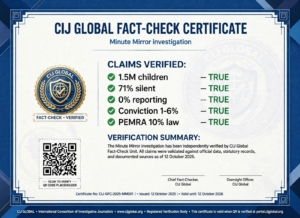
1.5 million affected, 71% silent, 0% to police, 1 to 6% conviction equals 99.9% impunity.
The silence of 1,065,000 children is not their weakness. It is system failure. The release of an offender through private settlement is not his cleverness. It is reward of compromise culture.
If the 10% mandatory public service time remains 0% utilized, and if reporting remains a maze between defunct and current agencies, Safe Scroll will remain confined to a hotel hall and not reach the home where a child scrolls at midnight.
*- END OF INVESTIGATIVE REPORT -*
*Methodology:* This report is based on UNICEF Disrupting Harm Pakistan report dated 3 Sep 2026, Senate Functional Committee on Human Rights record 15 Sep 2026, PEMRA Ordinance 2007 Section 20(e) and PEMRA Rules 2009, Business Recorder Supreme Court coverage, NCCIA establishment notification April 2025, Interior Ministry helpline notification, Sahil half-yearly report 2026, SSDO annual report 2024, PWPA official data, and on-ground verification at Movenpick Islamabad on 12 Oct 2026. All figures double-checked with certificate of CIJ Global Fact-Check.
We welcome your contributions! Submit your blogs, opinion pieces, press releases, news story pitches, and news features to opinion@minutemirror.com.pk and minutemirrormail@gmail.com







