Summary
- Renowned scholars Nain Sukh and Aamir Riaz TuTu explored the historical foundations of Pakistan-Iran relations, shifting regional alliances, energy politics and Pakistan’s diplomatic options amid growing international uncertainty.
- Discussing Pakistan’s strategic importance, the speakers said the country’s geographic location once again positioned it to play a diplomatic role between the United States and Iran.
- An interactive question-and-answer session followed, during which participants engaged the speakers on the conflict’s social, cultural, economic and geopolitical consequences, as well as its implications for Pakistan’s foreign policy.
THAAP’s 65th talk brought together scholars, researchers and participants for an in-depth discussion on the geopolitical, economic and strategic implications of the US-Iran conflict, with particular emphasis on its impact on Pakistan and the rapidly evolving global order.
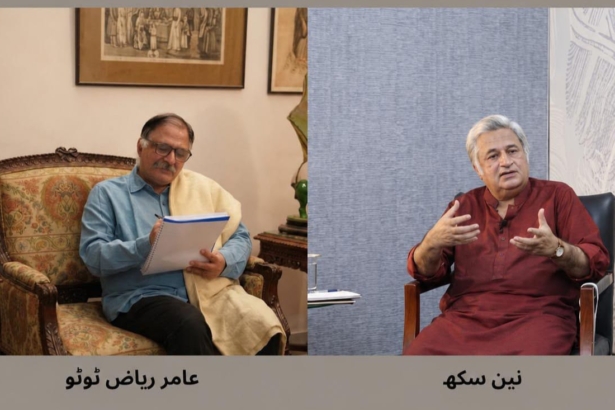
Renowned scholars Nain Sukh and Aamir Riaz TuTu explored the historical foundations of Pakistan-Iran relations, shifting regional alliances, energy politics and Pakistan’s diplomatic options amid growing international uncertainty.
Opening the discussion, Nain Sukh highlighted the centuries-old civilizational, cultural and linguistic links between Pakistan and Iran.
He noted that Persian civilization has profoundly influenced the region, particularly Punjab’s language, folklore and social traditions, underscoring the deep historical connections shared by the two countries.
The speakers observed that Pakistan’s post-independence alignment with the United States shaped many aspects of its political and economic development. They argued that the latest confrontation between Washington and Tehran was the outcome of years of mounting tensions, further intensified by changing regional alliances and strategic rivalries.
Speaking on the economic dimension of the conflict, Aamir Riaz TuTu said that modern wars are primarily driven by economic and strategic interests rather than religious or civilizational differences. He argued that Iran’s growing partnership with China heightened US concerns, contributing to escalating tensions that eventually erupted into conflict. The disruption of regional stability and energy routes, he said, affected global oil and gas supplies, resulting in higher energy prices and inflation across many parts of the world.
Discussing Pakistan’s strategic importance, the speakers said the country’s geographic location once again positioned it to play a diplomatic role between the United States and Iran. However, they stressed that Pakistan should ensure its diplomatic contributions translate into tangible national benefits.
Drawing a historical parallel, Nain Sukh referred to Pakistan’s role in facilitating the secret backchannel diplomacy that paved the way for US-China rapprochement in the early 1970s. According to the speaker, former US Secretary of State Henry Kissinger had reportedly expected Pakistan to seek meaningful strategic or economic concessions in return for its assistance. Instead, Pakistan’s leadership is said to have responded by asking, “What more can we do for you?” The speaker described this as a missed diplomatic opportunity and argued that Pakistan should learn from such experiences by pursuing concrete national interests whenever it undertakes major mediation efforts.
The discussion also focused on the persistent trust deficit between the United States and Iran. The speakers noted that repeated negotiations followed by renewed military actions reflected the fragile nature of relations between the two sides and highlighted the unpredictability of the regional security environment.
An interactive question-and-answer session followed, during which participants engaged the speakers on the conflict’s social, cultural, economic and geopolitical consequences, as well as its implications for Pakistan’s foreign policy.
Concluding the event, host of the evening Prof. Pervaiz Vandal thanked the speakers for their insightful analysis and observed that the US-Iran conflict has accelerated the emergence of new regional alignments and power centres. While predicting the future remains difficult, he emphasized that Pakistan’s greatest strength lies in building robust institutions, strengthening its economy and governance, and developing a foreign policy that safeguards national interests in an increasingly complex world.
We welcome your contributions! Submit your blogs, opinion pieces, press releases, news story pitches, and news features to opinion@minutemirror.com.pk and minutemirrormail@gmail.com