Summary
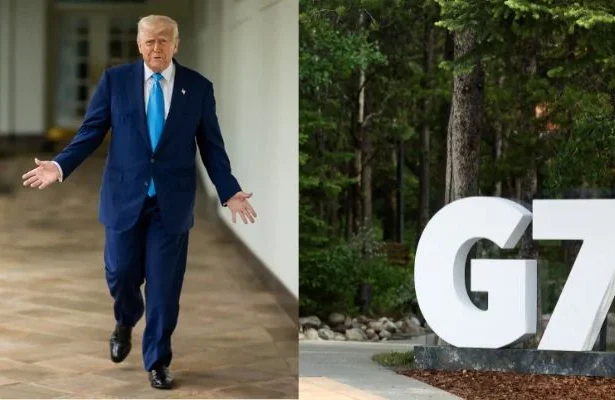
- US President Donald Trump is heading to France for the annual G7 Summit amid uncertainty surrounding a proposed peace agreement with Iran and growing disagreements among world leaders over the regulation of artificial intelligence (AI).
- The Iran issue is expected to dominate discussions among world leaders, particularly because of its implications for regional stability, global energy markets and international security.
- In addition to Iran and AI, G7 leaders will discuss the ongoing Russia-Ukraine war, cybersecurity threats, organised crime, economic cooperation and global security challenges.
US President Donald Trump is heading to France for the annual G7 Summit amid uncertainty surrounding a proposed peace agreement with Iran and growing disagreements among world leaders over the regulation of artificial intelligence (AI).
The three-day summit begins on Monday in the French town of Évian-les-Bains, near the Swiss border. Leaders from the United States, Canada, Britain, France, Germany, Italy and Japan are expected to discuss some of the world’s most pressing political, economic and security challenges.
One of the most closely watched issues at the summit will be the ongoing diplomatic efforts aimed at ending tensions between the United States and Iran. President Trump recently expressed confidence that an agreement could soon be reached to help end the conflict that began earlier this year and pave the way for the reopening of the strategically important Strait of Hormuz.
However, uncertainty remains over the timing and finalisation of the proposed agreement. Iranian officials have been cautious about confirming any deadline, while reports indicate that negotiations are still ongoing. Diplomatic sources suggest that although progress has been made, several key issues still need to be resolved before any formal agreement can be announced.
The Iran issue is expected to dominate discussions among world leaders, particularly because of its implications for regional stability, global energy markets and international security.
Another major topic expected to generate intense debate is artificial intelligence. European countries are pushing for stricter regulations on AI technologies, citing concerns over environmental impact, energy consumption and ethical considerations.
The United States, on the other hand, has largely favoured a more flexible approach, arguing that excessive regulation could hinder innovation and reduce competitiveness in the rapidly expanding technology sector.
Technology leaders are also expected to play a role in the discussions. OpenAI Chief Executive Sam Altman is among the prominent figures expected to participate in conversations about the future of artificial intelligence and its impact on global economies.
Analysts believe differences between the US and European nations could lead to heated exchanges during the summit as governments attempt to balance innovation with oversight and public safety concerns.
In addition to Iran and AI, G7 leaders will discuss the ongoing Russia-Ukraine war, cybersecurity threats, organised crime, economic cooperation and global security challenges.
The summit comes at a time of heightened geopolitical tensions and economic uncertainty, making this year’s gathering one of the most significant in recent years.
Observers say the decisions and discussions held during the summit could have far-reaching consequences for international diplomacy, technology policy and global security in the months ahead.
We welcome your contributions! Submit your blogs, opinion pieces, press releases, news story pitches, and news features to [email protected] and [email protected]