Summary
- NACTA, “Revised National Action Plan 2021”; NACTA, National Prevention of Violent Extremism Policy 2024.
- Government of Pakistan, National Security Division, National Security Policy of Pakistan 2022–2026, Executive Summary and sections on economic and human security.
- NACTA, Revised National Action Plan 2021; UNODC, Roadmap for Afghanistan 2025–2027, sections on terrorism, illicit drugs and weapons trafficking.
A security State is not necessarily a secure State. The first concentrates authority in the name of danger. The second makes law, intelligence, policing, justice and public trust work when danger arrives. Pakistan enlarged its security apparatus during the long “War on Terror”, but the State’s monopoly over violence, institutional capacity and moral authority were steadily contested. The apparatus survived. Security did not.1
Part IX ended with a simple warning: a policy that attacks instruments while preserving incentives manufactures its own obsolescence. The drone replaces the courier; methamphetamine supplements heroin; digital value joins cash and hawala. The same principle governs armed violence. A commander may be killed and a hideout destroyed, but routes, recruiters, financiers, grievances and official protectors can reproduce the threat.
Pakistan’s official and international records strip away any illusion of victory. The National Counter Terrorism Authority (NACTA) says that between 2001 and 2022 the country lost 83,000 lives and more than Rs. 35 trillion. The Global Terrorism Index 2026 places Pakistan, for the first time, as the country most affected by terrorism: 1,139 deaths and 1,045 incidents in 2025, the highest level since 2013. It also identifies Tehreek-e-Taliban Pakistan (TTP) as the fastest-growing terrorist group, with deaths attributed to it rising by 90 per cent.2
These figures do not deny the courage or sacrifice of soldiers, police officers, intelligence personnel and citizens. They expose the burden placed upon them by strategic choices made far above the checkpoint. On July 30, 2026, militants using heavy weapons attacked the Khazina police post in Hangu. Eleven officers were killed; reinforcements were ambushed and an armoured vehicle damaged. The episode reduced the grand vocabulary of security to its human truth: policemen defending a post against a private army created by a regional history they did not write.3
The first institutional casualty was the distinction between force authorised by law and force tolerated for policy. Once an armed non-State actor is treated as useful in one theatre, its organisation, weapons, funding and claim to religious or political legitimacy cannot be confined indefinitely to the assigned battlefield. Alliances change. Sponsors withdraw. Commanders defect. The capacity to coerce remains and searches for a new patron, enemy or revenue stream.
Washington demonstrated the same error on an industrial scale. The final report of the Special Inspector General for Afghanistan Reconstruction records US$148.2 billion appropriated for reconstruction and related activities, including US$88.8 billion for security. After twenty years and about US$90 billion in international support, the Afghan defence and security forces were still not independent or sustainable. They collapsed in August 2021. Hardware, payrolls and favourable statistics had simulated a State whose logistics, legitimacy and decisions remained externally dependent.4
Pakistan inherited the afterlife. A United Nations monitoring report issued in December 2025 estimated TTP strength at about 6,000 fighters across several Afghan provinces and reported continued logistical, operational and financial support from the Taliban. External sanctuary is real and Pakistan is entitled to demand action against it. It is not a complete explanation. A sanctuary becomes most dangerous when weak policing, illicit finance, unresolved grievances and selective enforcement provide entry points on this side of the border.5
The second casualty was institutional coherence. The military sees an operational theatre; intelligence agencies see networks; provincial police see crimes; Counter Terrorism Departments see cells; NACTA sees policy; the Anti-Narcotics Force sees drugs; the Financial Monitoring Unit sees transactions; prosecutors see admissible evidence. The violent network combines all of them. A hierarchy of powerful organisations is not the same as a coordinated State. Information may travel upwards without ever moving sideways into a prosecutable case.
Pakistan’s written policies already diagnose the failure. The Revised National Action Plan 2021 promises that no militant or armed criminal gang will operate. It calls for choking terror finance, curbing narcotics and weapons trafficking, strengthening Counter Terrorism Departments, concluding cases in courts, reforming criminal justice and completing reforms in the merged districts. The National Prevention of Violent Extremism Policy 2024 adds prevention. These are not peripheral tasks. Together they describe the civilian architecture that repeated kinetic campaigns never built.6
The National Security Policy 2022–2026 went further. It called itself citizen-centric, placed economic security at the core and declared the safety, dignity and prosperity of people to be the purpose of national security. That formulation was correct. A hungry child, an uninvestigated disappearance, a school without teachers, a police station without forensic support and a district without representative local government are not separate from security. They are the terrain on which the State earns or loses allegiance.7
The third casualty was constitutional discipline. Emergency methods have a habit of surviving the emergency. When detention escapes prompt judicial scrutiny, surveillance loses legal boundaries or an enforced disappearance replaces arrest and trial, the State may obtain silence but forfeits evidence, accountability and trust. Justice Athar Minallah described enforced disappearances as among the gravest violations of fundamental rights and “no less than a subversion of the Constitution”. A State cannot defend its constitutional order by borrowing the lawlessness of those attacking it.8
Secrecy deepens the damage when it protects failure rather than operations. Parliament and the public hear how many raids occurred, militants were killed or weapons recovered. They rarely receive a traceable account of which financiers were convicted, which assets were finally confiscated, how many prosecutions survived appeal, which officials were punished for protection, and whether a cleared district acquired functioning courts, schools and local government. Without such measures, every operation can be announced as successful until the next attack proves otherwise.
The remedy is not institutional humiliation or indiscriminate disarmament of the State. Pakistan needs capable armed forces, intelligence services and police. It also needs a constitutional chain in which elected authority sets policy, Parliament examines results, courts protect legality and civilian institutions convert intelligence into durable justice. Operational secrecy can be preserved while strategy, expenditure and outcomes are independently audited.
Police and Counter Terrorism Departments must receive reliable funding, forensic laboratories, witness protection, protected communications and prosecutors trained from the beginning of an investigation. Every major terrorism case should include parallel inquiries into weapons, narcotics, digital evidence and finance. Success should be measured by disrupted recruitment, convictions sustained after appeal, assets lawfully confiscated, victims rehabilitated and normal civil administration restored—not by body counts alone.
Pakistan must press Kabul against TTP sanctuaries and protect its border, but external action cannot substitute for internal repair. The State must apply one law to every armed organisation, abandon the fantasy of manageable militancy and refuse collective punishment of border communities. Development without justice looks like purchase; force without political inclusion looks like occupation. Both feed the narrative of the recruiter.
After twenty-five years, the security State stands among the casualties of the “War on Terror” because it absorbed the war’s methods: secrecy without learning, force without institutional reform and alliances without accountability. Uncle Sam departed from Afghanistan. Pakistan remained with the weapons, debts, displaced populations, emboldened militants and a governing structure trained to manage emergencies rather than end them.
The concluding Part XI will ask the final and unavoidable question: who won the “War on Terror”?9
Endnotes
- Ikramul Haq, Pakistan: From Hash to Heroin(Lahore: Annoor Printers and Publishers, 1991), chapters 4 and 12; Ikramul Haq, Pakistan: From Drug-trap to Debt-trap, edited by Huzaima Bukhari (Lahore: Lahore Law Publications, 2003), Preface, pp. xiii–xiv, and Epilogue, pp. 262–264.
- NACTA, “Pakistan’s National Narrative against Terrorism and Extremism”; Institute for Economics and Peace, Global Terrorism Index 2026, Pakistan profile and principal findings.
- Associated Press, “Raid on a Pakistani police post leaves 11 officers and 15 attackers dead”, July 30, 2026; see also the report cited at the beginning of this series, Al Jazeera, “Attack on northwest Pakistan police post kills 11 officers”, July 30, 2026.
- Special Inspector General for Afghanistan Reconstruction, Final Report: Seventeen Years of Reconstruction Oversight, December 2025, pp. 12–14 and 81–90; SIGAR, Why the Afghan Security Forces Collapsed, February 2023.
- United Nations Security Council, Analytical Support and Sanctions Monitoring Team, Thirty-seventh report concerning ISIL (Da’esh), Al-Qaida and associated individuals and entities, S/2025/796, December 8, 2025, paras. 88–89.
- NACTA, “Revised National Action Plan 2021”; NACTA, National Prevention of Violent Extremism Policy 2024.
- Government of Pakistan, National Security Division, National Security Policy of Pakistan 2022–2026, Executive Summary and sections on economic and human security.
- Constitution of the Islamic Republic of Pakistan, Articles 4, 9, 10A, 14 and 19A, in the National Assembly’s official text; Justice Athar Minallah’s reasons in Suo Motu Case No. 1 of 2023, para. 14.
- NACTA, Revised National Action Plan 2021; UNODC, Roadmap for Afghanistan 2025–2027, sections on terrorism, illicit drugs and weapons trafficking.
[To be continued]
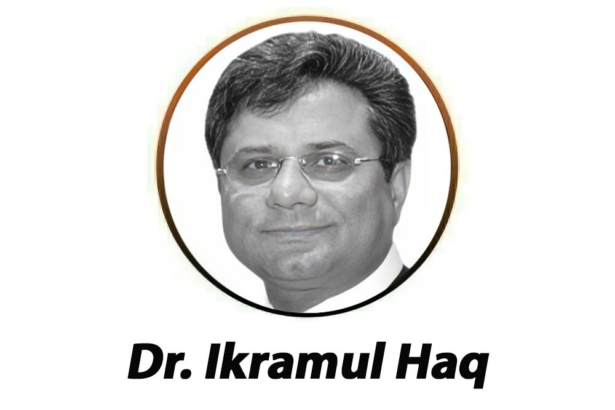
Dr. Ikramul Haq, Advocate Supreme Court, Adjunct Faculty at Lahore University of Management Sciences (LUMS), member Advisory Board and Visiting Senior Fellow of Pakistan Institute of Development Economics (PIDE), holds an LLD in tax laws. He was full-time journalist from 1979 to 1984 with Viewpoint and Dawn. He also served Civil Services of Pakistan from 1984 to 1996.
We welcome your contributions! Submit your blogs, opinion pieces, press releases, news story pitches, and news features to opinion@minutemirror.com.pk and minutemirrormail@gmail.com