Summary
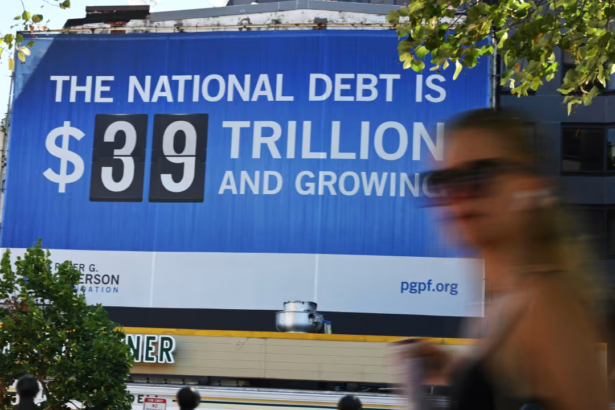
- The United States national debt has climbed past 40 trillion dollars during the first nineteen months of President Donald Trump’s second term, a striking contrast to his pledges to shrink the federal government, end costly overseas conflicts and use economic growth to bring down deficits.
- According to the Committee for a Responsible Federal Budget, his first term tax cuts added roughly 8.4 trillion dollars to the national debt, while his second term tax and immigration legislation added an additional 4.7 trillion dollars, based on estimates from the nonpartisan Congressional Budget Office.
- Conservative economic thinking has long held that lower tax rates paired with reduced government oversight encourage investment and growth, which in turn generates additional tax revenue and eases the burden of both antipoverty programs and the national debt, an argument Trump has continued to repeat.
The United States national debt has climbed past 40 trillion dollars during the first nineteen months of President Donald Trump’s second term, a striking contrast to his pledges to shrink the federal government, end costly overseas conflicts and use economic growth to bring down deficits.
Instead of shrinking, federal spending has continued to grow. The war involving Iran, now roughly six months old, has settled into a costly stalemate with no clear resolution in sight. At the same time, the cost of servicing existing government debt has risen sharply as yields on certain US Treasury bonds have reached their highest levels in nearly twenty years.
Budget analysts warn the combination points toward a looming fiscal crunch that will eventually force Congress and future presidents to make politically painful choices, either raising taxes or scaling back major social programs, potentially including Social Security. Maya MacGuineas, president of the Committee for a Responsible Federal Budget, a centrist think tank based in Washington, said no honest assessment of Trump’s record across both terms could describe it as a fiscal success. She said responsibility for the underlying trajectory extends well beyond the president alone, but that his administration has played a central role in shaping the policy agenda that led to the current situation.
The debt crossed the 40 trillion dollar mark just weeks ahead of the November midterm elections, which will determine whether Republicans retain control of Congress for the remainder of Trump’s term. Analysts note that many voters may not directly connect the debt figure to their daily lives until fiscal strain translates into benefit cuts or higher taxes, though the effects are already being felt through elevated mortgage rates tied to government bond yields and inflation that continues to outpace wage growth for many households.
Trump has overseen substantial increases in federal debt across both of his terms in office. According to the Committee for a Responsible Federal Budget, his first term tax cuts added roughly 8.4 trillion dollars to the national debt, while his second term tax and immigration legislation added an additional 4.7 trillion dollars, based on estimates from the nonpartisan Congressional Budget Office. White House spokesman Kush Desai defended the administration’s record, describing Trump as the first president to seriously confront widespread waste and inefficiency across the federal government, citing workforce reductions and the elimination of certain programs deemed wasteful. Trump and congressional Republicans did manage to reduce the annual deficit slightly in 2025, though the overall debt continued climbing regardless.
Responsibility for the country’s long term debt trajectory spans both political parties. Tax cuts enacted under Republican presidents Ronald Reagan and George W. Bush widened deficits significantly, as did the wars launched during the Bush administration. Democratic presidents Barack Obama and Joe Biden similarly increased spending through large stimulus measures following the 2008 financial crisis and the COVID nineteen pandemic. President Bill Clinton stands out as an exception, having posted modest budget surpluses during his second term amid strong economic growth and bipartisan entitlement reforms negotiated with a Republican controlled Congress.
Demographic pressures have added further strain to federal finances. As the generation born after World War Two continues to retire in large numbers, the trust funds supporting Social Security and Medicare are steadily depleting, with payroll tax revenue falling short of what will be needed to cover future benefit obligations. While earlier generations of Republican leaders often called for major entitlement reform, Trump has instead pushed his party away from that traditional position, introducing new safety net style initiatives such as government backed investment accounts for newborn children.
His administration has also shifted the broader structure of federal revenue, raising tariffs while cutting corporate tax rates, a combination that has moved more of the tax burden toward workers and households and away from businesses and investors. According to congressional budget officials, this approach has made government revenue increasingly reliant on a form of taxation that represents a shrinking share of overall economic output, while also shifting more of the tax burden toward low and middle income households rather than the highest earners. Romina Boccia, director of budget and entitlement policy at the conservative Cato Institute, said many Republicans have grown increasingly comfortable pursuing alternative revenue raising methods specifically to avoid politically difficult entitlement reforms.
Conservative economic thinking has long held that lower tax rates paired with reduced government oversight encourage investment and growth, which in turn generates additional tax revenue and eases the burden of both antipoverty programs and the national debt, an argument Trump has continued to repeat. Speaking en route to a political rally in late August, Trump said growth alone would resolve the debt problem easily, and during remarks from the Oval Office earlier this week he suggested his policies could push annual economic growth as high as 20 percent, a level achieved only once since 1947, during the sharp economic rebound following the end of COVID related shutdowns in 2020.
That optimistic outlook stood in contrast to comments from Federal Reserve Chair Kevin Warsh, who told finance ministers at a G20 meeting in North Carolina this week that record levels of investment flowing into artificial intelligence and major technology firms point to a shortage of available capital. Warsh said the resulting competition for investment dollars among governments and leading technology companies is pushing interest rates higher and worsening the government’s own financing challenges.
During his campaign, Trump promised that tax cuts would be paired with major spending reductions, and he later appointed Elon Musk to lead the now defunct Department of Government Efficiency. Musk had pledged to cut two trillion dollars from the federal budget, but the initiative ultimately reported savings of only 110 billion dollars, a figure the Government Accountability Office said relied on claims that were either overstated or could not be independently verified. The White House did not respond to a request for comment regarding those findings. MacGuineas noted that tax cuts are not inherently problematic on their own, but said they need to be paired with corresponding spending reductions, something that has not happened under the current administration.
Some current and former administration officials argue the White House deserves more credit for economic progress and efforts to ease consumer prices, changes they say will ultimately strengthen the country’s fiscal position. William Emmons, a former vice president at the Federal Reserve Bank of St. Louis, offered a more critical assessment, saying Trump inherited an already difficult fiscal environment dating back to his first term in 2016 and that his policies since then have made an already challenging situation considerably worse.
We welcome your contributions! Submit your blogs, opinion pieces, press releases, news story pitches, and news features to opinion@minutemirror.com.pk and minutemirrormail@gmail.com