
Summary
- On social media, Azad Jammu and Kashmir has been portrayed as if it is some no-go area, as if it is equivalent to Occupied Kashmir across the Line of Control, where every right of Kashmiris has been denied and there is no freedom of movement and speech.
- As soon as I entered the border of Azad Jammu and Kashmir, my mobile data stopped working – a small technical glitch that in Indian Occupied Kashmir has been reported as a months-long blackout.
- On social media, Azad Jammu and Kashmir has been portrayed as if it is some no-go area, as if it is equivalent to Occupied Kashmir across the Line of Control, where every right of Kashmiris has been denied and there is no freedom of movement and speech.
A Mother’s Decision to Travel
As a single parent, every journey out of Karachi is a decision. You think twice about your child’s safety, about whether the place you are going is worth the distance. When I decided to travel from Karachi to Azad Jammu and Kashmir, many colleagues asked me, “Why? It’s a sensitive area, it’s not safe for a woman journalist alone.”
My daughter, Bibi Marium, has Down syndrome, but she has never been an exception to my journalistic journey. She has been a part of my assignments across Pakistan, from Karachi Press Club to interior Sindh and Punjab. She travels with me, she learns with me.
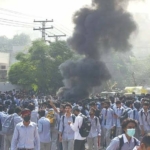
However, this time my concern as a mother was different. Since the 7th of June, protests had erupted in Azad Jammu and Kashmir. These have been primarily organised by the Jammu Kashmir Joint Awami Action Committee (JKJAAC) (which the Pakistani government banned on 5th June under the Anti-Terrorism Act). They first presented 7-point agenda, then 12-points agenda and finally 38-point charter to the Government of Azad Kashmir with demands such as a decrease in electricity costs and subsidised food prices. Most of their demands were accepted and some were under negotiation when the JKJAAC resorted to violence.
On social media, Azad Jammu and Kashmir has been portrayed as if it is some no-go area, as if it is equivalent to Occupied Kashmir across the Line of Control, where every right of Kashmiris has been denied and there is no freedom of movement and speech.
I wanted to see for myself – is Azad Kashmir really like that? Is there really no freedom here? Is it unsafe for a female journalist?
Road In
The road from Islamabad to Muzaffarabad gave me the first answer. I travelled all the way from Karachi to Kashmir not for a press release, but to see the truth with my own eyes – the truth which our mainstream and social media often fails to portray.
I came with the same perception that many in Sindh have – that Kashmir is only about LoC firing, tension and no-go areas. What I found was completely different.
As soon as I entered the border of Azad Jammu and Kashmir, my mobile data stopped working – a small technical glitch that in Indian Occupied Kashmir has been reported as a months-long blackout. But here, life was completely as usual.
The bazaars and markets had the usual hustle of the day. Youngsters were riding bikes, and I even saw EVs on the road. Right alongside my rented vehicle, a Medical College bus full of young female doctors was travelling – confident, laughing, coming from their college.
And I did not witness a single policeman on every nook and corner – which is a usual scene in Karachi. There were no checkposts, no frisking, no fear on faces. The absence of heavy police presence itself was a sign of peace. People were just living their routine life with dignity.
This was my first contrast – no internet for a few minutes, but complete freedom of movement on the ground.
The Moment Narrative Broke
After checking into my hotel, where Wi-Fi facility was easily available, I started chatting with the locals just to know the ground reality. They thought I was just a visitor from Karachi.
There was no complaint, no frowning. Shopkeepers, a hotel receptionist, a mother with her children – everyone was talking about routine things – inflation, children’s school admissions, marriage of a relative. No one was scared. And that is when I started thinking, how could mainstream media, especially social media, be so hugely misguiding about Azad Kashmir?
Before entering Central Muzaffarabad Press Club, I went to pay my Salam at Sayeen Saheli Sarkar, which was adjacent to the Press Club. Many women devotees there thought I was a foreigner. I smiled and told them, “No, I am from Karachi and I am a journalist.” I said it just to see their reaction.
And the reaction was unexpected. Had there been any unrest, had their rights been denied, they would have approached me with complaints – because I was all alone, a woman like them, a mother. But they didn’t. Instead, they welcomed me, they made dua for my daughter Bibi Marium, and one of them said, “Tussa sade mehman hou! (You are our guest!)”
That one sentence broke the entire false narrative I had carried from social media.
What Local Journalists Say
My observations were endorsed by senior journalists of press club.
Saeed-ur-Rehman, President, Union of Journalists AJK, who has 21 years of experience working with national dailies like Khabrain, Siasat and others, said:
“Press in AJK is as free as in any other part of Pakistan. In fact, we have never sought any approval from any authority to report from the LoC. The temporary net disconnection is owing to the flood of fake news which creates hurdles in true and honest reporting. That will also be restored in a couple of weeks.”
Negating the idea of limiting foreign correspondents, Sajjad Ahmed, who reports for a foreign media outlet from Muzaffarabad, said:
“I have been reporting for last many years and I have never received any advisory from any state platform on what to report and what not to report. All foreign media outlet representatives here are locals. How can they stop any local or restrict anyone from the city?”
As a journalist from Karachi, this was important for me. When a local correspondent says he faces no advisory, it shatters the propaganda that Azad Kashmir is a restricted zone like Indian Occupied Kashmir.
The Difference Explained: Azad vs Occupied
Veteran and seasoned journalist Ansar Khawaja, who has served in all big dailies of Lahore including Nawai Waqt, Din, Mashriq and many others, and is now associated with Jahan Pakistan Kashmir, summed up the entire difference for me. Khawaja said:
“Madam, you have every liberty to roam and report. You will not find a single person here who has any sentiment against Pakistan. We have our own Parliament, our own Prime Minister, our own independent Constitution, our own flag. In no way can one compare AJK with Indian Occupied Kashmir, where all human rights are suspended. That Kashmir is part of the Indian Union. There is a complete blackout of news in Occupied Kashmir. After the abrogation of Article 370, any Indian can buy land there. But not in AJK. Here, only a state subject can buy land.”
For me, a journalist who has come all the way from Karachi with her daughter, that legal and moral distinction was the story.
One side is Azad in its true spirit – with its own flag, assembly and courts. The other side is occupied, where even buying land by locals has become a question.
Who Hijacked a Genuine Movement?
On the recent situation, a senior official said:
“The JKJAAC was started organically by civil society and traders against poor governance and corruption. The government negotiated and accepted most demands. Later, anti-Pakistan elements hijacked and sponsored it, which worsened the situation.”
He added:
“No one can question the loyalty of Kashmiris towards Pakistan. Today people themselves realize the Committee has damaged them socially and economically. Tourism – their main income from May to November – suffered losses worth billions. Investors lost billions.”
This version matched what I gathered independently from two respected locals.
Sardar Zulfiqar, Vice Chairman, Azad Jammu and Kashmir Press Foundation, who himself belongs to the area of Poonch, where protestors are present, said:
“In the beginning, no doubt we were supporting JKJAAC. But when they were sponsored and supported by anti-Pakistan elements, their graph went down. Now to show their strength, they have resorted to violence and compulsion. They are using women and children as their shield.”
A shopkeeper’s loss, A Father’s Hope
Farrukh Azad Khan, owner of Apna Kitchen Hotel at Kamsara Challa Bandi, Muzaffarabad, and himself a former supporter of the Committee, said:
“I was the supporter of the committee, but when they misused the movement to weaken our own state, I disassociated myself from them. Before June, my daily income was more than Rs. 1.75 lakh, and now it has come down to only a few thousand. I have to pay rent, wages of workers, utility bills and the cost of raw material. It has become difficult to run business when our tourism industry is totally devastated.”
Still, he smiled and said with hope:
“InshaAllah, things will get better. Beta kitna bhi bara ho jaye, baap se bara nahi ho sakta – and Pakistan is our parent. I know we will be taken good care of.”
This was not an official speaking. This was a businessman counting his daily losses, yet standing firm with Pakistan.
Shopping at 8:30 PM in Madina Market
I also went to Madina Market for shopping. Though there were no tourists, even at 8:30 pm one could find local women at shops – jewellery, cosmetics, everyday household items. I bought a few gift items for my and Bibi Marium’s friends. I was totally surprised at their level of courtesy and respect for Karachiites. But more enduring was their calmness, which showed nothing of the disturbance or unrest as depicted in some news reports and features.
During shopping, I could not stop myself from asking how business was going. Baba Jee cheerfully said, “Beta Jee, do mahine tou dukan hi band rakhni pari, par ab halaat theek hain. Bus ab waisay tourist nahi atay.” [Son, we had to keep the shop closed for two months, but now the situation is fine. It’s just that tourists are not coming like before.]
Epilogue: Beyond Sensation
One cannot deny the fact that unavailability of net connection may hinder some part of life but there are many countries which allow limited internet connection, yet who has stopped their progress? They are still progressing. On the other hand, the newly installed government has assured to restore full internet as soon as anti-state elements are taken care of. No one can also rule out the fact that Rawalakot city is not not as stable as Muzaffarabad but that’s the only point where little unrest is reported, again the point is, the state is pushing all its limits to show restraint towards the people of the state, otherwise a major operation would have cleared all the area. People have died but the damage was on both sides, security personnel have also laid down their lives. We speak only the truth which suits us. Let the truth and sense prevail.
There is so much to write about a land I had never visited before. As a feature writer focused on pure human issues, I was surprised myself – AJK is a living portrait of independence, affiliated with Pakistan by choice, yet it is being painted so dark. I decided to find out the truth myself, a truth no one in Sindh cares to know.
As a news writer and journalist myself, I know how media works. It is interested in creating sensation that sells as breaking news, not in writing stories that create harmony and have a soothing effect.
But I will cover that in my next feature – revealing who benefits more from such negative portrayal, what is the volume of Kashmir’s tourism industry which is now hostage to this situation, how community policing has made a massive impact, and how LEAs are working together to uplift the lives of people living in border areas and to bring youth into the national mainstream.
Meet the author:
The writer is a senior journalist and columnist covering crime, law, social issues, governance, energy, health, literature, and women and children’s rights across Pakistan’s leading English media houses.
Feedback: mediawomen2014@gmail.com
By Humaira Motala
A Mother’s Decision to Travel
As a single parent, every journey out of Karachi is a decision. You think twice about your child’s safety, about whether the place you are going is worth the distance. When I decided to travel from Karachi to Azad Jammu and Kashmir, many colleagues asked me, “Why? It’s a sensitive area, it’s not safe for a woman journalist alone.”
My daughter, Bibi Marium, has Down syndrome, but she has never been an exception to my journalistic journey. She has been a part of my assignments across Pakistan, from Karachi Press Club to interior Sindh and Punjab. She travels with me, she learns with me.
However, this time my concern as a mother was different. Since the 7th of June, protests had erupted in Azad Jammu and Kashmir. These have been primarily organised by the Jammu Kashmir Joint Awami Action Committee (JKJAAC) (which the Pakistani government banned on 5th June under the Anti-Terrorism Act). They first presented 7-point agenda, then 12-points agenda and finally 38-point charter to the Government of Azad Kashmir with demands such as a decrease in electricity costs and subsidised food prices. Most of their demands were accepted and some were under negotiation when the JKJAAC resorted to violence.
On social media, Azad Jammu and Kashmir has been portrayed as if it is some no-go area, as if it is equivalent to Occupied Kashmir across the Line of Control, where every right of Kashmiris has been denied and there is no freedom of movement and speech.
I wanted to see for myself – is Azad Kashmir really like that? Is there really no freedom here? Is it unsafe for a female journalist?
Road In
The road from Islamabad to Muzaffarabad gave me the first answer. I travelled all the way from Karachi to Kashmir not for a press release, but to see the truth with my own eyes – the truth which our mainstream and social media often fails to portray.
I came with the same perception that many in Sindh have – that Kashmir is only about LoC firing, tension and no-go areas. What I found was completely different.
As soon as I entered the border of Azad Jammu and Kashmir, my mobile data stopped working – a small technical glitch that in Indian Occupied Kashmir has been reported as a months-long blackout. But here, life was completely as usual.
The bazaars and markets had the usual hustle of the day. Youngsters were riding bikes, and I even saw EVs on the road. Right alongside my rented vehicle, a Medical College bus full of young female doctors was travelling – confident, laughing, coming from their college.
And I did not witness a single policeman on every nook and corner – which is a usual scene in Karachi. There were no checkposts, no frisking, no fear on faces. The absence of heavy police presence itself was a sign of peace. People were just living their routine life with dignity.
This was my first contrast – no internet for a few minutes, but complete freedom of movement on the ground.
The Moment Narrative Broke
After checking into my hotel, where Wi-Fi facility was easily available, I started chatting with the locals just to know the ground reality. They thought I was just a visitor from Karachi.
There was no complaint, no frowning. Shopkeepers, a hotel receptionist, a mother with her children – everyone was talking about routine things – inflation, children’s school admissions, marriage of a relative. No one was scared. And that is when I started thinking, how could mainstream media, especially social media, be so hugely misguiding about Azad Kashmir?
Before entering Central Muzaffarabad Press Club, I went to pay my Salam at Sayeen Saheli Sarkar, which was adjacent to the Press Club. Many women devotees there thought I was a foreigner. I smiled and told them, “No, I am from Karachi and I am a journalist.” I said it just to see their reaction.
And the reaction was unexpected. Had there been any unrest, had their rights been denied, they would have approached me with complaints – because I was all alone, a woman like them, a mother. But they didn’t. Instead, they welcomed me, they made dua for my daughter Bibi Marium, and one of them said, “Tussa sade mehman hou! (You are our guest!)”
That one sentence broke the entire false narrative I had carried from social media.
What Local Journalists Say
My observations were endorsed by senior journalists of press club.
Saeed-ur-Rehman, President, Union of Journalists AJK, who has 21 years of experience working with national dailies like Khabrain, Siasat and others, said:
“Press in AJK is as free as in any other part of Pakistan. In fact, we have never sought any approval from any authority to report from the LoC. The temporary net disconnection is owing to the flood of fake news which creates hurdles in true and honest reporting. That will also be restored in a couple of weeks.”
Negating the idea of limiting foreign correspondents, Sajjad Ahmed, who reports for a foreign media outlet from Muzaffarabad, said:
“I have been reporting for last many years and I have never received any advisory from any state platform on what to report and what not to report. All foreign media outlet representatives here are locals. How can they stop any local or restrict anyone from the city?”
As a journalist from Karachi, this was important for me. When a local correspondent says he faces no advisory, it shatters the propaganda that Azad Kashmir is a restricted zone like Indian Occupied Kashmir.
The Difference Explained: Azad vs Occupied
Veteran and seasoned journalist Ansar Khawaja, who has served in all big dailies of Lahore including Nawai Waqt, Din, Mashriq and many others, and is now associated with Jahan Pakistan Kashmir, summed up the entire difference for me. Khawaja said:
“Madam, you have every liberty to roam and report. You will not find a single person here who has any sentiment against Pakistan. We have our own Parliament, our own Prime Minister, our own independent Constitution, our own flag. In no way can one compare AJK with Indian Occupied Kashmir, where all human rights are suspended. That Kashmir is part of the Indian Union. There is a complete blackout of news in Occupied Kashmir. After the abrogation of Article 370, any Indian can buy land there. But not in AJK. Here, only a state subject can buy land.”
For me, a journalist who has come all the way from Karachi with her daughter, that legal and moral distinction was the story.
One side is Azad in its true spirit – with its own flag, assembly and courts. The other side is occupied, where even buying land by locals has become a question.
Who Hijacked a Genuine Movement?
On the recent situation, a senior official said:
“The JKJAAC was started organically by civil society and traders against poor governance and corruption. The government negotiated and accepted most demands. Later, anti-Pakistan elements hijacked and sponsored it, which worsened the situation.”
He added:
“No one can question the loyalty of Kashmiris towards Pakistan. Today people themselves realize the Committee has damaged them socially and economically. Tourism – their main income from May to November – suffered losses worth billions. Investors lost billions.”
This version matched what I gathered independently from two respected locals.
Sardar Zulfiqar, Vice Chairman, Azad Jammu and Kashmir Press Foundation, who himself belongs to the area of Poonch, where protestors are present, said:
“In the beginning, no doubt we were supporting JKJAAC. But when they were sponsored and supported by anti-Pakistan elements, their graph went down. Now to show their strength, they have resorted to violence and compulsion. They are using women and children as their shield.”
A shopkeeper’s loss, A Father’s Hope
Farrukh Azad Khan, owner of Apna Kitchen Hotel at Kamsara Challa Bandi, Muzaffarabad, and himself a former supporter of the Committee, said:
“I was the supporter of the committee, but when they misused the movement to weaken our own state, I disassociated myself from them. Before June, my daily income was more than Rs. 1.75 lakh, and now it has come down to only a few thousand. I have to pay rent, wages of workers, utility bills and the cost of raw material. It has become difficult to run business when our tourism industry is totally devastated.”
Still, he smiled and said with hope:
“InshaAllah, things will get better. Beta kitna bhi bara ho jaye, baap se bara nahi ho sakta – and Pakistan is our parent. I know we will be taken good care of.”
This was not an official speaking. This was a businessman counting his daily losses, yet standing firm with Pakistan.
Shopping at 8:30 PM in Madina Market
I also went to Madina Market for shopping. Though there were no tourists, even at 8:30 pm one could find local women at shops – jewellery, cosmetics, everyday household items. I bought a few gift items for my and Bibi Marium’s friends. I was totally surprised at their level of courtesy and respect for Karachiites. But more enduring was their calmness, which showed nothing of the disturbance or unrest as depicted in some news reports and features.
During shopping, I could not stop myself from asking how business was going. Baba Jee cheerfully said, “Beta Jee, do mahine tou dukan hi band rakhni pari, par ab halaat theek hain. Bus ab waisay tourist nahi atay.” [Son, we had to keep the shop closed for two months, but now the situation is fine. It’s just that tourists are not coming like before.]
Epilogue: Beyond Sensation
One cannot deny the fact that unavailability of net connection may hinder some part of life but there are many countries which allow limited internet connection, yet who has stopped their progress? They are still progressing. On the other hand, the newly installed government has assured to restore full internet as soon as anti-state elements are taken care of. No one can also rule out the fact that Rawalakot city is not not as stable as Muzaffarabad but that’s the only point where little unrest is reported, again the point is, the state is pushing all its limits to show restraint towards the people of the state, otherwise a major operation would have cleared all the area. People have died but the damage was on both sides, security personnel have also laid down their lives. We speak only the truth which suits us. Let the truth and sense prevail.
There is so much to write about a land I had never visited before. As a feature writer focused on pure human issues, I was surprised myself – AJK is a living portrait of independence, affiliated with Pakistan by choice, yet it is being painted so dark. I decided to find out the truth myself, a truth no one in Sindh cares to know.
As a news writer and journalist myself, I know how media works. It is interested in creating sensation that sells as breaking news, not in writing stories that create harmony and have a soothing effect.
But I will cover that in my next feature – revealing who benefits more from such negative portrayal, what is the volume of Kashmir’s tourism industry which is now hostage to this situation, how community policing has made a massive impact, and how LEAs are working together to uplift the lives of people living in border areas and to bring youth into the national mainstream.
We welcome your contributions! Submit your blogs, opinion pieces, press releases, news story pitches, and news features to opinion@minutemirror.com.pk and minutemirrormail@gmail.com