Summary
- We began with definition, moved to creation of money, separated transaction deposits from investment capital, examined productive finance based on ownership and genuine risk, and then placed Bait-ul-Mal, waqf, zakat and qard hasan within a wider system of social protection.
- Pakistan is attempting to transform the legal foundations of banking, public debt, monetary operations, investment, insurance, pensions and social finance while preserving financial stability.
- A just financial order requires something larger: money accountable to society, investment connected with productive activity and genuine risk, communities capable of financing themselves, and public institutions ensuring that basic human need never becomes an opportunity for exploitation.
The preceding five parts of this series have argued that elimination of riba cannot be achieved by changing the vocabulary of finance. We began with definition, moved to creation of money, separated transaction deposits from investment capital, examined productive finance based on ownership and genuine risk, and then placed Bait-ul-Mal, waqf, zakat and qard hasan within a wider system of social protection.
The final question is no longer conceptual. It is legislative. Pakistan now has a date. The Constitution (Twenty-sixth Amendment) Act, 2024 substituted Article 38(f) with the direction to “eliminate riba completely before the first day of January, two thousand twenty-eight”. The constitutional deadline reinforces the Federal Shariat Court’s 2022 judgment in the Riba cases, reported as PLD 2023 FSC 47. The problem is that a deadline does not itself create a new financial order.
The Finance Division’s Post-2027 Financial System in Pakistan contains useful work on Sukuk, liquidity facilities, legislation, safety nets, technology and capacity building. It nevertheless remains a strategy, not a Prohibition of Riba law.
More importantly, some of its transitional assumptions sit uneasily with the word “completely”. Majority foreign-owned institutions may decide voluntarily whether to convert; conventional obligations contracted before the deadline may continue according to their terms until maturity; and fresh foreign financing is contemplated through Shariah-compliant modes subject to availability of reasonable options.
These concerns are understandable from the perspective of financial stability. They cannot become permanent legal exceptions. Pakistan therefore needs an umbrella Prohibition of Riba Act, enacted well before the constitutional cut-off, accompanied by consequential federal and provincial amendments [Who will draft Riba Prohibition Law? Minute Mirror, April 7, 2026]. Its first task must be the one identified in Part I: define what is prohibited.
The law should distinguish a loan or debt carrying a stipulated increase because of time from lawful consideration arising from genuine sale, lease, service, partnership or productive risk. Courts and regulators should be empowered to examine connected contracts as one economic arrangement. A murabaha, ijarah, musharakah or Sukuk should not become immune from scrutiny merely because recognised Islamic terminology appears in its documents.
The second requirement is a clear cut-off rule. No bank, financial institution, government agency or other regulated person should be permitted to originate a new interest-bearing financial contract in Pakistan after December 31, 2027. The prohibition must be activity-based, not ownership-based.
A transaction cannot change its constitutional character because shareholders of the institution happen to be foreign. This is also the weakness we identified earlier in examining the Government’s strategy paper.
Existing liabilities require different treatment. Pakistan cannot simply repudiate sovereign bonds, multilateral obligations or private contracts. That would replace one problem with default, litigation and financial isolation.
The law should instead require a complete register of every conventional obligation extending beyond the cut-off: principal, return, maturity, governing law, creditor, refinancing possibility and proposed conversion date. Contracts capable of consensual refinancing should be converted. Those that cannot immediately be altered should continue only under a transparent transitional schedule with definite sunset dates, rather than receiving an indefinite exemption merely because they were signed before 2028.
The third issue concerns money itself. Part II argued that commercial-bank money creation is not automatically riba. The power to create purchasing power through credit is nevertheless too important to remain outside reform.
Parliament should require a time-bound examination of sovereign transaction money, reserve arrangements and separation of monetary creation from productive financial intermediation. This question should be decided upon economic evidence and institutional consequences, not theological assertion.
Part III then demonstrated why payment accounts and investment accounts require legal separation. Money held for immediate payment and nominal safety should not be treated as risk capital. Funds deliberately invested for commercial return should carry transparent exposure to the enterprises and assets from which that return arises. Deposit protection against institutional failure must similarly be distinguished from a State guarantee against every commercial investment loss.
The fourth area is productive finance. The law should protect genuine murabaha, ijarah, salam, istisna, musharakah, mudarabah and other permissible arrangements while prescribing minimum standards of ownership, possession, disclosure and risk. Shariah audit should examine economic substance rather than merely documentation.
Taxation must also become neutral. Equity participation, leasing and genuine asset transactions should not suffer additional fiscal costs merely because legislation was historically designed around conventional debt. Public finance cannot remain outside this discipline.
Government should not treat Sukuk merely as a technique for reproducing conventional borrowing against whatever public assets can be placed in a registry. The official strategy itself proposes an Assets Registry Company and expanded hybrid Sukuk issuance. Sovereign instruments must confer genuine economic rights and corresponding responsibilities rather than provide documentary assets solely to support a predetermined financial return.
Fiscal reform is inseparable from elimination of riba. No monetary arrangement can remain sound where governments continuously borrow merely to finance structural deficits.
Monetary policy requires the same intellectual honesty. The Government’s strategy envisages Shariah-compliant open-market operations, standing facilities and liquidity arrangements. These are necessary developments, but changing contractual forms will not be enough if their sole objective becomes mechanical reproduction of the existing interest-rate corridor.
SBP ultimately needs a transparent post-riba monetary framework explaining liquidity creation and absorption, lender-of-last-resort assistance, foreign-exchange operations and monetary transmission. The fifth element takes us beyond banking altogether.
Part V argued that riba flourishes not only because creditors seek gain but also because human beings are compelled by need. A successful transition must therefore strengthen Bait-ul-Mal, professionally governed public waqf lillah, independently administered zakat and revolving qard hasan funds. Essential healthcare, education, disability support and subsistence during genuine incapacity should never become markets for financial extraction.
Local cooperative institutions should provide the bridge from protection to participation. The lesson drawn from Rabobank was not that Pakistan should import a Dutch banking model. It was that communities can mobilise their resources and build productive institutions from below.
Properly regulated cooperatives can gradually shift economic power away from patrons and concentrated financial interests towards citizens themselves.
Governance is consequently as important as Shariah nomenclature. Pakistan requires consistency across banking, securities, takaful, pensions and public finance. A national Shariah authority may provide that consistency, but its standards and decisions must be published, reasoned and subject to independent audit and legal scrutiny. No closed clerical, governmental or banking group should possess unaccountable authority to declare its own financial products compliant.
The Finance Division says the amendments so far identified in banking laws are “minor in nature”. That description understates the task. Pakistan is attempting to transform the legal foundations of banking, public debt, monetary operations, investment, insurance, pensions and social finance while preserving financial stability. This requires coordinated primary legislation, not scattered amendments drafted independently by regulators. The transition should therefore be phased, but the prohibition cannot be optional.
Gradualism concerns the method. January 1, 2028 concerns the destination. This series began by asking what riba means. It ends by asking what kind of society its elimination should produce.
If Pakistan reaches 2028 with the same concentration of economic power, the same dependence upon sovereign debt, the same citizens forced to borrow for survival and the same guaranteed returns merely wrapped in new contracts, the constitutional promise will have been honoured in form and defeated in substance.
A just financial order requires something larger: money accountable to society, investment connected with productive activity and genuine risk, communities capable of financing themselves, and public institutions ensuring that basic human need never becomes an opportunity for exploitation. That would be reconstruction, not relabelling.
[Concluded]
_______________________________________________________________________
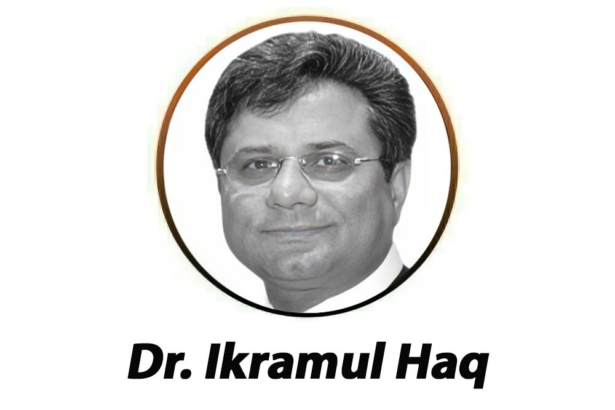
Dr. Ikramul Haq, Advocate Supreme Court, Adjunct Faculty at Lahore University of Management Sciences (LUMS), member Advisory Board and Visiting Senior Fellow of Pakistan Institute of Development Economics (PIDE), holds an LLD in tax laws. He was full-time journalist from 1979 to 1984 with Viewpoint and Dawn. He also served Civil Services of Pakistan from 1984 to 1996.
We welcome your contributions! Submit your blogs, opinion pieces, press releases, news story pitches, and news features to opinion@minutemirror.com.pk and minutemirrormail@gmail.com