Summary
- Aurangzeb said the total federal expenditure for FY2026–27 is Rs18,771 billion.
- He said the private sector will lead future economic growth.
- The finance minister said Pakistan’s youth, which makes up 68% of the population, will remain a key focus of development policies.
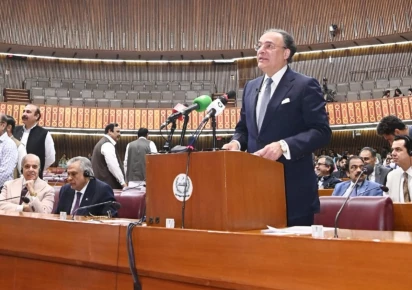
Finance Minister Muhammad Aurangzeb has presented Pakistan’s federal budget for the fiscal year 2026–27 in the National Assembly. The budget outlines a broad economic strategy focused on stabilisation, reforms, and growth.
The government has set a GDP growth target of 4% for the upcoming fiscal year. Inflation is projected at 8.2%, while the budget deficit is estimated at 3.6% of GDP. A primary surplus of 2% of GDP has also been targeted.
Aurangzeb said the total federal expenditure for FY2026–27 is Rs18,771 billion. He added that Pakistan’s economy has grown to $452 billion, despite facing floods and regional tensions during the outgoing fiscal year.
He noted that per capita income has increased to $1,901. Large-scale manufacturing has also shown its strongest performance in four years.
The minister said current expenditure stands at Rs17.4 trillion, including Rs8,054 billion for interest payments and Rs2,680 billion in grants. He highlighted that foreign exchange reserves have improved significantly, rising to over $17 billion, enough to cover nearly three months of imports.
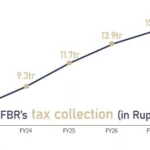
On revenue targets, the Federal Board of Revenue (FBR) is expected to collect Rs15,264 billion, while non-tax revenues are estimated at Rs5,336 billion. He said tax collection has nearly doubled over the past three years.
Aurangzeb said Pakistan has returned to international capital markets after four years. The country raised $750 million through Eurobonds and also issued its first Panda Bond in China, which received strong investor interest.
He said 11 initial public offerings (IPOs) were launched during the year, and over 250 companies began operations in Special Technology Zones.
The finance minister reaffirmed the government’s commitment to privatisation. He said the private sector will lead future economic growth. He added that institutions such as DISCOs, GENCOs, and airports will be privatised in the next phase.
On infrastructure, Rs3 trillion has been allocated for defence spending. An additional Rs365 billion has been earmarked for transport and connectivity projects, including highways, railways, and ports.
Energy sector reforms were also highlighted. The minister said net-zero accumulation of circular debt has been achieved. He added that subsidies worth Rs1,091 billion will support electricity consumers, while gas and LNG agreements have been renegotiated to save costs.
Aurangzeb said tax reforms are being introduced to provide relief to salaried individuals. Income tax slabs for middle-income groups have been reduced, and no tax will be imposed on annual income up to Rs600,000.
He also announced a reduction in super tax on high-income earners and cuts in withholding tax for property filers. Export-related taxes have been reduced, while several levies have been abolished to support trade and investment.
For small traders, a simplified fixed tax system has been introduced under Section 99B. Under this scheme, retailers will pay 1% tax on annual sales, along with simplified compliance procedures.
The government is also launching major FBR reforms. These include AI-based monitoring systems, a National Faceless Centre, and integration of third-party data from financial and property sectors.
In the industrial sector, 6,860 acres of Pakistan Steel Mills land will be converted into a Special Economic Zone to attract investment and create jobs.
IT and digital growth were also highlighted. IT exports have reached $4.5 billion, marking a 20% increase. The rollout of 5G services in five cities is also planned.
On social protection, the government has expanded welfare programmes. The Benazir Kafalat Programme will support 12 million families, while education scholarships and housing schemes have also been increased.
The finance minister said Pakistan’s youth, which makes up 68% of the population, will remain a key focus of development policies. He added that hundreds of thousands of young people have been trained under national skill development programmes.
Aurangzeb concluded by stating that Pakistan’s economic outlook is improving, supported by reforms, investor confidence, and international engagement. He thanked political leadership, provincial governments, and institutions for their role in achieving economic stabilisation.
We welcome your contributions! Submit your blogs, opinion pieces, press releases, news story pitches, and news features to [email protected] and [email protected]