


Summary
- The government aims for a US$1 trillion economy by 2035, exports above US$100 billion and sustained real growth of about six percent.
- In September 2026, it said the trillion-dollar objective requires “fundamental transformation”, sustained six percent growth and a decisive shift towards exports, while acknowledging that Pakistan has relied too long on external borrowing and multilateral financing for its external requirements.
- Ministry of Planning, Development & Special Initiatives, Pakistan Governance Forum 2026 statement on the US$1 trillion economy, governance, exports and human development.
Part VIII ended with a proposition: economic sovereignty requires a financial system capable of financing productive risk over long horizons. Pakistan now attaches a number to that ambition. The government aims for a US$1 trillion economy by 2035, exports above US$100 billion and sustained real growth of about six percent. The target deserves neither applause nor dismissal. It deserves arithmetic.
World Bank data put Pakistan’s gross domestic product (GDP) at about US$407.3 billion in 2025. Reaching US$1 trillion by 2035 from that base requires dollar GDP to grow by about 9.4 percent every year for ten years. That is a demanding compound rate. It is also not the same thing as six percent real GDP growth.
Dollar GDP reflects real growth, domestic prices and the exchange rate. Six percent real growth sustained for a decade would be a major break from Pakistan’s recent record, but it does not mechanically produce a trillion dollars. Persistent rupee depreciation can offset part of the increase when output is translated into dollars. The target requires macroeconomic stability alongside productivity growth.
The Planning Ministry itself now makes the more important point. In September 2026, it said the trillion-dollar objective requires “fundamental transformation”, sustained six percent growth and a decisive shift towards exports, while acknowledging that Pakistan has relied too long on external borrowing and multilateral financing for its external requirements. That diagnosis is consistent with the argument developed throughout this series.
The export arithmetic, however, deserves closer attention. The government speaks of raising exports beyond US$100 billion by 2035 from roughly US$40 billion. That requires growth of around 11 percent a year over nine years. More importantly, exports of US$100 billion in a US$1 trillion economy would equal only 10 percent of GDP.
Pakistan’s exports of goods and services were already about 10 percent of GDP in 2025. If the economy reaches one trillion dollars while exports merely reach US$100 billion, the export share would remain broadly where it is today. An export-led transformation requires exports to grow faster than the economy, diversify into higher-value products and services, and generate the foreign exchange needed for machinery, technology and external obligations.
Investment presents the second test. Pakistan cannot compound output at transformational rates while investing at survival rates.
World Bank indicators put gross capital formation at about 14.3 percent of GDP in 2025. The government’s Annual Plan recorded total investment at 13.8 percent in FY2024-25 and targeted 14.7 percent for FY2025-26. There is no universal investment ratio that guarantees six percent growth; efficiency matters as much as volume. The direction is nevertheless clear. The World Bank’s Pakistan@100 work concludes that sustained transformation requires a substantial increase in both public and private investment.
That capital must also be allocated differently. Part VII distinguished borrowing to build from borrowing to survive. Part VIII showed how government borrowing can absorb bank balance sheets that should also finance farms and firms. Raising the investment rate while directing capital into protected, low-productivity activities would enlarge balance sheets without transforming production.
The third test is productivity. Pakistan’s difficulty has never been lack of episodic growth. It has been inability to sustain growth once imports rise faster than exports and external financing tightens. The World Bank describes a recurring pattern in which consumption-led expansion produces external vulnerability, followed by adjustment and another slowdown. A trillion-dollar strategy must increase output per worker, not merely aggregate demand.
Human capital is inseparable from that calculation. Pakistan’s Human Capital Index is only 0.41. The World Bank estimates that a child born today will, on average, be only 41 percent as productive as she or he could have been with complete education and full health. The Planning Minister has himself highlighted child stunting of about 40 percent and some 25 million out-of-school children. A country cannot become a high-productivity economy while wasting human capability on this scale.
Population magnifies the challenge. Using the government’s cited annual population growth of 2.55 percent merely as an illustration, a population of around 255 million would approach 328 million after ten years if that rate persisted. A US$1 trillion economy would then mean per-capita GDP of only about US$3,050. The trillion-dollar threshold would be an important milestone, not development completed.
The fourth test is the state itself. Pakistan’s development plans have repeatedly contained sensible objectives. The missing variable has been institutional continuity and implementation. Generalist administration cannot substitute indefinitely for specialist capacity in taxation, energy, trade, cities, technology, water, education and finance. Nor can federal ministries perform functions constitutionally and practically belonging to provinces and local governments.
The World Bank’s 2026 work on fiscal federalism identifies weaknesses in the alignment of responsibilities, revenues and transfers across federal, provincial and local tiers. Productive federalism requires each level to have functions it can perform, revenues it can mobilise and transparent transfers where necessary. Cities cannot become engines of growth while metropolitan transport, land use, waste, water and local taxation remain institutionally fragmented.
This brings the series back to sovereignty. We began with the East India Company because its transformation from trader to ruler revealed how economic power becomes political power. Plassey opened the gate. Buxar and the Diwani gave the Company access to revenue. The Collector converted fiscal authority into administrative machinery. Colonial revenue extraction eventually became a state.
Independent Pakistan inherited sovereignty but not automatically a democratic fiscal order. Revenuecracy made collection targets more important than a social contract.
Debtocracy emerged when weak revenue, exports and productivity made refinancing a recurring condition of government. External conditionality did not recreate Company rule; there are no foreign armies and no Diwani. It did, however, expose how formal sovereignty can coexist with narrowing fiscal and developmental choice.
The answer is not autarky, repudiation of debt or hostility to international institutions. Countries with strong sovereignty borrow, trade, receive investment and work with multilateral institutions. Their strength lies in being able to choose the terms and purposes of engagement because productive capacity, revenue and institutions give them alternatives.
Pakistan@100 provides the more meaningful horizon: 2047, the centenary of independence. Its framework rests on accumulation of physical and human capital, productive allocation of resources, environmental and social sustainability, and governance capable of implementation. These are not donor slogans if they are converted into Pakistan-owned institutions and measurable national outcomes.
The US$1 trillion target for 2035 can serve as an intermediate test rather than an end in itself. The meaningful indicators are whether exports rise faster than GDP; investment and savings finance productive assets; children learn and grow healthy; women and young people enter productive employment; cities govern themselves effectively; taxation becomes equitable and predictable; and external borrowing increasingly finances transformation rather than survival.
Pakistan does not need to prove sovereignty by borrowing from nobody. It must acquire the capacity to decide when to borrow, from whom, on what terms and for what productive purpose. That is the distance between Debt Raj and economic sovereignty.
The journey that began with control over revenue ends with control over productive capacity. By 2047, the decisive measure of independence will not be the size of Pakistan’s debt or even the headline size of its GDP. It will be whether its citizens possess the human, institutional and productive capacity to finance their own future.
References
- Dr. Ikramul Haq, “Company Raj to Debt Raj—VIII: Who finances production?”, Minute Mirror, September 23, 2026.
- World Bank, Pakistan Data, GDP (current US$), 2025.
- 3. Ministry of Planning, Development & Special Initiatives, “Ahsan Iqbal Sets Export Acceleration as First Priority under 11 National Economic Missions of URAAN Pakistan”, September 10, 2026.
- Ministry of Planning, Development & Special Initiatives, Pakistan Governance Forum 2026 statement on the US$1 trillion economy, governance, exports and human development.
- World Bank, World Development Indicators, Pakistan: exports of goods and services and gross capital formation.
- Ministry of Planning, Development & Special Initiatives, Annual Plan 2025-26.
- 7. World Bank, Pakistan Human Capital Review: Building Capabilities Throughout Life.
- World Bank, Country Partnership Framework for Pakistan, FY2026 up to FY2035.
- World Bank, “Pakistan: Strengthening Fiscal Federalism to Drive Development”, July 1, 2026.
- World Bank, Pakistan@100: Shaping the Future, 2019.
- Ministry of Planning, Development & Special Initiatives, URAAN Pakistan: 5Es National Economic Transformation Plan 2024-29.
[Concluded]
________________________________________________________________
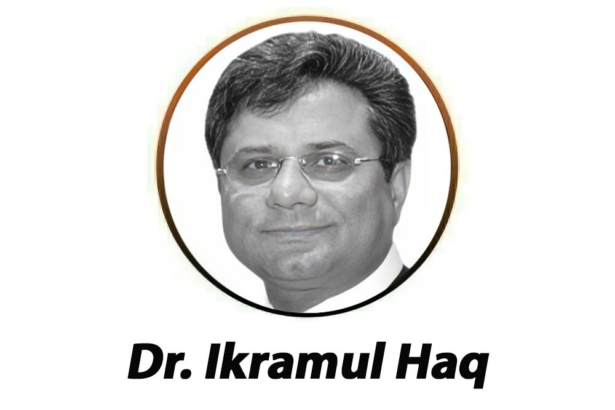
Dr. Ikramul Haq, Advocate Supreme Court, writer, literary critic, Adjunct Faculty at Lahore University of Management Sciences (LUMS), member Advisory Board and Visiting Senior Fellow of Pakistan Institute of Development Economics (PIDE), holds an LLD in tax laws. He was full-time journalist from 1979 to 1984 with Viewpoint and Dawn. He also served Civil Services of Pakistan from 1984 to 1996.
We welcome your contributions! Submit your blogs, opinion pieces, press releases, news story pitches, and news features to opinion@minutemirror.com.pk and minutemirrormail@gmail.com




کہا تم نے کہ کیوں ہو غیر کے ملنے میں رسوائی
بجا کہتے ہو، سچ کہتے ہو، پھر کہیو کہ ہاں کیوں ہو
غالب رح