Summary
- The Tax Administration Reform Project (TARP) cost US$149 million, financed by the World Bank, the United Kingdom’s Department for International Development and Pakistan.
- World Bank, “Pakistan: World Bank Approves $1 Billion Additional Financing for DASU Hydropower Project”, June 10, 2024.
- World Bank, “Pakistan: World Bank Expands Support for Tax Revenue Project to Boost Fiscal Sustainability”, May 29, 2025.
Part VI argued that Pakistan’s vulnerability cannot be read from debt-to-gross domestic product alone. Debt-carrying capacity depends on revenue, exports, reserves, productivity, maturity, currency and the assets standing behind liabilities. That leads to a harder question: what does a country leave behind after it borrows?
Borrowing is not development merely because a development institution provides it. A loan can finance a railway, dam, school system or transmission network that raises future productive capacity. It can also finance a budget already unable to support itself. A third category finances institutional reform. Its asset is less visible, but the test should be equally demanding: did the institution become measurably better?
China’s historical experience with the World Bank offers a revealing contrast. A Bank evaluation recorded two unusual features of its China strategy. Lending consistently emphasised infrastructure at a time when infrastructure lending was declining elsewhere. Budget support was not an important instrument. China was reluctant to accept conditionality; across the period reviewed there was only one adjustment loan involving policy conditionality.
This did not mean China developed because the World Bank lent to it. The causation ran differently. External finance was inserted into a state-led development strategy that had already decided what productive capacity it wanted to create. The borrower retained ownership of the destination.
India’s relationship with the World Bank began similarly. Its first Bank loan in 1949 financed Indian Railways. During the 1950s, Bank assistance helped provide foreign exchange for power and steel plants and supported ports. Later lending contributed to institutions and infrastructure including PowerGrid and the National Highways Authority of India. The important point is not that every Indian loan succeeded. It is that much external finance became identifiable productive capacity.
Pakistan also has examples of borrowing to build. Any fair comparison must acknowledge them. Dasu Hydropower Stage I is one. The World Bank approved another US$1 billion in 2024 for the project. Stage I is designed for 2,160 megawatts and more than 12,000 gigawatt-hours of low-cost renewable electricity annually. The Bank estimates that substitution of imported fuel could eventually save Pakistan around US$1.8 billion a year. In this case, the debt is attached to an asset capable of producing electricity and reducing an external vulnerability.
The problem is not that Pakistan never borrows productively. It is the coexistence of project borrowing with recurrent borrowing required to keep the fiscal and external accounts functioning.
The World Bank’s own definition of Development Policy Financing is important. It is rapidly disbursing, non-earmarked general budget financing linked to policy and institutional actions. There is nothing inherently illegitimate about such support. A severe crisis can justify it. The danger begins when exceptional support becomes part of the normal financing architecture of the state.
Pakistan’s FY2025 fiscal deficit was financed predominantly from domestic sources, but the World Bank records Rs. 619 billion of external financing, largely from multilateral lenders and commercial banks for budgetary support. Domestic bank borrowing financed most of the deficit. This is the distinction that matters: the creditor may change, but borrowing used to bridge a fiscal gap does not automatically create a new productive asset.
The US$500 million RISE operation in 2020 illustrates the policy-financing model. It supported fiscal management, debt transparency, tax reform, private-sector growth and energy-sector changes during the Covid shock. These were legitimate objectives. The analytical question is whether repeated policy lending produces durable institutional change sufficient to reduce the need for the next round of support.
Tax administration provides an uncomfortable laboratory. The Tax Administration Reform Project (TARP) cost US$149 million, financed by the World Bank, the United Kingdom’s Department for International Development and Pakistan. It sought to modernise the revenue authority. The World Bank’s completion assessment ultimately rated the project outcome “Moderately Unsatisfactory”, noting that sustainable revenue mobilisation required political commitment that had often been uncertain.
Years later came Pakistan Raises Revenue. Originally US$400 million, it received another US$70 million in 2025 and was extended to June 2027. The World Bank reports gains: 1.5 million new taxpayers, fewer withholding-tax lines, improved information technology and greater tax-expenditure transparency. These achievements should be recognised. The project nevertheless raises the institutional question at the heart of this series. After decades of externally financed tax reform, why does the Federal Board of Revenue (FBR) still require another externally financed transformation plan?
The same test applies beyond taxation. Pakistan’s Access to Justice Programme, approved by the Asian Development Bank in 2001, involved two programme loans totalling US$330 million, alongside a separate technical-assistance loan. Justice reform cannot be judged like a power plant; its return is institutional. The appropriate questions are measurable: did cases move faster, access become cheaper, courts become more accountable and citizens obtain more reliable justice?
This is not an argument against technical assistance. Poor countries can learn from international experience. Nor is it an argument that every policy loan is wasted. The distinction is between assistance that builds domestic capability and assistance that becomes a substitute for it.
The World Bank’s new ten-year Country Partnership Framework for Pakistan is revealing because the Bank itself says the new approach seeks to focus less on short-term adjustment programmes and scattered small investments, and more on selective, stable and larger investments in areas critical for sustained development. That is close to the change Pakistan itself should demand.
Every external loan should face a simple public test before approval: what permanent productive or institutional capacity will exist when this debt has been repaid?
For physical infrastructure, the answer can be megawatts, freight capacity, irrigation, water, digital connectivity or reduced import dependence. For human capital, it can be learning, health and skills. For institutional loans, it must be measurable improvements in tax capacity, justice, regulation or public administration—not another consultant’s report followed by another reform loan.
The deeper reform is to change the purpose of borrowing. Long-term concessional finance should be matched, as far as practicable, with long-lived productive and human assets. Budget support should remain exceptional rather than become structural. Reform borrowing should contain transparent baselines, independently verifiable outcomes and a clear point at which foreign technical support ends because domestic capability has been created.
Pakistan’s debt problem will not be solved merely by borrowing less. A low-investment country can become poorer by cutting productive investment in the name of fiscal prudence. The objective is to borrow differently while building the revenue, exports and savings that gradually reduce the need to borrow for survival.
That brings the argument to finance itself. China and India did not only build infrastructure. They also developed institutions capable of directing long-term capital towards agriculture, industry, technology and enterprise. Pakistan’s banking system remains heavily drawn towards financing government.
Part VIII will ask the next question: who finances production? It will examine cooperative and development finance, including the Rabobank experience, and why affordable long-term credit reaches farmers and enterprises in successful economies while Pakistan repeatedly channels financial savings towards the state. Economic sovereignty requires more than escaping debtocracy. It requires a financial system that finances production before it finances government.
References
- Dr. Ikramul Haq, “Company Raj to Debt Raj—VI: Sovereign debt, misleading ratios”, Minute Mirror, September 21, 2026.
- World Bank, China country assistance evaluation, discussion of infrastructure lending and limited use of budget support.
- World Bank, “The World Bank Celebrates 75 Years of Partnership with India”.
- World Bank, “Pakistan: World Bank Approves $1 Billion Additional Financing for DASU Hydropower Project”, June 10, 2024.
- World Bank, “Development Policy Financing”.
- World Bank, Pakistan Development Update: Staying the Course for Growth and Jobs, 2025.
- World Bank, “Pakistan Undertakes Reforms to Bolster Fiscal Resilience and COVID-19 Recovery”, June 29, 2020.
- World Bank, Tax Administration Reform Project, Implementation Completion and Results Report.
- World Bank, “Pakistan: World Bank Expands Support for Tax Revenue Project to Boost Fiscal Sustainability”, May 29, 2025.
- Asian Development Bank, Pakistan: Access to Justice Program, Loans 1897-PAK and 1898-PAK.
- World Bank, Country Partnership Framework for Pakistan, FY2026–FY2035.
[To be continued]
________________________________________________________________
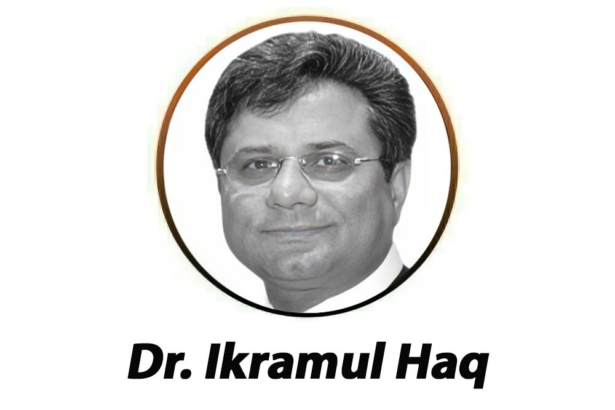
Dr. Ikramul Haq, Advocate Supreme Court, writer, literary critic, Adjunct Faculty at Lahore University of Management Sciences (LUMS), member Advisory Board and Visiting Senior Fellow of Pakistan Institute of Development Economics (PIDE), holds an LLD in tax laws. He was full-time journalist from 1979 to 1984 with Viewpoint and Dawn. He also served Civil Services of Pakistan from 1984 to 1996.
We welcome your contributions! Submit your blogs, opinion pieces, press releases, news story pitches, and news features to opinion@minutemirror.com.pk and minutemirrormail@gmail.com