Summary
- International Monetary Fund, Japan: 2026 Article IV Consultation, IMF Country Report No.
- International Monetary Fund, United States: 2026 Article IV Consultation, IMF Country Report No.
- International Monetary Fund, India: 2025 Article IV Consultation, IMF Country Report No.
Part V ended with a question that debt-to-gross domestic product cannot answer: why can some countries carry much larger sovereign debts without losing policy autonomy, while Pakistan becomes vulnerable at a lower ratio? The answer begins by abandoning the idea that one percentage can describe sovereign risk.
- Ali Abbas, Alex Pienkowski and Kenneth Rogoff’s Sovereign Debt: A Guide for Economists and Practitioners makes the point methodologically. Sovereign debt differs by institutional coverage, currency, maturity, instrument, jurisdiction and creditor. Gross debt can also conceal substantial public assets. The relevant question is not simply how much a government owes. It is what stands behind the obligation and how it will be serviced.
Japan provides the most dramatic illustration. The International Monetary Fund (IMF) projects public debt at about 203 percent of gross domestic product (GDP) in 2026. That figure would look catastrophic if applied mechanically to Pakistan. The IMF nevertheless assesses Japan’s sovereign-debt distress risk as moderate. Its explanation matters: average residual maturity is about 9.5 years; the investor base is deep and predominantly domestic; debt is denominated in yen, a reserve currency; and the public sector holds a large stock of financial assets.
The United States presents another case. IMF projections put general-government gross debt at about 126 percent of GDP in 2026. It faces serious long-term fiscal risks. It does not, however, confront Pakistan’s refinancing problem. United States Treasury securities trade in the world’s deepest sovereign bond market and the dollar remains the principal international reserve currency. A government borrowing in the currency that global investors themselves demand occupies a fundamentally different position from one that must earn or borrow foreign exchange to meet external obligations.
Italy and France complicate the picture further. Their projected 2026 gross public debt ratios are about 138 percent and 119 percent respectively. Both face fiscal pressures and the IMF urges consolidation. Their states, however, mobilise revenues on a scale Pakistan does not. Italy’s general-government revenue is around 48 percent of GDP. France’s exceeds 52 percent.
Pakistan’s corresponding revenue and grants are projected by the IMF at about 15.8 percent of GDP in fiscal year 2025-26. Tax revenue is about 12.9 percent. Pakistan’s general-government debt including IMF obligations is projected around 70 percent of GDP.
Pakistan’s headline debt ratio is therefore far below those of Japan, the United States, Italy or France. The fiscal capacity supporting it is also far smaller. This is why debt-to-revenue can reveal what debt-to-GDP conceals.
Canada offers an equally important warning against careless comparisons. Its gross public debt is projected at about 111 percent of GDP, but net public debt is only around 10 percent because the public sector owns substantial financial assets, including pension assets. Gross and net debt describe very different balance sheets.
Switzerland illustrates another confusion. Its external debt is exceptionally large—above 200 percent of GDP—but that is not the same thing as sovereign debt. IMF data put Swiss public debt at only about 40 percent of GDP in 2026. Switzerland also collects government revenue of about one-third of GDP, runs a large current-account surplus and possesses enormous external assets and reserves. Comparing Pakistan’s public debt with Switzerland’s total external debt would compare different concepts.
India is closer and more instructive. Its general-government debt is projected at about 81 percent of GDP in 2025-26, above Pakistan’s ratio. It is not free of fiscal risk. The difference lies partly in composition and economic capacity. Indian government debt is overwhelmingly rupee-denominated and largely held domestically. External debt is below one-fifth of GDP. IMF projections put foreign-exchange reserves above US$700 billion and real growth around 6.6 percent in 2025-26.
Pakistan’s position is different. The IMF projects gross official reserves below US$18 billion in 2025-26 and gross external financing requirements approaching US$19 billion. It says Pakistan’s debt is sustainable under the baseline, but medium-term risks remain high because of large gross financing needs and difficulty obtaining external financing. Its assessment of Pakistan’s capacity to repay the Fund is more revealing still: adequate, but “critically dependent” on policy implementation and timely external financing. That is not a debt-ratio problem. It is a debt-carrying-capacity problem.
A sovereign services domestic debt from fiscal resources and external debt from fiscal resources converted into foreign exchange. Its resilience therefore depends on revenue, exports, reserves, domestic savings, maturity, interest cost, currency denomination, investor confidence, growth and productive assets. Population matters as well because growth that barely exceeds population growth does little to raise living standards or enlarge the tax base.
This also explains why high sovereign debt does not automatically produce mass poverty in advanced economies. Their citizens are not protected by debt. They are protected by much higher productivity, incomes, public revenues, social institutions and accumulated physical and human capital. Debt can finance those assets; it can also threaten them if badly managed. The causal chain runs through the productive and institutional capacity of the economy, not through a single debt percentage.
Pakistan’s difficulty is that weak revenue, weak exports and low productivity interact. When exports cannot generate sufficient foreign exchange, external obligations become harder to service. When revenue is inadequate, interest payments crowd out development. When development is compressed, human and physical capital suffer. Low productivity then restricts growth, exports and future revenue. Debt becomes both consequence and amplifier of the low-growth trap.
The comparison should not be used to argue that Pakistan can safely borrow more because Japan, America or Italy owe more. That would reproduce the very error we are challenging. Nor should lower debt automatically be celebrated if it is achieved by suppressing development expenditure while structural weaknesses remain.
The correct objective is to increase debt-carrying capacity while reducing dependence on borrowing for recurrent survival. That requires a different fiscal state.
Revenue must rise through equitable taxation of capacity rather than extraction from those easiest to reach. Exports must become large enough to finance imports and external obligations without repeated emergency adjustment. Domestic savings must finance longer-term investment. Public assets must be measured alongside liabilities. Debt management must lengthen maturities and reduce currency and rollover risks. Above all, borrowing must create productive capacity. This brings us to the next distinction.
China and India have used long-term multilateral finance for railways, power, roads and other infrastructure. Pakistan has also financed important infrastructure externally, but it has repeatedly required external resources for budget support, balance-of-payments pressures and refinancing. Loans have even been contracted for repeated programmes to reform taxation, administration and justice while the same institutional weaknesses persist.
The relevant question is consequently not merely how much Pakistan borrows. It is: what remains after the borrowing?
Part VII will examine that question by distinguishing borrowing to build from borrowing to survive. If debt leaves behind productive infrastructure, human capital, stronger institutions and greater export capacity, it can enlarge sovereignty. If it mainly finances recurring deficits and the next repayment cycle, debtocracy reproduces itself.
References
- Dr. Ikramul Haq, “Company Raj to Debt Raj—V: Debtocracy: when borrowing begins to govern”, Minute Mirror, September 20, 2026.
- S. Ali Abbas, Alex Pienkowski & Kenneth Rogoff (eds.), Sovereign Debt: A Guide for Economists and Practitioners, Oxford University Press, 2019.
- International Monetary Fund, Japan: 2026 Article IV Consultation, IMF Country Report No. 26/75, 2026.
- International Monetary Fund, United States: 2026 Article IV Consultation, IMF Country Report No. 26/76, 2026.
- International Monetary Fund, Italy: 2026 Article IV Consultation, July 2026.
- International Monetary Fund, France: 2026 Article IV Consultation, July 2026.
- International Monetary Fund, Canada: 2025 Article IV Consultation, IMF Country Report No. 26/12, 2026.
- International Monetary Fund, Switzerland: 2026 Article IV Consultation, September 2026.
- International Monetary Fund, India: 2025 Article IV Consultation, IMF Country Report No. 25/314, 2025.
- International Monetary Fund, Pakistan: Third Review Under the Extended Arrangement Under the Extended Fund Facility, IMF Country Report No. 26/101, May 2026.
- World Bank, China country assistance evaluation: infrastructure lending and limited use of budget support.
- World Bank, “Celebrating 75 Years of World Bank-India Partnership”, October 19, 2021.
[To be continued]
________________________________________________________________
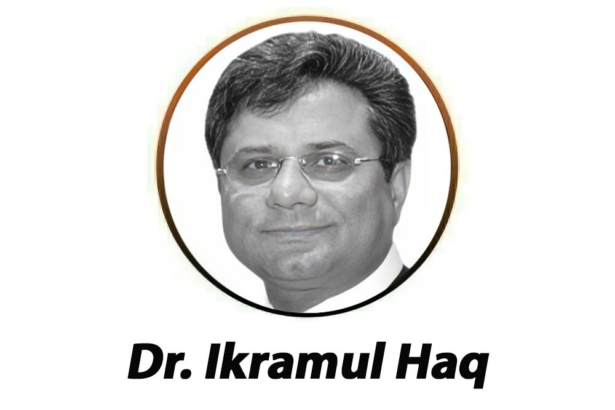
Dr. Ikramul Haq, Advocate Supreme Court, writer, literary critic, Adjunct Faculty at Lahore University of Management Sciences (LUMS), member Advisory Board and Visiting Senior Fellow of Pakistan Institute of Development Economics (PIDE), holds an LLD in tax laws. He was full-time journalist from 1979 to 1984 with Viewpoint and Dawn. He also served Civil Services of Pakistan from 1984 to 1996.
We welcome your contributions! Submit your blogs, opinion pieces, press releases, news story pitches, and news features to opinion@minutemirror.com.pk and minutemirrormail@gmail.com