Summary
- BEIRUT: Renewed Israeli air raids across southern Lebanon have intensified regional tensions, leaving at least four people dead and raising concerns that ongoing diplomatic efforts to secure a broader peace agreement could be jeopardised.
- Lebanese officials and local media reported that Israeli warplanes carried out multiple strikes on towns and villages across southern Lebanon on Friday, causing casualties and significant property damage.
- In another significant development, Israeli forces reportedly issued evacuation notices to residents of 20 towns and villages in southern Lebanon.
BEIRUT: Renewed Israeli air raids across southern Lebanon have intensified regional tensions, leaving at least four people dead and raising concerns that ongoing diplomatic efforts to secure a broader peace agreement could be jeopardised.
The latest attacks occurred despite a US-mediated ceasefire arrangement that was intended to reduce hostilities along the Lebanon-Israel border. Lebanese officials and local media reported that Israeli warplanes carried out multiple strikes on towns and villages across southern Lebanon on Friday, causing casualties and significant property damage.
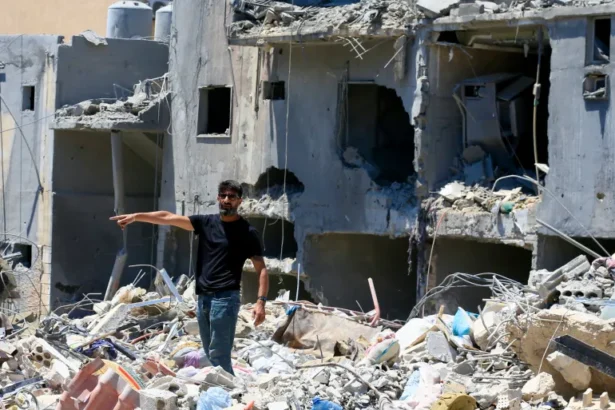
According to reports, one person was killed in an airstrike on the town of Maarakeh in the Tyre district. In a separate attack, the mayor of Ar-Rihan municipality, Badie, lost his life when Israeli aircraft targeted the area in the Jezzine district. Two additional fatalities were reported in Deir al-Zahrani in the Nabatieh district, where an airstrike destroyed a residential building and caused extensive damage to surrounding structures.
The attacks have fueled fears among residents that the conflict could escalate further despite international efforts to contain it. Witnesses described scenes of panic as explosions echoed across several communities, forcing families to seek shelter and assess the damage left behind.
Observers noted that many of the targeted locations lie well beyond the area commonly referred to by Israeli authorities as the “Yellow Line,” a zone in southern Lebanon that has remained at the centre of security disputes. The continued expansion of military operations into deeper parts of Lebanese territory has heightened concerns among local communities and political leaders.
The violence comes at a sensitive moment for regional diplomacy. Reports emerging on Friday suggested progress in negotiations aimed at ending broader hostilities involving regional powers. According to statements attributed to mediators, discussions have focused on achieving a comprehensive agreement that could potentially bring an end to fighting on multiple fronts, including Lebanon.
However, analysts warn that continued military activity could undermine these efforts. Since Israel is not directly involved in the ongoing negotiations between other regional stakeholders, uncertainty remains regarding whether any broader agreement would effectively reduce tensions along the Lebanese border.
Meanwhile, the ceasefire arrangement announced earlier this month has struggled to deliver lasting calm. Although the agreement called for a complete halt to hostilities, exchanges of fire and military operations have continued, casting doubt on its effectiveness.
In another significant development, Israeli forces reportedly issued evacuation notices to residents of 20 towns and villages in southern Lebanon. People living in affected areas were instructed to move north of the Zahrani River as military operations intensified. The orders triggered fresh displacement concerns among civilians already affected by months of instability.
Lebanese authorities also reported that several homes and public buildings in the Bint Jbeil region were damaged or destroyed during early morning strikes. Rescue teams and local officials have been assessing the extent of the destruction while providing assistance to affected families.
Amid the growing uncertainty, Lebanese President Joseph Aoun called for national unity and stability. Addressing a public gathering, he described the current period as a critical moment for the country’s future. He stressed the importance of strengthening state institutions, upholding the rule of law and avoiding internal divisions that could further weaken the nation.
With another round of talks expected later this month, hopes for a lasting settlement remain alive. However, continued violence on the ground highlights the challenges facing diplomats as they seek to transform fragile ceasefire arrangements into a durable and comprehensive peace.
We welcome your contributions! Submit your blogs, opinion pieces, press releases, news story pitches, and news features to [email protected] and [email protected]