



Summary
- Khyber Pakhtunkhwa Governor Faisal Karim Kundi and Interior Minister Mohsin Naqvi have pledged stronger coordination between the federal and provincial administrations to combat terrorism.
- Naqvi said federal authorities had repeatedly sought cooperation from the provincial government over the past two-and-a-half years.
- The federal government cited rising terrorist attacks, threats to public safety, assaults on law enforcement personnel and government installations, and what it described as inadequate action by the provincial administration against militancy.
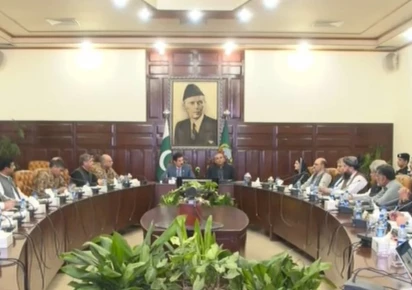
Khyber Pakhtunkhwa Governor Faisal Karim Kundi and Interior Minister Mohsin Naqvi have pledged stronger coordination between the federal and provincial administrations to combat terrorism. The commitment came during the province’s first Apex Committee meeting following the imposition of emergency measures and governor’s rule.
The meeting was held at the Governor’s House in Peshawar on Monday. Kundi and Naqvi jointly chaired the session, which was attended by members of the newly formed 11-member advisory council and senior government officials.
Addressing the meeting, Kundi said eliminating terrorism was the government’s top priority. He stressed that security could not be compromised, even if development projects had to be delayed.
The governor called for stronger cooperation between federal and provincial institutions. He also emphasised the need to provide police and the Counter-Terrorism Department (CTD) with modern equipment, adequate resources and essential facilities to tackle terrorist threats.
Kundi urged authorities to focus on practical measures that produce visible results rather than actions intended merely to demonstrate progress. He said the people of Khyber Pakhtunkhwa wanted peace, development and prosperity but continued insecurity had restricted their ability to live and travel freely.
He added that lasting peace would create opportunities for investment and economic growth. The province has significant potential in agriculture, energy, tourism and natural resources, he said, adding that improved security could help unlock these opportunities.
Naqvi described the meeting as a significant step towards restoring coordination between the federal and provincial governments. He said it was the first time in approximately two-and-a-half years that he could confidently state that both administrations were on the same page regarding counter-terrorism efforts.
The interior minister paid tribute to security personnel who had fought militants despite what he described as insufficient government support. He maintained that security forces could not defeat terrorism without clear political leadership and effective government coordination.
Naqvi said federal authorities had repeatedly sought cooperation from the provincial government over the past two-and-a-half years. He argued that stronger government involvement was necessary to improve the effectiveness of security operations.
However, he cautioned that immediate results should not be expected, warning that difficult challenges could lie ahead. He assured participants that the governor, advisory council, police and federal government would work together to address the situation.
The interior minister also proposed reviving a security plan covering five districts. Under the proposed arrangement, police and other relevant institutions would receive additional assistance in phases.
Highlighting the challenges faced by law enforcement personnel, Naqvi said police officers needed appropriate equipment and resources to confront militants equipped with modern weapons. He expressed confidence that ongoing efforts to strengthen the police force could improve its operational capacity.
Naqvi also thanked the public for maintaining peace over the preceding 24 hours. He said residents wanted stability and expected the authorities to deliver lasting security.
The meeting followed the federal government’s decision on Sunday to impose emergency measures and governor’s rule in Khyber Pakhtunkhwa. President Asif Ali Zardari approved the move on the advice of Prime Minister Shehbaz Sharif, invoking Articles 232 and 234 of the Constitution.
The federal government cited rising terrorist attacks, threats to public safety, assaults on law enforcement personnel and government installations, and what it described as inadequate action by the provincial administration against militancy.
Under the new arrangement, executive authority was transferred from the provincial government to Governor Kundi. The chief minister, provincial ministers, advisers, special assistants and advocate general ceased to hold office under the order.
The emergency measures apply to 12 districts, including eight merged tribal districts: Bajaur, Mohmand, Khyber, Kurram, Orakzai, North Waziristan, South Waziristan Upper and South Waziristan Lower. Dera Ismail Khan, Tank, Bannu and Lakki Marwat are also covered.
The federal government has additionally authorised the deployment of Pakistan Army personnel and resources under Article 245 to assist the civil administration and protect citizens, public property and government installations.
An 11-member advisory council has been established to assist the governor with provincial administration. The government has also ordered the creation of an Area Development Secretariat to oversee security, law enforcement, administration and development in the 12 designated districts.
We welcome your contributions! Submit your blogs, opinion pieces, press releases, news story pitches, and news features to opinion@minutemirror.com.pk and minutemirrormail@gmail.com







