Summary
- Having covered Pakistani politics for nearly three decades and followed Nawaz Sharif closely since his arrival in London from exile in 2006, I have witnessed every major phase of his political journey.
- The Muzaffarabad rally reinforced what I have believed for years: Nawaz Sharif has entered another active phase of his political career.
- More than forty years after entering politics, Nawaz Sharif remains one of Pakistan’s most enduring and influential political figures.
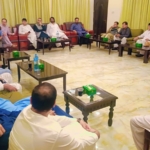
The Pakistan Muslim League (N)’s power show in Muzaffarabad during the Azad Jammu and Kashmir election campaign was far more than an ordinary political rally. To me, it marked the re-emergence of Nawaz Sharif as the central figure in Pakistan’s political landscape.
The message from Muzaffarabad was unmistakable. Nawaz Sharif spoke of development rather than division, construction rather than confrontation, and public welfare rather than political vendettas. His interaction with the crowd was genuine and heartfelt. One symbolic moment that captured public attention was his light-hearted remark expressing a desire to become the Prime Minister of Azad Jammu and Kashmir. It reflected his affection for the region and the deep emotional bond he has always maintained with the people of Kashmir, whose support has remained consistent throughout his political career.
Having covered Pakistani politics for nearly three decades and followed Nawaz Sharif closely since his arrival in London from exile in 2006, I have witnessed every major phase of his political journey. From Duke Street in London, where he addressed party workers during years of political exile, to the massive public gathering in Muzaffarabad, I saw the same determination and resilience that has defined his politics for decades.
Few political leaders in South Asia have experienced the highs and lows that Nawaz Sharif has endured. His elected government was overthrown by General Pervez Musharraf in 1999. He was prosecuted, imprisoned and later forced into exile. Years later, he returned to Pakistan and regained political power, only to face another period of legal and political challenges following the Panama Papers case. In my view, elements within the state establishment and parts of the judiciary played significant roles during different phases of these political confrontations. Regardless of differing opinions on those events, what remains remarkable is that every major attempt to end his political career has ultimately been followed by his return to the centre of national politics.
Many analysts predicted that the 2024 general elections would mark the end of Nawaz Sharif’s political dominance. I never shared that assessment. Throughout my television appearances and reporting, I consistently argued that he remained the principal decision-maker within the PML-N and that no major political decision was taken without his approval.
One of the defining strengths of the Sharif family’s politics has been continuity of leadership. Shehbaz Sharif has repeatedly demonstrated exceptional political loyalty to his elder brother. On several occasions, he chose party unity over personal ambition. Following the difficult electoral environment of 2024, he assumed the office of Prime Minister at a time when Pakistan was facing severe economic and diplomatic challenges. In my assessment, his government helped restore economic confidence, improved macroeconomic stability and steered Pakistan away from a potentially deeper financial crisis. His administrative style has always been focused on governance and delivery rather than political rhetoric.
Maryam Nawaz’s rise represents another important chapter in the party’s evolution. During the years when Nawaz Sharif faced political disqualification and exile, she emerged as one of the PML-N’s most visible campaigners. She endured political pressure, remained active throughout the party’s most difficult period and gradually established herself as a national political leader in her own right.
As Chief Minister of Punjab, Maryam Nawaz has sought to build her political identity around governance, administrative reforms and public service delivery. Whether one agrees with her politics or not, she has brought energy and visibility to the office and has made rapid implementation of development initiatives a defining feature of her administration. Her speeches continue to energise party workers, while her governance record is increasingly becoming central to the PML-N’s political narrative.
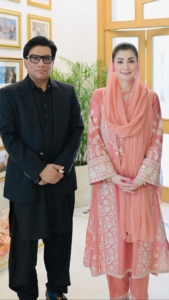
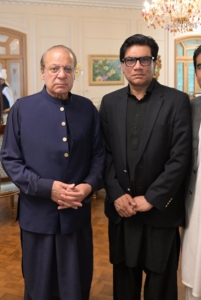
When I met Nawaz Sharif and Maryam Nawaz at Jati Umra earlier this year, I observed the same resolve that I had seen nearly two decades earlier during the London exile years. The determination to continue serving through politics appeared unchanged.
The Muzaffarabad rally reinforced what I have believed for years: Nawaz Sharif has entered another active phase of his political career. His message is no longer about political survival—it is about political continuity, stability and development.
Whether one supports him or opposes him, it is difficult to deny one reality. More than forty years after entering politics, Nawaz Sharif remains one of Pakistan’s most enduring and influential political figures. His resilience has become part of Pakistan’s political history, and Muzaffarabad demonstrated that his political story is far from over.
The views expressed in this article are solely my personal observations and political analysis based on decades of reporting on Pakistan’s politics.
We welcome your contributions! Submit your blogs, opinion pieces, press releases, news story pitches, and news features to opinion@minutemirror.com.pk and minutemirrormail@gmail.com