Summary
- UNITED NATIONS: Pakistan has rejected allegations by an Indian delegate that Islamabad sponsors terrorism, with a Pakistani diplomat accusing New Delhi of using propaganda to deflect attention from its own alleged support for militant groups.
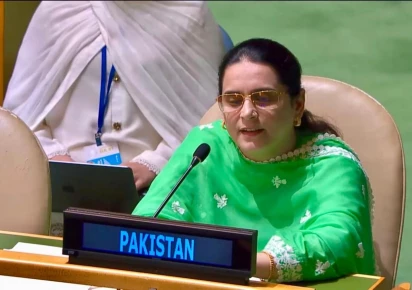
- Saima Saleem, counsellor at Pakistan’s Mission to the United Nations, exercised her right of reply at the UN General Assembly on Friday after India’s delegate Petal Gahlot criticised Pakistan during a response to Prime Minister Shehbaz Sharif’s address.
- Saleem rejected the allegations and said India was allegedly supporting groups that carry out attacks in Pakistan, including the Tehreek-e-Taliban Pakistan (TTP) and the Balochistan Liberation Army (BLA) and its Majeed Brigade.
UNITED NATIONS: Pakistan has rejected allegations by an Indian delegate that Islamabad sponsors terrorism, with a Pakistani diplomat accusing New Delhi of using propaganda to deflect attention from its own alleged support for militant groups.
Saima Saleem, counsellor at Pakistan’s Mission to the United Nations, exercised her right of reply at the UN General Assembly on Friday after India’s delegate Petal Gahlot criticised Pakistan during a response to Prime Minister Shehbaz Sharif’s address.
Gahlot had accused Pakistan of presenting itself as a security-conscious state while allegedly supporting terrorism. Saleem rejected the allegations and said India was allegedly supporting groups that carry out attacks in Pakistan, including the Tehreek-e-Taliban Pakistan (TTP) and the Balochistan Liberation Army (BLA) and its Majeed Brigade.
She said Pakistan had suffered heavily from terrorism, claiming that nearly 100,000 people had lost their lives since the beginning of the century. She also said terrorism had caused significant economic losses and left lasting effects on several generations.
Saleem further alleged that India’s involvement in terrorism had extended beyond the region, referring to cases in Canada and the United States. She called on India to condemn attacks that have killed Pakistani civilians.
The Pakistani diplomat also responded to Indian remarks concerning recent developments in Azad Jammu and Kashmir. She contrasted the situation in Azad Kashmir with Indian-administered Jammu and Kashmir, arguing that Kashmiris in the former have political participation and the ability to express their views, while people in Indian-administered Kashmir continue to face restrictions and rights concerns.
On the Indus Waters Treaty, Saleem criticised India’s decision to hold the 1960 agreement in abeyance, describing water as a vital resource for Pakistan’s population.
She also rejected what she described as Indian narratives regarding the May 2025 military confrontation between the two countries. Referring to the conflict as Marka-e-Haq, she said Pakistan’s position had been demonstrated during the confrontation.
The diplomat further accused India’s ruling RSS-BJP political establishment of promoting Hindutva ideology through state policy and alleged that minorities, including Muslims, Christians, Dalits and Sikhs, faced discrimination and violence.
On Kashmir, Saleem reiterated Pakistan’s position that Jammu and Kashmir remains an internationally disputed territory. She said its final status should be determined in accordance with the aspirations of the Kashmiri people and relevant United Nations resolutions.
We welcome your contributions! Submit your blogs, opinion pieces, press releases, news story pitches, and news features to opinion@minutemirror.com.pk and minutemirrormail@gmail.com