Summary
- UN Secretary-General António Guterres commended Pakistan’s “leading role and strong voice at the UN”, its contribution to international peace and security and, in particular, its mediation efforts aimed at peaceful conflict resolution and durable regional stability.
- The Prime Minister’s UN warning therefore represented a clear articulation of Pakistan’s position that water security is directly connected with national security, regional stability and international law.
- The recognition from the UN Secretary-General of Pakistan’s “leading role and strong voice”, together with Prince Rahim Aga Khan’s acknowledgement of the Prime Minister’s peace efforts, provided external recognition of that diplomatic activity.
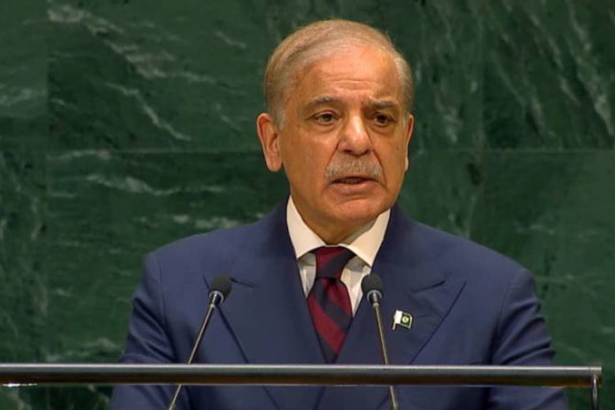
Prime Minister Shehbaz Sharif’s address to the 81st session of the United Nations General Assembly placed Pakistan’s diplomatic priorities firmly at the centre of discussions on regional peace, Palestine, Islamophobia, South Asian security and the protection of Pakistan’s vital interests.
At a time of heightened tensions across the Middle East and growing challenges to regional stability, the Prime Minister presented Pakistan as a country seeking dialogue and diplomacy while also making clear that its sovereignty, security and fundamental national interests would be defended.
The international response during the Prime Minister’s UN engagements provided an important indication of how Pakistan’s diplomatic role is being viewed. UN Secretary-General António Guterres commended Pakistan’s “leading role and strong voice at the UN”, its contribution to international peace and security and, in particular, its mediation efforts aimed at peaceful conflict resolution and durable regional stability. He also appreciated Pakistan’s role and sacrifices in the fight against terrorism.
Prince Rahim Aga Khan also lauded Prime Minister Shehbaz Sharif’s efforts for regional peace and stability at a critical time when the region was engulfed by conflict.
Diplomacy as Pakistan’s central message
The central theme of the Prime Minister’s international engagement was that dialogue and diplomacy must remain the path towards resolving conflicts.
Pakistan’s role in facilitating contacts between Washington and Tehran was highlighted as an example of this approach. Shehbaz Sharif referred to Pakistan bringing the two sides “under one roof in Islamabad”, while acknowledging the contribution of Field Marshal Syed Asim Munir and Deputy Prime Minister and Foreign Minister Ishaq Dar.
The Prime Minister’s message was that Pakistan’s diplomacy was aimed not at widening conflicts but at creating space for dialogue and de-escalation. During his meeting with Iranian President Masoud Pezeshkian, the Iranian president appreciated Pakistan’s diplomacy and concerted efforts for regional peace and security.
This diplomatic engagement was also recognised by the UN Secretary-General, who specifically appreciated Pakistan’s mediation efforts.
Palestine remains a defining priority
The Palestinian issue occupied a prominent place in the Prime Minister’s message.
Pakistan reiterated its support for the Palestinian people’s right to self-determination and for an independent, sovereign, viable and contiguous State of Palestine on the pre-1967 borders, with Al Quds Al Sharif as its capital.
The message reflected Pakistan’s longstanding position that a sustainable peace in the Middle East requires a political settlement that addresses the rights of the Palestinian people.
A firm warning on the Indus waters
Perhaps the most direct part of the Prime Minister’s address concerned the Indus Waters Treaty and Pakistan’s water security.
Shehbaz Sharif made the position unequivocal:
“Water must never be weaponized. Rivers should nourish nations, not divide them.”
He warned that any attempt to stop, impede or divert Pakistan’s share of the waters would be treated as “an act of war”, adding:
“India must make no mistake about it.”
The statement comes against the backdrop of Pakistan’s continued insistence that the Indus Waters Treaty remains legally binding. On 1 September, Pakistan’s Foreign Office said the Permanent Court of Arbitration at The Hague had reaffirmed that the treaty remained in force and binding and that India’s unilateral attempt to place it in “abeyance” did not relieve it of its treaty obligations.
Pakistan has consistently argued that the treaty contains no provision allowing either party unilaterally to suspend or terminate its obligations.
The Prime Minister’s UN warning therefore represented a clear articulation of Pakistan’s position that water security is directly connected with national security, regional stability and international law.
Haramain Sharifain: a red line
Another particularly emphatic element of the Prime Minister’s message was Pakistan’s position on Saudi Arabia and the sanctity of the Haramain Sharifain.
Declaring that “Haramain Sharifain is a red line for us,” Shehbaz Sharif reaffirmed Pakistan’s solidarity with Saudi Arabia and its commitment to the security and sanctity of the holy sites.
Pakistan had already publicly condemned the attempted drone attack near Makkah Al-Mukarramah and expressed support for Saudi Arabia’s sovereignty, territorial integrity and the security of the Haramain Sharifain.
Islamophobia and the wider Muslim world
The Prime Minister also used the global platform to raise concerns about Islamophobia and discrimination against Muslims.
His message was framed around the principle that religious hatred and violence have no place in an international system built around human dignity, tolerance and the rule of law.
During his meeting with UN Secretary-General António Guterres, he again raised the growing trend of Islamophobia and called for effective international action to counter it.
Pakistan’s evolving diplomatic profile
The significance of the Prime Minister’s UN appearance goes beyond a single speech.
Pakistan entered the 81st UN General Assembly amid major regional challenges, including the conflict in the Middle East, tensions involving Iran, the continuing crisis in Gaza, Afghanistan-related security concerns and the dispute with India over the Indus Waters Treaty.
Against that backdrop, Islamabad sought to present itself simultaneously as a stakeholder defending its national interests and as a country prepared to facilitate dialogue and contribute to regional peace.
The recognition from the UN Secretary-General of Pakistan’s “leading role and strong voice”, together with Prince Rahim Aga Khan’s acknowledgement of the Prime Minister’s peace efforts, provided external recognition of that diplomatic activity.
The Prime Minister’s message at the United Nations can therefore be seen as an attempt to combine diplomacy with clearly defined red lines: dialogue over confrontation, support for Palestinian statehood, solidarity with Saudi Arabia, opposition to Islamophobia and an unequivocal position on Pakistan’s water rights.
For Pakistan, the wider objective remains clear — to strengthen its diplomatic influence, protect its national interests and contribute to efforts aimed at reducing conflict and promoting regional stability.
As Shehbaz Sharif put it, “The pursuit of peace is among the noblest of human endeavours.” His UN engagement sought to place that principle at the centre of Pakistan’s international diplomacy while making clear where Islamabad believes its fundamental national interests cannot be compromised.
We welcome your contributions! Submit your blogs, opinion pieces, press releases, news story pitches, and news features to opinion@minutemirror.com.pk and minutemirrormail@gmail.com