Summary
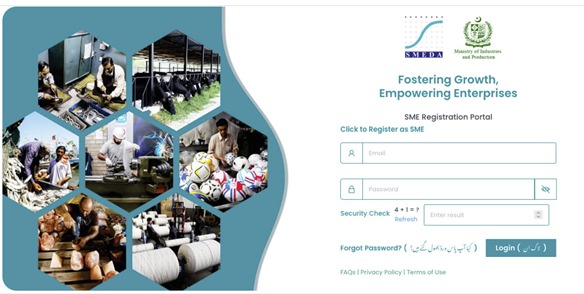
- LAHORE (July 9) – The Small and Medium Enterprises Development Authority (SMEDA) has accelerated efforts to promote business registration through its SME Registration Portal (SMERP), paving the way for enterprise formalization across Pakistan.
- Speaking about the importance of formalization, CEO SMEDA Nadia Jahangir Seth emphasized that SME registration is not merely an administrative process but a gateway to economic opportunity, business sustainability and long-term resilience.
- SMEDA officials note that enterprise formalization contributes not only to business growth but also improved working conditions, social protection, skills development, environmental sustainability and inclusive economic growth.
LAHORE (July 9) – The Small and Medium Enterprises Development Authority (SMEDA) has accelerated efforts to promote business registration through its SME Registration Portal (SMERP), paving the way for enterprise formalization across Pakistan.
The initiative is part of SMEDA’s commitment to providing an enabling business ecosystem to Micro, Small and Medium Enterprises (MSMEs) to help them scale and flourish, thereby contributing to the national economic growth as envisioned by the government.
SMEDA, under the guidance of Ministry of Industries and Production which is advancing Prime Minister Shehbaz Sharif’s vision of achieving inclusive economic growth, is working with a renewed vigour to equip MSMEs with knowledge and tools to become competitive – facilitating their journey through registration.
Entrepreneurs, especially women and budding businesses, are encouraged to register through https://smerp.smeda.org/ or by visiting SMEDA’s official website and take the first step toward being recognized, competitive and future-ready entities.
Why Registration Matters?
Officials engaged in the registration drive say SMEDA, as Pakistan’s premier SME development institution under the MoI&P, is actively engaging entrepreneurs – with special focus on women-led enterprises and micro-businesses – to register themselves through SMERP and become part of the formal economic system.
The registration initiative aims to provide MSMEs with improved visibility, business recognition and access to a wide range of facilitation services that support enterprise development in an increasingly competitive economic environment, they explain.
Speaking about the importance of formalization, CEO SMEDA Nadia Jahangir Seth emphasized that SME registration is not merely an administrative process but a gateway to economic opportunity, business sustainability and long-term resilience.
“Formalization enables SMEs to strengthen their business identity, access finance and markets, improve credibility and participate more effectively in national and global value chains,” she stated.
Ms Seth said SMEDA’s SME Registration Portal offers enterprises a free and simplified mechanism to initiate their formalization journey. “Registered MSMEs can benefit from business advisory services, capacity-building programs, networking opportunities, exposure through trade fairs and exhibitions, and stronger linkages with financial institutions and larger enterprises,” she said.
According to SMEDA officials, formalization is increasingly becoming essential for enterprises seeking integration into modern supply chains and export markets, particularly in light of evolving international compliance requirements related to sustainability, traceability, labour standards and due diligence.
SMEDA-ILO collaboration
SMEDA’s ongoing collaboration with the International Labour Organization aims to strengthen Pakistan’s enterprise formalization agenda. In December 2025, SMEDA and ILO jointly launched Pakistan’s first National SME and Worker Formalization Roadmap under the “SME Formalization and Just Transition” initiative.
The roadmap provides a coordinated national framework to simplify business registration, strengthen labour compliance, support supply chain due diligence and facilitate SME participation in the formal economy.
Pakistan continues to face significant informality challenges, with a large proportion of enterprises and workers operating outside formal systems. This limits access to finance, reduces productivity, weakens competitiveness and restricts compliance with international trade requirements such as GSP+ obligations and emerging sustainability standards.
Through awareness campaigns, training sessions, helpdesk services, digital facilitation tools and policy advocacy, SMEDA and ILO are working together to make formalization more accessible and beneficial for SMEs across sectors including textiles, garments, auto parts manufacturing and services.
Under the collaboration, awareness and training sessions based on ILO Recommendation No 204 on the “Transition from the Informal to the Formal Economy” have already been conducted in Lahore and Karachi, bringing together SMEs, chambers of commerce, worker organizations, sector associations and government institutions.
SMEDA officials note that enterprise formalization contributes not only to business growth but also improved working conditions, social protection, skills development, environmental sustainability and inclusive economic growth.
We welcome your contributions! Submit your blogs, opinion pieces, press releases, news story pitches, and news features to opinion@minutemirror.com.pk and minutemirrormail@gmail.com