Summary
- US President Donald Trump’s upcoming visit to Ankara for the NATO summit is expected to strengthen defense cooperation between the United States and Turkey, particularly regarding the supply of fighter jet engines for Turkey’s indigenous KAAN stealth fighter program.
- Defense analysts believe Trump’s remarks are most likely related to the approval of General Electric F110 engines that Turkey needs for its KAAN fighter aircraft.
- Nevertheless, many analysts believe Turkey’s exclusion from the F-35 program has accelerated its drive toward defense self-reliance, with increased investment in the KAAN project.
US President Donald Trump’s upcoming visit to Ankara for the NATO summit is expected to strengthen defense cooperation between the United States and Turkey, particularly regarding the supply of fighter jet engines for Turkey’s indigenous KAAN stealth fighter program. However, analysts believe the long-running dispute over Turkey’s removal from the F-35 fighter jet program is unlikely to be resolved anytime soon.
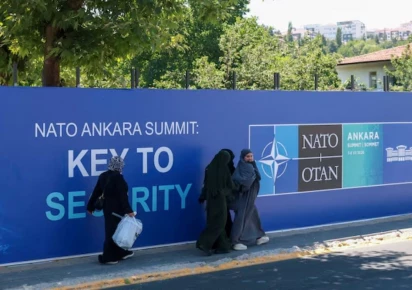
The NATO summit, scheduled for July 7-8 and hosted by Turkish President Recep Tayyip Erdogan, will bring together leaders of the alliance’s 32 member states. The meeting is expected to provide an opportunity for discussions on regional security and bilateral defense ties.
Last month, Trump hinted at positive developments when he said he would make Erdogan “very happy” in response to questions about Turkey’s request for additional F110 fighter jet engines and its hopes of rejoining the F-35 program.
Defense analysts believe Trump’s remarks are most likely related to the approval of General Electric F110 engines that Turkey needs for its KAAN fighter aircraft. According to Sinan Ulgen, director of the Istanbul-based EDAM think tank, political barriers that previously delayed the engine supply may now be easing.
Turkey has already built and tested prototype KAAN aircraft powered by F110 engines, but further production depends on securing additional engines. Around 40 engines are expected to be required initially to expand the program before Turkey develops its own indigenous powerplant.
The KAAN project, led by Turkish Aerospace Industries (TAI), is designed to replace Turkey’s aging fleet of F-16 fighter jets and establish the country among the small group of nations capable of producing fifth-generation stealth combat aircraft. Although Turkey plans to equip the aircraft with a domestically developed engine in the future, that project remains in the early stages of development.
Turkey received its first batch of 10 F110 engines last year and has been negotiating with Washington to purchase approximately 80 more. However, those talks have faced delays because of political tensions stemming from Ankara’s purchase of the Russian S-400 air defense system in 2017.
The S-400 acquisition prompted the United States to remove Turkey from the multinational F-35 program in 2019. A year later, Washington imposed sanctions under the Countering America’s Adversaries Through Sanctions Act (CAATSA), further complicating defense cooperation between the two NATO allies.
Turkish officials continue to argue that both the engine approvals and the F-35 issue should be addressed together. Nevertheless, many analysts believe Turkey’s exclusion from the F-35 program has accelerated its drive toward defense self-reliance, with increased investment in the KAAN project.
Although Indonesia has already signed a multibillion-dollar agreement to purchase 48 KAAN aircraft, experts believe the NATO summit could generate additional international interest. Potential future partners may include Gulf countries and some European nations, though significant technical and political challenges remain before the aircraft becomes a major competitor in the global defense market.
Despite optimism surrounding the engine deal, analysts remain skeptical that Turkey will soon rejoin the F-35 program. Lifting CAATSA sanctions would require congressional approval, while the underlying dispute over the Russian S-400 system remains unresolved. As a result, experts believe progress on the fighter jet issue is likely to be slow, even if broader defense cooperation between Washington and Ankara improves.
We welcome your contributions! Submit your blogs, opinion pieces, press releases, news story pitches, and news features to opinion@minutemirror.com.pk and minutemirrormail@gmail.com