Summary
- Before the annexation of Punjab in 1849, two major languages were in use: Persian, the language of the court, and Punjabi, the language of the people.
- In his book, Aamir Riaz addresses the question of why Maharaja Ranjit Singh did not implement Punjabi as the official language of his kingdom.
- Aamir explains that the British did not recognise Shahmukhi Punjabi as a language of education, and resistance movements did not fully embrace it either.
The second part of my review of Aamir Riaz’s book, ‘Punjab Di Vel’
Does Punjab Have a Language of Its Own?
Punjab’s colonialists and neo-colonialists would argue that Punjab does not have a language of its own. According to this view, Muslim Punjabis had Urdu, Hindus Hindi, and Sikhs had Gurmukhi, which was called as a vernacular language. When Gurmukhi was first introduced into the educational syllabus in colonial Punjab, its content was largely religious.
We know that Urdu and Hindi were developed and standardised in the colonial context, with Fort William College playing an important role in their development. Before the annexation of Punjab in 1849, two major languages were in use: Persian, the language of the court, and Punjabi, the language of the people. Arabic and Sanskrit were also used to a limited extent as languages of religious learning.
The opponents of Punjab and the Punjabi language have repeatedly raised two questions. First, was Punjabi ever made an official language? Why did Maharaja Ranjit Singh not make Punjabi the official language of the Lahore Darbar? Second, Punjabi has two scripts. Should it not first adopt a single script, like Urdu or Persian, before its supporters demand that it be made an official language or a medium of instruction?
Let us deconstruct these arguments. Before the annexation of Punjab in 1849, Punjabi was a powerful and vibrant language. Although it was not the language of the court, it was fully alive among the people and had produced rich and creative literature over many centuries. Nobody was suppressing it, nor were Punjabi children speaking Persian in their homes. Being a Punjabi speaker was not considered a sign of inferiority or illiteracy. The courts were limited institutions, and the influence of Persian was largely confined to particular administrative domains.
Although Persian remained the language of the court in much of India for centuries, the great poets who wrote in Persian and shaped its literary tradition had their origin in Persia itself. Meanwhile, Punjabi continued to flourish on its own soil.
Punjabi was everywhere. People spoke, thought, and expressed themselves in it. Indeed, Punjabi literature sometimes challenged the cultural boundaries of the courtly world. We can see this in the poetry of Shah Hussain, Bulleh Shah, and Waris Shah, whose work engages with, challenges, and sometimes ridicules the imagery and metaphors of Persian literary traditions.
The British colonialists changed this situation in accordance with their imperial designs. After annexing Punjab, they imposed Urdu as a language of administration and education. The Muslim aristocracy readily accepted Urdu, because it had a fragrance of Persian, while Hindi had of Sanskrit. The British established an educational system in which Urdu was taught and promoted.
In the pre-British period, there was no comparable, centralised system of public education. Madrassahs and Dharam Shalas had their own systems of learning, in which languages such as Arabic, Persian, and Sanskrit were studied according to different intellectual and religious traditions.
Napier is often quoted as saying, “We have conquered Punjab militarily, but we have yet to conquer it culturally.” When the British arrived in Punjab, they already had more than a century of experience in ruling parts of India. They therefore came with considerable administrative experience and confidence. They wanted to consolidate their control without taking unnecessary risks. In my view, their promotion of Urdu in Punjab was also connected to their fear of Punjabi and its association with a recently annexed kingdom—a kingdom whose annexation was achieved with conspiracies and intrigues.
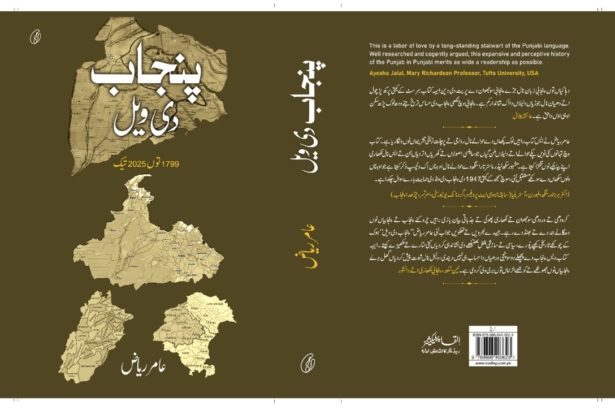
In his book, Aamir Riaz addresses the question of why Maharaja Ranjit Singh did not implement Punjabi as the official language of his kingdom. He also argues that the Maharaja understood Persian well enough to correct letters by listening to them being read aloud.
Aamir’s explanation is that Ranjit Singh’s Lahore Darbar was a kingdom, not a modern nation-state. The modern concepts of a single official language, one national flag, and one national anthem did not operate in the same way in that political context.
As for Punjabi’s two scripts, this is no reason for present-day rulers to refuse to implement Punjabi in western Punjab. The existence of two scripts did not prevent Baba Farid and Baba Guru Nanak from composing Punjabi poetry in their respective literary traditions. Why, then, should it prevent people today from using and promoting their language? Aamir’s book discusses these issues in detail.
It is strange that discussions of Aamir Riaz’s book tend to focus on its first chapter, which deals with Ranjit Singh, while the rest of the book receives far less attention than it deserves. Many podcasts and other talk shows are titled simply “Ranjit Singh”. In this essay, I attempt to shift the discussion towards the language question in Punjab and India.
Throughout the book, the question of language runs like a thread, from the introduction to the final pages. However, Chapter 7, which discusses the opponents of British rule and analyses the politics of resistance, addresses the issue particularly directly. Its section on language is subtitled “Languages, Scripts, Dialects and the Clever Game of Education”.
Aamir asks a fundamental question: What was the British language policy?
The British abolished Persian as the language of administration in important domains and promoted English, presenting it as the gateway to knowledge. As if that were not enough, they associated local languages and scripts with particular religions, while English was presented as the language of civilization and science, without being similarly defined by its association with Christianity.
This approach resembles James Mill’s interpretation of Indian history, in which the history was divided into Hindu, Muslim, and British periods. In a comparable framework, languages were assigned religious identities: Hindi to Hindus, Urdu to Muslims, and Punjabi in Gurmukhi to Sikhs.
Although these divisions were constructed and reinforced under British rule, why do we continue to follow them? Aamir repeatedly asks this question.
He argues that Sanskrit, Pali, and Hindi were associated with the Devanagari script, while Gurmukhi was also increasingly identified with a specifically Sikh and non-Muslim identity. Meanwhile, Arabic, Persian, Urdu, Sindhi, Pashto, and Punjabi in the Shahmukhi script were increasingly classified as Muslim languages.
But are languages and scripts inherently tied to religion? If these categories were shaped by colonial administrators, why have we continued to reproduce them in South Asia after 78 years of independence?
One reason, Aamir suggests, is that the diversity of languages was never adequately recognised within our resistance movements. This is an important point. Because of our support for Congress and the left in India, we often overlooked their positions on the language question.
Leftist parties in Punjab generally used Urdu, with the exception of the Mazdoor Kisan Party (MKP), which embraced the people’s language, Punjabi. Even today, many left-wing groups in Punjab do not use Punjabi in their writings, speeches, or discussions.
Aamir explains that the British did not recognise Shahmukhi Punjabi as a language of education, and resistance movements did not fully embrace it either. In the Nehru Report of 1928 and Jawaharlal Nehru’s An Autobiography, published in 1936, the idea of “Hindustani” figured in discussions of language, rather than an exclusive choice between Hindi and Urdu. Yet, according to Aamir’s analysis, the Congress government’s language policies in 1937 strengthened the position of Hindi.
After independence, Hindi was promoted in Indian schools and public institutions. On the one hand, Congress argued that the British had divided Hindustani into two languages, Urdu and Hindi. On the other hand, the Indian state promoted Hindi as an official language, leaving the idea of Hindustani behind.
Language thus became closely connected with political power rather than simply with the acquisition and transmission of knowledge. It became an instrument of the nationalist state.
In his famous book, ‘History of Indigenous Education in the Punjab,’ G. W. Leitner warned the British that Punjabis were learning Urdu because it offered access to government employment. If another language offered better employment opportunities in the future, he argued, people would abandon Urdu in favour of that language.
We have witnessed a similar process ourselves. When better employment opportunities became available through English, the children of both Hindi- and Urdu-speaking families rushed to learn it.
If we understand language in terms of knowledge, cultural continuity, and intellectual inheritance, we can appreciate the importance of mother tongues and respect cultural diversity. By promoting Urdu and Hindi as languages of civilisation and science, Pakistan and India reproduced aspects of the British language policy they had inherited.
Our ruling elites had been shaped by centralised systems of government in which a single national language was considered necessary for nation-building. However, the imposition of Hindi and Urdu on diverse linguistic communities also had roots in the language politics of the resistance movements themselves.
Congress had its own position on the Hindi-Urdu conflict and, at various points, promoted the idea of Hindustani as a common language. Mahatma Gandhi, who was closely associated with Congress, established the Hindi Prachar Sabha in 1918 to promote Hindi. Such initiatives further complicated the linguistic divisions that had developed during the colonial period, including those shaped by the language policies associated with Fort William College.
On the one hand, Congress claimed to recognise linguistic diversity. On the other, the 1928 Nehru Report did not recognise Punjabi as a separate language in its discussion of the national language question. We must ask whose narrative this approach served.
Nor were revolutionaries and opponents of British rule necessarily supporters of linguistic diversity. Many supported the promotion of Urdu. From communists to members of the Jamiat Ulama-e-Hind, numerous opponents of British rule also participated in organisations concerned with the promotion of Urdu.
Sikhs who opposed British rule but remained distant from Shahmukhi, promoting Punjabi exclusively in Gurmukhi, were, in effect, continuing a linguistic division that colonial policies had helped reinforce.
Baba Farid’s poetry has survived in the Shahmukhi tradition, yet the British failed to recognise the long history of Punjabi written in that script and did not introduce it into the school curriculum. Those who opposed British rule also largely failed to challenge this exclusion.
Before the British arrived, Sanskrit, Turkish, Persian, and Arabic were among the classical languages through which knowledge circulated in the region. There was already a rich intellectual heritage. However, as the Hindi-Urdu conflict deepened linguistic and religious divisions, many Muslim intellectuals moved away from Sanskrit, Devanagari, and Gurmukhi traditions, while many Hindu and Sikh intellectuals distanced themselves from Persian, Turkish, and Arabic, treating them as the languages of Muslim invaders.
Thus, we can conclude this part of the discussion by examining the colonial dimension of British language policy. Aamir Riaz offers a fundamental analysis of how British imperial policy divided people by reinforcing linguistic categories and distinctions between scripts. Urdu and Hindi were developed as distinct linguistic identities, and Punjabi society was further divided along linguistic and script-based lines.
The consequences of these divisions continue to shape our understanding of language, culture, and identity in Punjab today.
(Continued)
Zubair Ahmad is a Lahore based Punjabi writer and columnist . He is poet, critic and fiction writer.
We welcome your contributions! Submit your blogs, opinion pieces, press releases, news story pitches, and news features to opinion@minutemirror.com.pk and minutemirrormail@gmail.com