
Summary
- ISLAMABAD: The Federal Board of Revenue (FBR) has introduced an automated and faceless scrutiny mechanism for sales tax returns, allowing its computerized system to identify discrepancies and notify registered taxpayers through the IRIS portal before any legal or penal action is initiated.
- The newly inserted chapter is titled “Procedure for Electronic Scrutiny and Intimation of Issues Detected by the Computerized System.” Under Rule 150HA, the new mechanism will apply to the automated scrutiny, analysis and cross-matching of sales tax returns and other available information relating to registered persons.
- The new mechanism is expected to affect registered persons covered under the Sales Tax Act, 1990, including manufacturers, importers, wholesalers, retailers and other registered taxpayers falling within the relevant tax framework.
ISLAMABAD: The Federal Board of Revenue (FBR) has introduced an automated and faceless scrutiny mechanism for sales tax returns, allowing its computerized system to identify discrepancies and notify registered taxpayers through the IRIS portal before any legal or penal action is initiated.
The new procedure has been introduced through SRO 1655 (I)/2026, issued by the Revenue Division on September 25, 2026. Through the notification, the FBR has made further amendments to the Sales Tax Rules, 2006, by inserting a new Chapter XII-A after Rule 150H.
The newly inserted chapter is titled “Procedure for Electronic Scrutiny and Intimation of Issues Detected by the Computerized System.”
Under Rule 150HA, the new mechanism will apply to the automated scrutiny, analysis and cross-matching of sales tax returns and other available information relating to registered persons. The process will be conducted through the computerized system implemented by the FBR under Section 50B of the Sales Tax Act, 1990.
Under the new system, sales tax returns and relevant data can be electronically examined to identify factual or legal errors, discrepancies and mismatches.
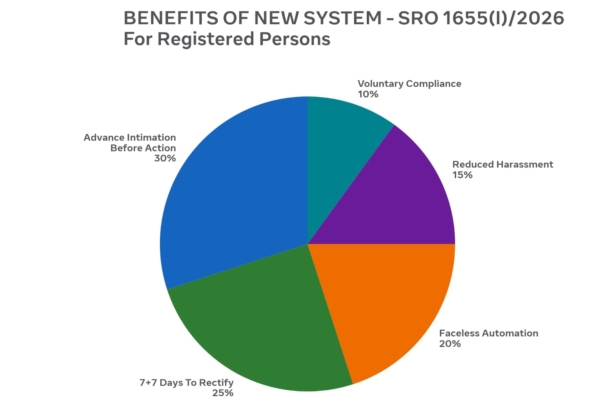
Rule 150HB provides that where the computerized system detects an issue, an advance intimation may be sent to the registered person through an online advice or the IRIS system. The purpose of the communication is to give the taxpayer an opportunity to explain the discrepancy, correct an error or take other appropriate corrective action before legal or penal proceedings are initiated.
The same system-generated advance intimation may also be issued by the concerned Officer of Inland Revenue having jurisdiction over the registered person.
The notification provides an opportunity for the taxpayer to respond within a specified period. The response period will be at least seven days. In case no response is received, a reminder may be issued, providing another period of at least seven days for the taxpayer to respond.
The procedure therefore establishes a sequence in which the computerized system first identifies a discrepancy, followed by an electronic intimation through IRIS. The taxpayer is then given an opportunity to clarify the matter or correct the identified error before the matter proceeds to further legal action.
After receiving the taxpayer’s response, the concerned Inland Revenue officer will examine the explanation and determine whether any further action is required under the relevant provisions of the law.
The new mechanism is expected to affect registered persons covered under the Sales Tax Act, 1990, including manufacturers, importers, wholesalers, retailers and other registered taxpayers falling within the relevant tax framework.
Taxpayers receiving an advance intimation through IRIS will need to review the identified discrepancy and respond within the prescribed period. Businesses may also need to maintain proper purchase, sales and inventory records to support their explanations and reconcile information reported in their tax returns.
The FBR’s move forms part of its broader efforts to expand automation and reduce manual interaction in tax administration. By shifting initial scrutiny to a computerized system, the new framework seeks to establish a structured process for identifying discrepancies and providing taxpayers an opportunity to address them before further proceedings.
The effectiveness of the mechanism will depend on how accurately the computerized system identifies discrepancies, how clearly taxpayers are informed about the issues and how the subsequent responses are handled by the relevant authorities.
The notification, SRO 1655 (I)/2026 dated September 25, 2026, was issued by the Government of Pakistan, Revenue Division, FBR, Islamabad.
We welcome your contributions! Submit your blogs, opinion pieces, press releases, news story pitches, and news features to opinion@minutemirror.com.pk and minutemirrormail@gmail.com