Summary
- Hundreds of thousands of children across Gaza went back to in person classes on Saturday for the first time in almost three years, gathering in tents, damaged buildings and makeshift learning spaces as the territory tries to restore a semblance of normal life after a devastating war.
- The ministry has organized the school year around two parallel tracks, one for students able to physically reach a school or designated learning site, and a virtual option for those who cannot access classrooms in person, including families displaced outside Gaza.
- For thousands of families across the strip now sending children back into tents and half rebuilt classrooms, the reopening marks less a return to normal life than a fragile first step toward rebuilding one, layered atop war damaged buildings, shortages of even the most basic supplies, and years of interrupted childhoods that will take far longer than a single school year to repair.
Hundreds of thousands of children across Gaza went back to in person classes on Saturday for the first time in almost three years, gathering in tents, damaged buildings and makeshift learning spaces as the territory tries to restore a semblance of normal life after a devastating war.
The Palestinian Ministry of Education and Higher Education said roughly 541,000 students have re entered education programs with the start of the new school year, including about 100,000 enrolled through the UN Relief and Works Agency for Palestine Refugees, known as UNRWA. Three schools opened their doors on Saturday: an UNRWA facility in the al Nuseirat camp in central Gaza and two government run schools in the western and eastern parts of Gaza City, while additional students attended temporary learning sites scattered across the strip. Officials plan to expand in person education gradually to roughly 700 sites across Gaza, alongside 25 temporary school buildings expected to arrive soon.
The ministry has organized the school year around two parallel tracks, one for students able to physically reach a school or designated learning site, and a virtual option for those who cannot access classrooms in person, including families displaced outside Gaza. Officials have barred students from enrolling in both tracks simultaneously and require those in the virtual system to attend lessons in full.
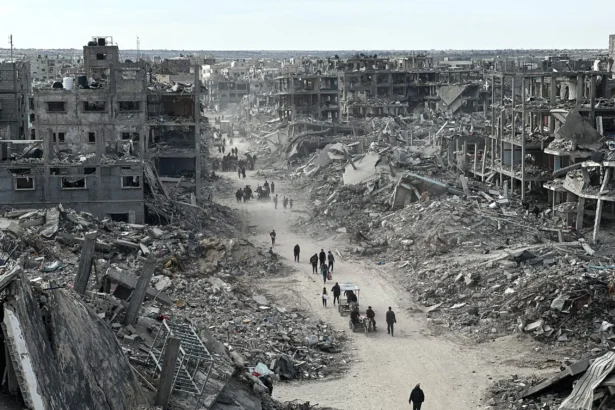
The scale of disruption facing Gaza’s education system remains severe. The UN Children’s Fund estimates that 98 percent of school buildings in the territory sustained damage since the war began in October 2023, with more than 93 percent requiring major repairs or complete rebuilding. Roughly 700,000 children between the ages of four and 17 have missed close to three full years of formal, in person schooling, and about 420,000 of them have had no classroom instruction whatsoever since the conflict started. Gaza education officials say more than 620,000 students overall have been deprived of regular schooling, and count around 22,000 students among the dead, along with more than 770 education workers, including 532 teachers, according to Ibrahim Ramadan, director of education for East Khan Younis.
The physical conditions inside reopened schools reflect just how much infrastructure the war destroyed. At the UNRWA school in al Nuseirat, some classrooms have no desks at all, leaving children to sit on blankets spread across the floor, while others make do with old, damaged furniture that survived the fighting. A math teacher working with sixth graders in a tent classroom described students sitting on mattresses and balancing notebooks on their laps, many arriving without stationery or textbooks of their own.
Basic school supplies have also become significantly more expensive under continuing Israeli import restrictions into Gaza. Khaled Aliyan, a 30 year old stationery trader, said a notebook that once cost three shekels now sells for fifteen, and that prices across all school supplies have climbed sharply. Israel’s COGAT military agency, which controls the flow of goods into Gaza, did not respond to a request for comment on the restrictions or on strikes that have damaged school buildings during the conflict. Israel has repeatedly accused Hamas of using schools for military purposes, an allegation the group denies.
Despite a ceasefire reached last year that halted the most intense fighting, Israeli forces continue to control more than 60 percent of Gaza, and the underlying conflict has not formally ended. Palestinian authorities say the war, which began after Hamas led fighters killed roughly 1,200 people in southern Israel in October 2023, has since killed more than 73,000 people in Gaza.
For families who have endured repeated displacement, the return of daily classes carries meaning well beyond academics. One mother, displaced with her family from the Zeitoun area to al Katiba in western Gaza City, said her children had only attended irregular, informally organized lessons run by volunteers during the war, since safety and basic survival needs, including fetching water, consistently took priority over schooling. For thousands of families across the strip now sending children back into tents and half rebuilt classrooms, the reopening marks less a return to normal life than a fragile first step toward rebuilding one, layered atop war damaged buildings, shortages of even the most basic supplies, and years of interrupted childhoods that will take far longer than a single school year to repair.
We welcome your contributions! Submit your blogs, opinion pieces, press releases, news story pitches, and news features to opinion@minutemirror.com.pk and minutemirrormail@gmail.com