Summary
- The government said the largest share of the budget is allocated for debt servicing.
- He also said Pakistan’s fiscal position has improved over time.
- However, the government said the budget focuses on stability, growth, and long-term reforms.
The federal government has presented a Rs18.7 trillion budget for the fiscal year 2026–27. The budget comes at a time of economic strain and heightened global tensions, particularly in the Middle East.
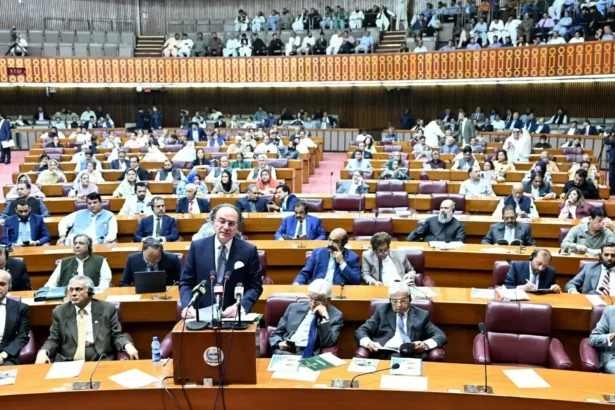
Finance Minister Muhammad Aurangzeb presented the budget in the National Assembly. He said Pakistan is moving toward greater economic stability. He also said the country’s international standing has improved in recent years.
The budget session was marked by strong political tension. Opposition members protested and raised slogans. Treasury benches supported the prime minister and the budget speech. At one point, a scuffle also broke out between members of both sides.
The government said the largest share of the budget is allocated for debt servicing. A total of Rs8.054 trillion has been set aside for this purpose. Defence spending is allocated Rs3 trillion. The Public Sector Development Programme (PSDP) has been given Rs1 trillion.
The finance minister said inflation is expected to remain around 7%. He said this is despite pressure caused by global uncertainty and energy-related challenges.
He also said Pakistan’s fiscal position has improved over time. The tax-to-GDP ratio has increased from 8.5% to 10.3% in the last three years. The fiscal deficit has also reduced from 7.8% to around 4%.
The government said the primary balance has moved into surplus. It has improved to 1.6% of GDP. Officials said this reflects better fiscal management.
The minister said Pakistan has returned to the international bond market. He said the country successfully issued a $750 million Eurobond. He called it a sign of restored investor confidence.
The PSDP allocation of Rs3.675 trillion includes federal and provincial development programs. Funds will be used for transport, energy, water, agriculture, IT, health, and education projects.
The government also announced housing and urban development plans. Around 150,000 affordable and climate-resilient homes will be constructed. Digital master plans will also be prepared for major cities.
The budget includes tax relief for salaried individuals. Tax rates have been reduced across four income slabs. The super tax has also been removed for certain categories. Officials said the aim is to reduce burden on the middle class.
Health and education sectors received increased allocations. Rs25.1 billion has been set aside for health projects. Rs46 billion has been allocated for higher education and research.
The finance minister said energy reforms are continuing. He said subsidies have been reduced and circular debt control has improved. LNG import agreements have also been renegotiated to save foreign exchange.
The government also reported progress in privatisation. It said PIA has been successfully handed over to the private sector. Other state-owned enterprises are also planned for privatisation in the coming years.
The budget session remained tense throughout. However, the government said the budget focuses on stability, growth, and long-term reforms.
We welcome your contributions! Submit your blogs, opinion pieces, press releases, news story pitches, and news features to [email protected] and [email protected]