Summary
- Foreign Office spokesperson Tahir Hussain Andrabi said on Wednesday that Islamabad remained hopeful that diplomatic efforts could help end the standoff and restore regional stability.
- Andrabi said Pakistan’s diplomatic engagement had also included discussions in Istanbul during the meeting linked to the Makkah Joint Defence Agreement.
- Islamabad will host the organisation’s summit next year under the theme “Turning Vision into Action, Connectivity, Innovation and Shared Prosperity.” He said Pakistan would work with SCO members to promote regional peace, economic cooperation, connectivity and shared development.
Pakistan has reaffirmed its commitment to dialogue and diplomacy to help ease tensions between Iran and the United States, despite the latest escalation in the region.
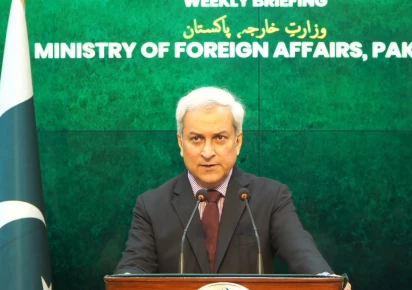
Foreign Office spokesperson Tahir Hussain Andrabi said on Wednesday that Islamabad remained hopeful that diplomatic efforts could help end the standoff and restore regional stability.
Speaking at the Foreign Office’s weekly briefing, Andrabi said Pakistan would continue working with friendly countries to support efforts aimed at resolving the crisis through peaceful means.
He said Prime Minister Shehbaz Sharif discussed the regional situation with Iranian President Masoud Pezeshkian during their meeting on the sidelines of the Shanghai Cooperation Organisation (SCO) Summit. The prime minister reaffirmed Pakistan’s support for dialogue, restraint and diplomacy.
According to the spokesperson, Pakistan believes that the understanding reached under the Islamabad memorandum of understanding provides a practical route towards lasting peace and stability.
Deputy Prime Minister and Foreign Minister Ishaq Dar also held discussions with Iranian Foreign Minister Abbas Araghchi during the SCO Summit in Bishkek.
Andrabi said Pakistan’s diplomatic engagement had also included discussions in Istanbul during the meeting linked to the Makkah Joint Defence Agreement. He added that Field Marshal Asim Munir’s recent visit to Tehran was part of Islamabad’s efforts to facilitate de-escalation between Washington and Tehran.
The discussions focused on reopening the Strait of Hormuz, reducing regional tensions, overcoming the military deadlock and finding a negotiated solution to the conflict.
The spokesperson said the visit helped create diplomatic momentum, followed by subsequent engagement by Oman and Qatar.
On the Indus Waters Treaty, Andrabi said the Permanent Court of Arbitration at The Hague had reaffirmed that the treaty remained legally binding. He said the ruling rejected India’s unilateral attempt to place the agreement in abeyance.
Pakistan, he added, welcomed the decision and maintained that disputes concerning the treaty must be addressed through its established mechanisms and in accordance with international law.
Andrabi also highlighted Pakistan’s new role as chair of the SCO. Islamabad will host the organisation’s summit next year under the theme “Turning Vision into Action, Connectivity, Innovation and Shared Prosperity.”
He said Pakistan would work with SCO members to promote regional peace, economic cooperation, connectivity and shared development.
The spokesperson further briefed journalists about the first meeting of the Strategic, Political and Defence Committee formed under the Makkah Joint Defence Agreement between Pakistan, Saudi Arabia and Türkiye.
The three countries agreed to strengthen defence cooperation, collective security, technology development and defence production while supporting regional peace and stability.
A new secretariat will be established in Saudi Arabia, with Pakistan initially providing its secretary-general for a three-year term.
Andrabi also outlined Foreign Minister Ishaq Dar’s recent diplomatic engagements in Türkiye and the United Kingdom, including meetings with senior officials on regional and international issues.
We welcome your contributions! Submit your blogs, opinion pieces, press releases, news story pitches, and news features to opinion@minutemirror.com.pk and minutemirrormail@gmail.com