Summary
- Khuram Shahzad was invited by Bielefeld University as a resource person to conduct a workshop titled “Fake News on Social Media and Migration.”The session was organised in connection with the university’s Research Training Group on World Politics and was attended by Dr.
- Khuram Shahzad explained that fake news can influence public opinion, shape social perceptions and affect policy debates, particularly when it concerns sensitive issues such as migration and refugees.
- Participants discussed examples of fake news concerning migration circulating on social media in Germany and were introduced to practical methods for examining and identifying potentially misleading information.
LAHORE: Punjab University’s research on the scientific identification of fake news and propaganda content has received international recognition after Assistant Professor and Senior Public Relations Officer Dr. Khuram Shahzad conducted a specialised training workshop at Bielefeld University in Germany.
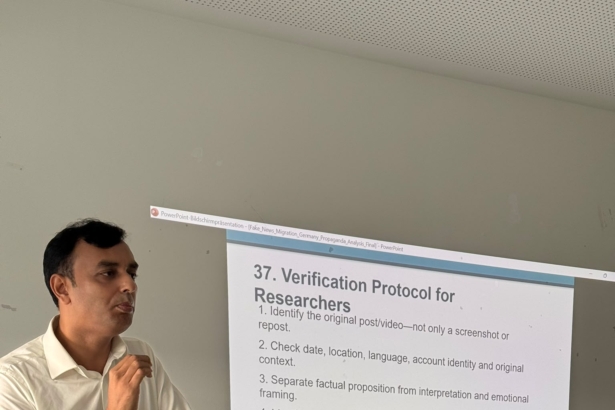
Dr. Khuram Shahzad was invited by Bielefeld University as a resource person to conduct a workshop titled “Fake News on Social Media and Migration.”The session was organised in connection with the university’s Research Training Group on World Politics and was attended by Dr. Aksakel, along with students enrolled in BS and Master’s programmes.
Bielefeld University, a major public-sector institution in Germany, has around 25,000 students studying on its campus and is ranked among the country’s leading universities.
During the workshop, Dr. Khuram Shahzad discussed the emergence, spread and impact of fake news on social media, particularly in relation to migration. He explained various methods for identifying misleading and unverified information and highlighted the importance of scientifically assessing content before accepting or sharing it.
The methodologies presented during the training were based on Dr. Khuram Shahzad’s PhD research completed at Punjab University in Pakistan. As part of his doctoral research, he developed a model consisting of 11 scientific indicatorsfor identifying propaganda content.
His invitation by Bielefeld University to share this research with German academics and students provides an example of how research conducted at Pakistani universities can contribute to international academic discussions and knowledge-sharing.
The workshop also focused on the broader social consequences of misinformation. Dr. Khuram Shahzad explained that fake news can influence public opinion, shape social perceptions and affect policy debates, particularly when it concerns sensitive issues such as migration and refugees.
He told participants that developing an understanding of scientific research methods for identifying misinformation can help students critically examine information available on social media. Such awareness, he said, can also encourage a more responsible and evidence-based approach to important social issues.
Dr. Khuram Shahzad expressed his gratitude to German Ambassador to Pakistan Ina Lepel for her support in promoting educational and research links between Germany and Pakistan. He also thanked Dr. Aksakel of Bielefeld University for facilitating the academic engagement.
He said stronger collaboration between Pakistani and German universities could create additional opportunities for students, faculty members and researchers to exchange knowledge and experiences. According to him, greater academic cooperation could also contribute to developing research-based approaches to common social challenges faced by both countries.
Speaking during the workshop, Dr. Akhtakl highlighted the significance of migration and refugee-related issues, noting that misleading information about these subjects on social media can contribute to misconceptions within societies and potentially influence national policy discussions.
He stressed the importance of developing the capacity to scientifically examine and assess propaganda and misleading content.
The workshop concluded with an extended question-and-answer session. Participants discussed examples of fake news concerning migration circulating on social media in Germany and were introduced to practical methods for examining and identifying potentially misleading information.
We welcome your contributions! Submit your blogs, opinion pieces, press releases, news story pitches, and news features to opinion@minutemirror.com.pk and minutemirrormail@gmail.com