Summary
- The United States military said it destroyed or disabled three Iranian oil tankers after Iran’s Islamic Revolutionary Guard Corps (IRGC) launched ballistic missiles at two US Navy vessels in regional waters.
- He said Washington would continue defending American forces and could target Iran’s oil fleet if attacks on US assets continued.
- Iranian media separately reported that a US missile struck a small Iranian oil tanker near Kharg Island on Saturday.
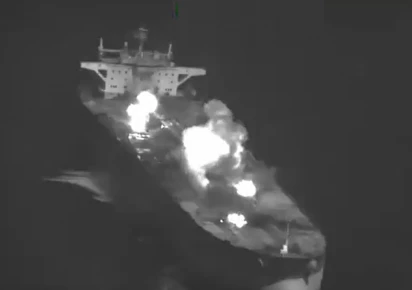
The United States military said it destroyed or disabled three Iranian oil tankers after Iran’s Islamic Revolutionary Guard Corps (IRGC) launched ballistic missiles at two US Navy vessels in regional waters.
US Central Command (CENTCOM) said on Saturday that an aircraft carrier and a guided-missile destroyer successfully avoided multiple Iranian attacks. No US personnel were reported injured.
According to CENTCOM, US forces disabled the M/T Downy off the coast of Kharg Island and the M/T Stark 1 near Jask. A third vessel, the unladen M/T Kylo, also known as the “Noxen”, was destroyed in the Gulf of Oman after its crew was ordered to leave the ship.
CENTCOM alleged that the three vessels were linked to a large oil network used to generate funds for the IRGC and its regional allies.
CENTCOM commander Admiral Brad Cooper said the US response was intended to send a direct warning to Iran. He said Washington would continue defending American forces and could target Iran’s oil fleet if attacks on US assets continued.
Iranian media separately reported that a US missile struck a small Iranian oil tanker near Kharg Island on Saturday. No casualties were reported.
Kharg Island is a key part of Iran’s oil export infrastructure and is estimated to handle the vast majority of the country’s crude exports. US President Donald Trump has previously threatened to take control of the strategically important island.
The latest confrontation comes amid a sharp escalation in tensions between Washington, Tehran and their regional allies. The conflict intensified following US-Israeli attacks on Iran on February 28, after which Tehran launched missile and drone attacks against Israel and US interests in the region.
The two sides had reached a memorandum of understanding in June concerning freedom of navigation through the Strait of Hormuz. However, implementation of the agreement has remained stalled because of disagreements over security arrangements in the strategic waterway.
Meanwhile, tensions inside the US administration have also grown over reports of military information being leaked to the media.
US investigators reportedly conducted polygraph examinations on around 50 military officers and civilian officials in August as part of an investigation into leaks concerning American weapons stocks.
The investigation reportedly focused on sensitive information about shortages of long-range missiles and Patriot air-defence interceptors following the war with Iran.
CBS News reported that the examinations were conducted by military investigators rather than the FBI. Some senior officials were not included, including Chairman of the Joint Chiefs of Staff General Dan Caine.
According to the report, none of those tested failed questions intended to determine whether they had provided information to the media. Investigators were also reportedly examining the possibility that restricted military information could have been accessed by someone working for a foreign intelligence service.
Pentagon spokesman Sean Parnell declined to discuss individual personnel or investigations but said classified information leaks were being treated seriously.
Trump has rejected reports of major strategic weapons shortages, saying the US military has large quantities of weaponry available. He has described the leaks as false and treasonous and warned that those responsible would face serious consequences.
The investigation followed other unauthorised disclosures, including part of a document reportedly showing senior military commanders expressing reservations about continuing large-scale operations against Iran.
Separately, Democratic Congressman Ted Lieu questioned the administration’s description of Iran as a “failed state”. He argued that Iran’s continued ability to launch missiles and drones at US bases and regional allies raised questions about that assessment.
We welcome your contributions! Submit your blogs, opinion pieces, press releases, news story pitches, and news features to opinion@minutemirror.com.pk and minutemirrormail@gmail.com